LangChain ecosystem emerges as a control point, OpenAI and Anthropic define model leadership, and fragmentation persists across emerging AI stack layers
IT Brand Pulse just published the results of its AI Brand Leader surveys covering the AI Engineering stack. This is interesting because AI is shifting from experimentation to production, causing the center of gravity to move from data center infrastructure to AI engineering.
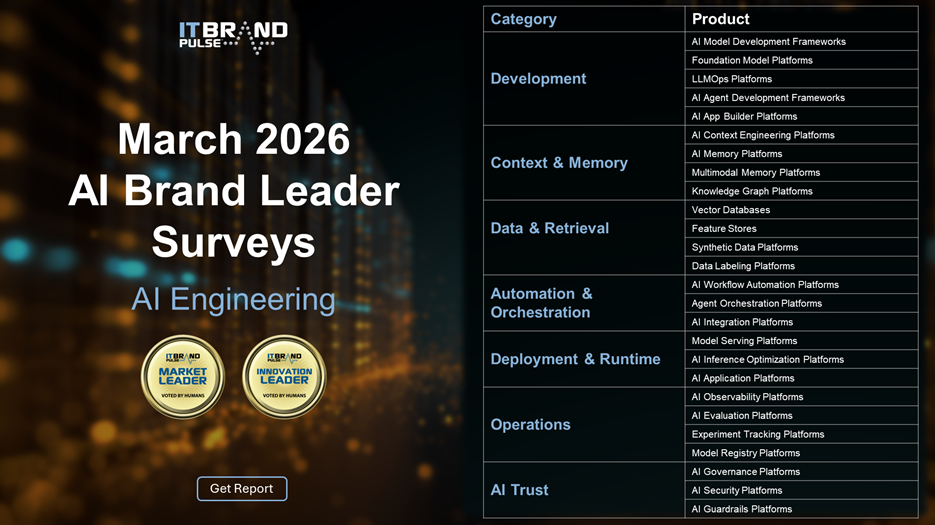
Based on votes from the global AI developer community, the independent, non-sponsored research identified Market Leaders and Innovation Leaders across 26 product categories spanning development, context & memory, data & retrieval, orchestration, runtime, operations, and AI trust.
The survey results show that while leadership is beginning to emerge, most of the AI Engineering stack is still highly contested. As developers are choosing tools, they’re signaling which platforms are preferred environments for building AI apps.
Survey Highlights
Leadership is real but dominance is rare
Across all 26 AI Engineering categories, Market Leaders averaged just over 30% of the vote, with Innovation Leaders slightly higher. The relatively small spreads between first and second place confirm that most categories remain competitive and unconsolidated, with multiple credible vendors in each segment.
Market and innovation leadership often align
In 19 of 26 categories, the same vendor was voted both Market Leader and Innovation Leader, indicating strong alignment between developer adoption and perceived technical momentum. This pattern suggests that in many areas of the AI stack, the leading vendor is not just widely used, but also defining the direction of the category.
Key splits signal strategic battlegrounds
Seven categories showed a split between Market Leader and Innovation Leader, highlighting where the most important competitive shifts are underway. These splits reveal a gap between installed base and forward momentum, often signaling where next-generation leaders may emerge:
- AI Model Development Frameworks – TensorFlow voted market leader; PyTorch voted innovation leader
- Foundation Model Platforms – OpenAI voted market leader; Anthropic voted innovation leader
- AI Governance Platforms – IBM OpenPages voted market leader; Credo AI voted innovation leader
LangChain ecosystem emerges as a dominant control layer
A cross-category presence positions LangChain as a central control point in the AI Engineering stack, shaping how developers build, orchestrate, and operationalize AI applications. LangChain, along with LangSmith and LangGraph, stands out as one of the most influential platforms across multiple categories, including:
- LLMOps Platforms
- AI Agent Development Frameworks
- AI Context Engineering Platforms
- Agent Orchestration Platforms
OpenAI and Anthropic define the model platform race
The Foundation Model Platform category reflects a two-horse race at the frontier of AI innovation. Cloud platform providers such as Google Vertex and AWS Bedrock remain relevant but trail the top tier in developer perception:
- OpenAI leads in market adoption, driven by ecosystem scale and developer reach
- Anthropic leads in innovation, recognized for advances in safety, controllability, and long-context performance
Clear leaders emerge in mature categories
Several categories show strong, durable leadership with significant vote spreads. These are established control points where developer preferences are more consolidated:
- Weights & Biases in Experiment Tracking
- Scale AI in Data Labeling
- Neo4j in Knowledge Graphs
- TensorFlow in Model Development Frameworks
- TensorRT-LLM in Inference Optimization
Emerging categories remain fragmented
In contrast, newer categories remain highly fragmented, with “Others” capturing significant vote share. This indicates that taxonomy, use cases, and vendor positioning are still evolving rapidly for:
A Stack in Transition
The results reveal an AI Engineering landscape entering a new phase where early build-out created many tools and categories, developers are now identifying default platforms, and leadership is forming, but remains fluid
Rather than full consolidation, the data shows a layered market with clear leaders in mature categories, competitive races in strategic categories, and fragmented innovation in emerging layers.
This reflects a shift from point solutions to integrated platforms, where perceptions of leadership in the future will be defined by vendors that connect development, context, orchestration, runtime, and trust into a cohesive system.