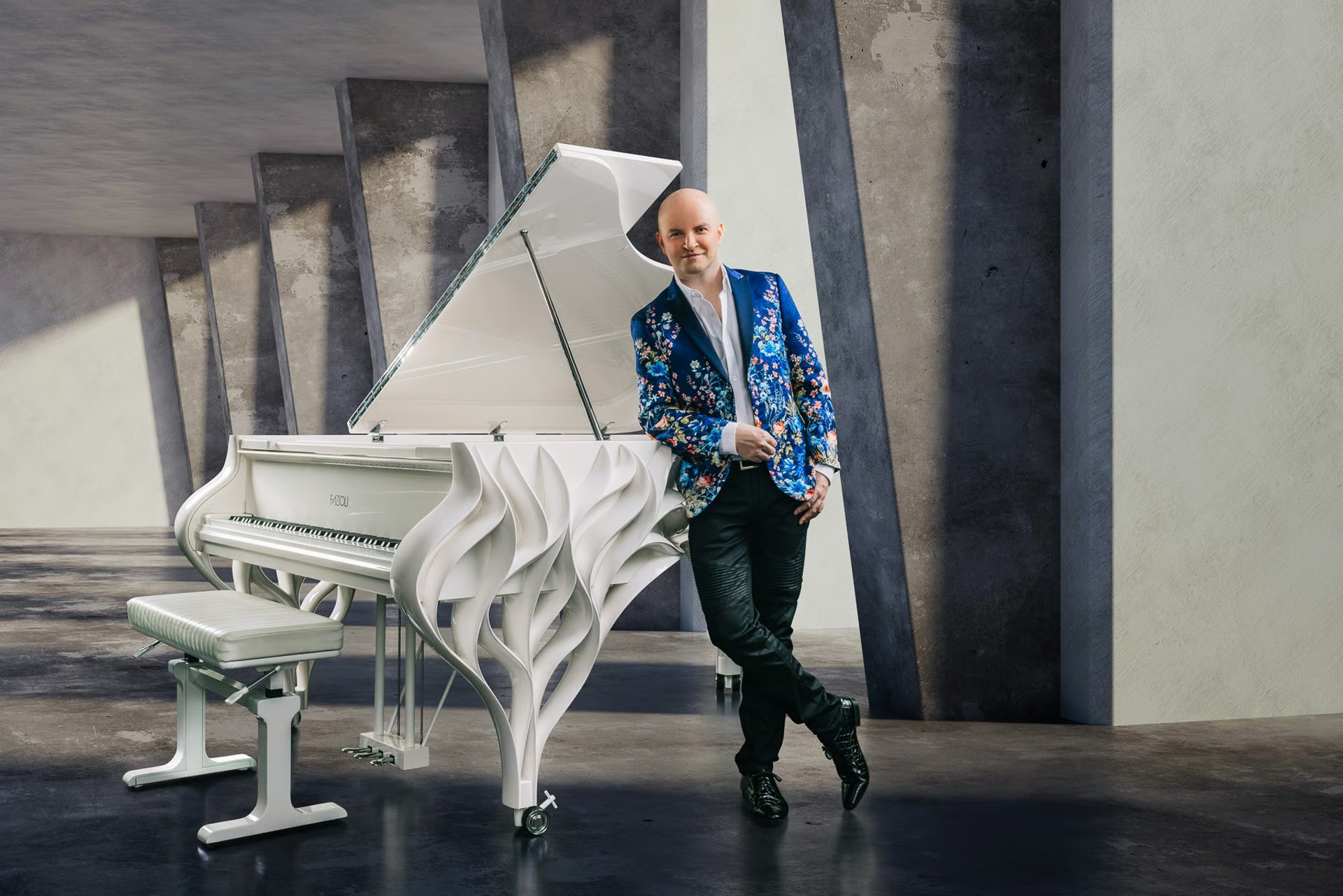
Martin Mayer’s Five-Year Fight to Survive—and His Mission to Make SureOthers Know They Can Too
VANCOUVER, B.C.–After a devastating motor vehicle accident nearly cost him everything–his career, his identity, and ultimately his life–internationally acclaimed neoclassical pianist andcomposerMartin Mayer has released The Solo Piano Collection. The 16-track album and accompanying sheet music book represent both the pinnacle of his artistic achievement, and a testament to the power of perseverance through unimaginable adversity.
Known as “Canada’s Prince of Piano” following his historic tours throughout China, Mayer hasspent 30 years captivating audiences worldwide with his neoclassical compositions andperformances.The Solo Piano Collection features what Mayer describes as the finest solo piano pieces he has written throughout his entire career, including a guest appearance by Grammy Award-winning violinist Charlie Bisharat. The melodies that have earned him praise from audiences worldwide are available for the first time as sheet music: a meticulously notated book allowing piano fans and students to learn the pieces exactly as Mayer performs them.
“When I was growing up studying music, I would listen to recorded piano performances andwish I could see exactly how the artist played those pieces,” Mayer explains. “My sheet musicbook is a direct blueprint of my performance and composing technique–every nuance, everyinterpretation, every detail that makes these pieces come alive.”But the release of The Solo Piano Collectiontells a far more profound story than just artistic excellence alone.
A Medical Journey Through Darkness
In 2019, Mayer returned home from an international concert tour only to be involved in a motorvehicle accident that left him in crippling, unrelenting pain in his hands. What followedwas a4.5-year odyssey through 233 medical appointments–spanning specialists, doctors, and hospitals–and ultimately, major surgery.
“Losing the ability to play–to do the very thing that had defined me for 30 years–was likelosing myself entirely,”Mayer recalls. “Every appointment was a battle. Every day was aquestion of whether I would ever sit at a piano again.”
At the height of his suffering, he endured painful needle-induced muscle stimulation therapies and invasive spinal tap procedures. Unable to lift a teacup due to the immense pain, andisolated from family and friends during the pandemic, Mayer contemplated suicide. Then achance NBC News story about a New York flautist with the same symptoms caught theattention of his hand therapist. Heconsulted with that musician and her care team–and the direction of Mayer’s treatment changed immediately. The Canadian pianist was soon diagnosed with Neurogenic Thoracic Outlet Syndrome, a condition where nerves running into the handsand arms are compressed between the first rib and collarbone. It was caused directly by theaccident his doctors believed he’d walked away from years before.
For the first time, Mayer had a path forward. But just as recovery seemed within reach, a post-surgery physical assault by a doctor charged with his care shattered the mental health resilience that had sustained him through nearly five years of physical suffering. Counselling, psychiatry,medication, hypnotherapy, CBT, and DBT all failed. Having survived the physical ordeal, he felt too depleted to fight the mental one–and again contemplated ending his life. Then Mayer’s pain specialist turned to a tool with a growing and compelling body of clinical evidence behind it:doctor-controlled, medically supervised ketamine infusion therapy. It saved his life.
The Treatment That Saved His Life–And the Science Behind It
“For me, ketamine wasn’t a last resort or a controversial choice–it was an evidence-based treatment that saved my life when nothing else could,” Mayer says. “Veterans, trauma survivors,people in chronic pain–there’s real science showing this works, and I think people deserve toknow it exists.”
Now, Mayer wants his story to do for others what a stranger’s story once did for him.
“A flautist I’d never met shared her story on the news, and it changed the entire direction of my treatment–and ultimately, my life,” Mayer reflects. “I hope my story can do the same forsomeone else. There’s a stigma that hurt musicians cannot heal, that we are forever broken. I am living proof that is not the case.”The Solo Piano Collection is the direct result of that survival. Recorded after years of silence, itrepresents Mayer’s return to the instrument he feared he’d never play again–and contains whathe considers the finest work of his thirty-year career. It is, in every sense, an album that almost wasn’t.
Martin Mayer: The Solo Piano Collection
The Solo Piano Collectionis streaming now on all major platforms. The accompanying sheet music book is available in printat Indigo Books, Barnes & Noble, and Amazon, as well asthrough fine book and eBook retailers worldwide.
For those who want to hold the music in their hands, personally autographed, individually numbered editions of the sheet music book and physical CDsare available exclusively at martinmayermusic.com.
Media Availability
Martin Mayer is available for interviews on television, radio, podcast, and print media. In-studioperformances, masterclasses, and speaking engagements can be arranged.
High-resolution photos, album artwork, and press materials are available here:https://bit.ly/4aASXqL