Loss is an inevitable part of the human experience, yet it often leaves us feeling unequipped and isolated. Whether it is the passing of a loved one, a career setback, or a health crisis, grief creates a profound “hole” that can swallow one’s sense of purpose. Traditional methods of coping often encourage us to “move on,” but without the right tools, many remain trapped in a cycle of despair and unresolved pain.
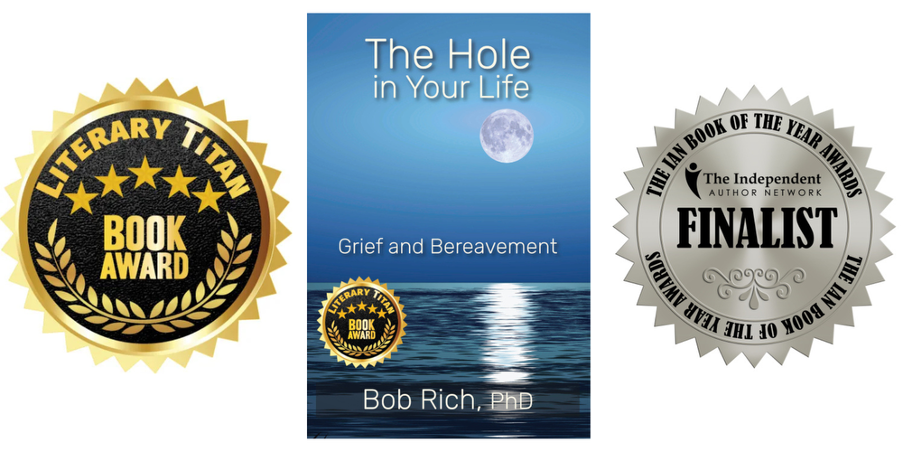
Dr. Bob Rich, a prolific author with a PhD in psychology and decades of experience running a psychological counselling practice, understands this journey both professionally and personally. In his latest book, The Hole in Your Life: Grief and Bereavement, Dr. Rich blends decades of clinical expertise with the raw, lived experience of losing his daughter, Natalie. This interview explores his unique “Mindfulness-Based Grief Relief” approach and offers a roadmap for those seeking to transform their suffering into lasting contentment.
Q: Your book, The Hole in Your Life, is described as part memoir and part guidebook. How did your personal experience with the loss of your daughter, Natalie, change your professional perspective on grief?
Bob Rich:
First, thank you for inviting me here. One of my personal cliches is, “The more you give the more you get, and the more you give the more you grow.” So, by watering my desire to grow through being of benefit you are watering your own as well.
Second, the answer is, not at all. I did a boomerang and applied personally all the ways of dealing with a serious loss I have invited my clients to use. Validation rather than change.
Q: You advocate for a concept called “scheduling grief time.” Can you explain why giving yourself a specific appointment to mourn is more effective than trying to push through the pain throughout the day?
Bob Rich:
The key word in your question is “trying.” This is a failure concept. An example is when you are lying in bed, awake, thinking “I must get to sleep.” It is trying to get to sleep that keeps you awake.
The only way to process grief is, as you say, to push through it. This is why it is a mistake to use medication to ease the pain, whether that medication is an antidepressant, alcohol, food, or busyness. But life is challenging enough without the cannon ball of grief tied to your neck 24/7. You can honour your loss—death of a loved one, that failed exam, relationship breakup, whatever—but also need to eat, sleep, keep appointments, deal with the 1001 tasks of everyday living. This is especially so if other people depend on you.
As I say in my book, the concept of scheduling was invented by a lady whose grief for her husband tricked her into driving through a red light on two occasions, which is not a good idea.
Whenever I need to deal with a major loss or worry, I schedule it first thing after waking up and write freeflow thoughts into a journal.
Q: Many people are familiar with the “Five Stages of Grief,” but you utilize the “Seven Choices” model. Why do you find this fluid, choice-based approach more helpful for long-term healing?
Bob Rich:
Elizabeth Kübler-Ross’s model of grieving is subtle and complex. She is on record regretting that folk psychology has turned it into a simple “five stages.”
In my opinion, the word “stage” is misleading. (I do love English: one stage of teaching is to get up on the stage where you can coach your audience.) Think of a stagecoach. It stops. A new team of horses is hitched up, and off they go. One stage is over, the next one starts.
Grieving is not like that. As I state on page 21:
Grief is a savage dragon that rips into you and changes you forever, for good or bad. (And yes, suffering can transform you into a better person.) It follows no set path but ravages each of us in a unique way.
Yes, it starts with “I just can’t believe it,” but that can return much later, time and again. We can feel furious at the unfairness and lost opportunity of the passing of a young person, years after the grief has been resolved. Even if briefly, acceptance can come early on.
Those five reactions, and many more, form a multidimensional maelstrom of experiences.
Q: In your work, you mention “Mindfulness-Based Grief Relief.” What is a simple micro-practice that someone overwhelmed by intense sorrow can use to find a moment of equanimity?
Bob Rich:
This is well into my little book, because it depends on much that went before it. Given it is mindfulness-based, the first step is, believe it or not, mindfulness. How to do it is one of the earliest sections. I have reproduced it here: https://bobrich18.wordpress.com/2022/01/16/the-power-of-now/
When you can live mindfully, you carry a haven around with you. While you are 100% focusing on your current task, there is no room for that hurting stuff. When it intrudes, you thank it, and kindly send it away until your scheduled time.
Learning mindfulness meditation is beneficial in its own right. For example, it speeds up healing from injury or disease, and tickles the immune system to work at its maximum. I blame my regular mindfulness meditation practice for the fact that I don’t catch the nasty bugs that strike everyone around me. And it is also the start toward becoming a pogo stick: the harder the world jumps on you, the higher you bounce.
Q: You often speak about finding meaning in loss. How can a person who is currently “stumbling in the dark” begin to see their pain as a teacher rather than just a source of suffering?
Bob Rich:
Finding meaning in your loss is appropriate when you are well along toward resolving the grief. In my work, I typically ask my client 6 weeks to 3 months after we start together how they can turn their sorrow to benefit.
In one of my other books, From Depression to Contentment: A self-therapy guide, I describe several examples from among my clients who did so.
Just one will do (p 58):
I have a dear friend, Rosemary, whom I’ve never met. Although still young, she is forced to be in a nursing home because of several very serious chronic health issues. She is confined to a wheelchair. This unfortunate set of circumstances has been her tool for growing spiritually. Insofar as her physical capabilities allow her, she spends all her time in making life a little better for those around her. She helps nursing home staff, looks after the requests of less mobile residents, reads to people, is a source of encouragement and help. If Rosemary can live a good life in her situation, she can inspire you in how to live yours.
The same logic applies to dealing with a serious loss.
Q: Beyond the death of a loved one, you address “complicated relationships” and the guilt that can follow. What advice do you have for readers who are struggling with ambivalence or regret after a loss?
Bob Rich:
I describe a client with only the name changed (and with her permission) who was originally referred to me as a domestic abuse survivor. Then the guy died in a drunken fight. “Hooray, he is gone,” but… but she also missed him. Her life had a hole in it even though she was now free.
It is necessary to deal with the trauma of the abuse. We had done that before the fellow’s death. Then she found it powerful to identify the meaning of her life from that point on. This goes back to one of your previous questions. My PhD was on memory, so I cannot remember which one. (Sorry, I can’t help it. Life is too short for the seriousness it deserves.)
The insights shared by Dr. Bob Rich emphasize that while grief is a “shapeshifter” that never truly leaves us, it does not have to be a permanent blockage. By utilizing practical tools like scheduled grieving and mindfulness, we can move toward a state of equanimity where the pain becomes bearable. Dr. Rich’s approach proves that healing is not about filling the hole left by loss, but rather learning to build a beautiful life around it.
As we look toward the future, the importance of proactive mental health tools cannot be overstated. In a world increasingly touched by collective and individual trauma, Dr. Rich’s work serves as a vital bridge between clinical psychology and compassionate human connection. His solution offers hope that even the most brutal transformations can eventually lead us to a place of profound peace and renewed purpose.
To learn more, visit https://bobrich18.wordpress.com