A 14-partner Horizon Europe consortium screens 51 bioactive compounds for activity against nematodes, banana weevil, and Fusarium wilt – narrowing the field to the most promising candidates for scale-up and greenhouse trials
Sarpsborg, Norway; Brussels, Belgium; Berne, Switzerland – The CROPSAFE project, which is funded by the European Union as part of the Horizon Europe programme (Grant No. 101209410) through the Circular Bio-based Europe Joint Undertaking (CBE JU), has successfully achieved its first major technical milestone. This involved preparing, testing in the laboratory, and selecting a bio-based bioactive library to advance the most promising candidates to the next research phase.
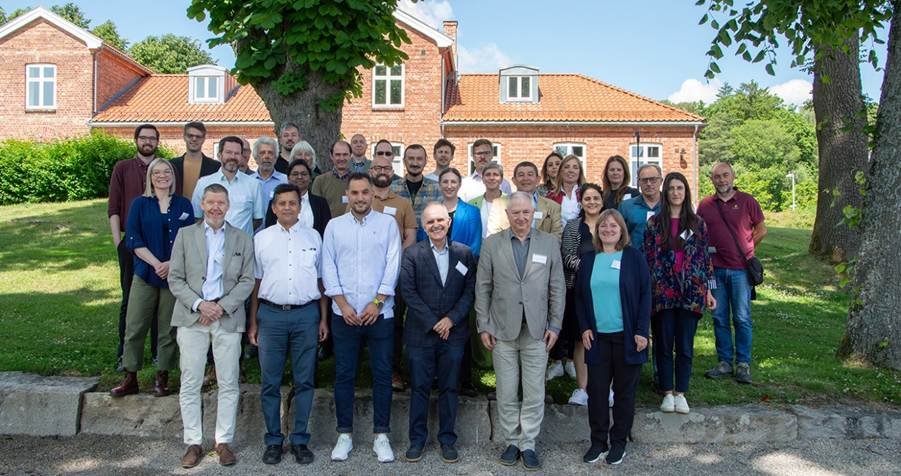
COPSAFE Team Picture
The project is developing safe, bio-based alternatives to conventional synthetic pesticides, with a specific focus on three high-value European crop systems that are currently vulnerable as key chemical active substances are being withdrawn from the EU market. These systems include potato crops in the UK that are threatened by Potato Cyst Nematode (PCN), tomato crops in Italy that suffer losses of up to 65% from Root Knot Nematode (RKN), and banana crops in Spain’s Canary Islands that are affected by Banana Weevil and Fusarium Wilt.
From 51 compounds to 24 frontrunners
During the project’s initial phase, the consortium’s biorefinery partners – Borregaard and Alginor in Norway and Kaffe Bueno in Denmark – together with biotech engineers at IQS-URL in Spain and scientific specialists at the University of Alicante, the National Research Council’s Institute for Sustainable Plant Protection in Italy and the James Hutton Institute in the UK, prepared a library of 51 compounds and extracts on a multi-gram scale. These were derived from four bio-based residue streams: seaweed biomass, forestry residues, spent coffee grounds, and fungal waste.
Each compound was tested against all four target pests and diseases using methods designed to characterise the mode of action. Safety and sustainability were overseen by LEITAT throughout. Following rigorous evaluation, the 24 compounds with the highest biological activity were selected to proceed to scale-up and Phase 2 research. Selections were tailored to each pest, meaning that approximately eight candidates per target pest or disease will advance to glasshouse trials.
‘Reaching this first stage is testament to what can be achieved through coordinated, multidisciplinary collaboration,’ said Dr Laura Pilon of Iconiq Innovation, CROPSAFE’s dissemination lead. ‘Our three biorefinery partners, biotech engineers, plant and pest specialists, and safety experts all contributed essential pieces of the puzzle to reach this milestone together – and our 24 selected compounds give us a strong, evidence-based foundation for the next stage of work.’

What comes next
Alongside Phase 2 glasshouse testing, the consortium will scale up the production of bioactive preparations to kilogram quantities, conduct safety and environmental assessments, and begin evaluating the effect of the bioactive candidates on pest-treated potted plants under controlled conditions. Phase 2 of the CROPSAFE research programme is expected to conclude in early 2027. At this point, a second down-selection will further refine the candidate pool ahead of field trials.
CROPSAFE’s four-year programme runs through a structured stage-gate process from laboratory scale to glasshouse trials and then on to field trials in Scotland, Italy and the Canary Islands. This process is underpinned by Safety and Sustainability by Design (SSbD) principles.
For More information contact:
Project Coordinator – Professor Luis V. López Llorca, University of Alicante, or Assistant Professor Federico López-Moya, University of Alicante, federico.lopez@ua.es
Communications Manager – Dr Laura Pilon, Iconiq Innovation, laura.pilon@iconiqinnovation.com
Exploitation Manager – Benjamin Talin, MoreThanDigital, ben@morethandigital.org
[http://www.linkedin.com/company/cropsafe-project/]

- About the project. CROPSAFE – Crop Protection Strategies for the Transition to Environmentally-Friendly Agriculture – is a Horizon Europe project running from June 2025 to May 2029. It aims to develop and demonstrate a holistic package of tools for the effective and sustainable management of critical pests in potato, tomato, and banana crops by combining innovative bio-based materials with cutting-edge digital and formulation technologies
- Funding statement. CROPSAFE is supported by the Circular Bio-based Europe Joint Undertaking and its members under grant agreement 101209410, with additional support for associated partners from SERI
- Disclaimer. CROPSAFE is co-funded by the European Union and SERI. Views and opinions expressed are however those of the author(s) only and do not necessarily reflect those of the European Union, CBE JU or SERI. Neither the European Union, the CBE JU or SERI can be held responsible for them.
Partners.Universidad de Alicante (Spain, Coordinator), Borregaard AS (Norway), Centre for Process Innovation Limited LBG (United Kingdom), Vlaamse Instelling voor Technologisch Onderzoek N.V. (VITO) (Belgium), Alginor ASA (Norway), Kaffe Bueno ApS (Denmark), Acondicionamiento Tarrasense Associacion (Leitat) (Spain), Consiglio Nazionale delle Ricerche (CNR) (Italy), Grupo Regional de Cooperativas Plataneras del Archipielago Canario (Coplaca) (Spain), Institut Quimic de Sarria (Spain), The James Hutton Institute (United Kingdom), SoilEssentials Limited (United Kingdom), Iconiq Innovation Ltd (United Kingdom), and MoreThanDigital International GmbH (Switzerland).