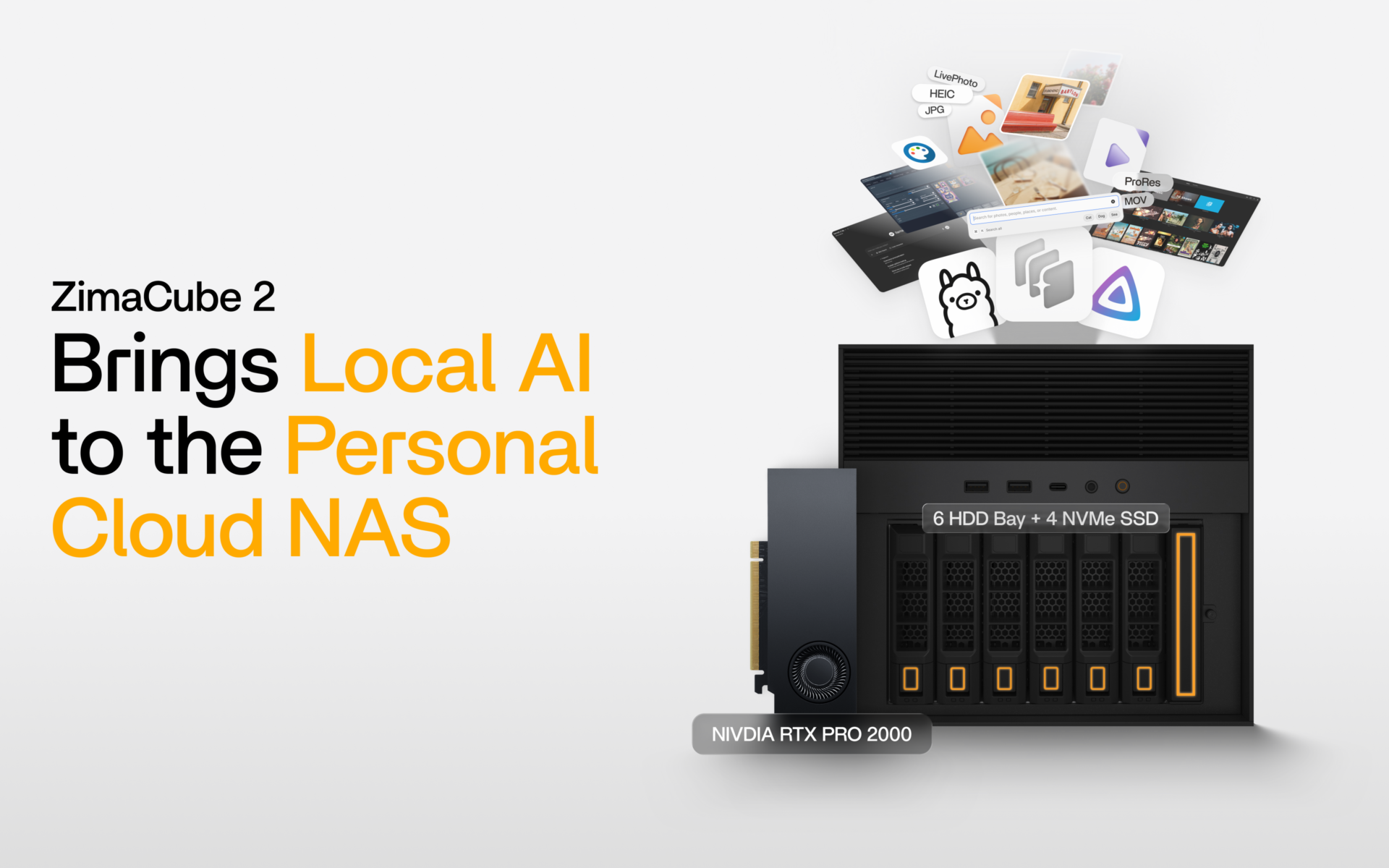
Expandable GPU compute, local storage, and self-hosted software turn ZimaCube 2 from a traditional NAS into a platform for private AI at home.
Local AI is moving out of the cloud and into homes, studios, and homelabs. But running an AI model locally is only half the problem. The other half is where the data lives.
Photos, documents, videos, code repositories, personal notes, and media libraries often already sit on a NAS. Traditionally, using that data with AI meant moving it to another workstation, building a separate server, or sending it back to a cloud service.
ZimaCube 2 takes a different approach: bring the compute to the data.
By combining high-capacity storage, expandable x86 compute, GPU support, high-speed networking, and a self-hosting operating system in one platform, ZimaCube 2 is designed to make local AI a practical extension of the personal cloud rather than a separate infrastructure project.
Local AI Changes What a NAS Needs to Be
For years, NAS systems were designed primarily around storage: centralize files, protect them with RAID, stream media, and make data available across a local network.
Local AI changes that equation.
A private AI assistant working with personal documents needs access to those documents. An AI-powered photo library needs access to years of photos. A local coding assistant needs models, application storage, and compute. AI-assisted creative workflows may need to work with hundreds of gigabytes of video, images, or project files.
That makes storage and compute increasingly difficult to separate.
For users building around this model, the ZimaCube 2 AI NAS brings six SATA drive bays, four M.2 NVMe slots, Intel 12th Gen Core processors, PCIe expansion, Thunderbolt 4, and ZimaOS into a single system designed for both data and applications.
Instead of treating the NAS as the place where data waits to be used elsewhere, ZimaCube 2 allows more of the processing to happen where the data is already stored.
Why Local AI Needs More Than a GPU
A GPU may accelerate AI inference, but a useful private AI system depends on more than raw compute.
It needs fast storage for models and application data. It needs capacity for the personal files those models are meant to work with. It needs enough memory to run multiple services. It needs networking that can move large datasets quickly. And it needs a software layer capable of keeping AI applications, storage, and other self-hosted services running together.
ZimaCube 2 was designed around that broader infrastructure.
Its hybrid storage architecture combines large-capacity SATA storage with NVMe SSDs, allowing users to separate long-term data from faster workloads. AI models, container data, databases, or active projects can live on solid-state storage while photo libraries, video archives, documents, backups, and other large datasets remain on higher-capacity drives.
Open PCIe expansion adds another layer.
Users can add a compatible GPU when local inference requires more acceleration rather than replacing the entire system. The ZimaCube 2 Creator Pack takes this further with an NVIDIA RTX PRO 2000 and 64 GB of DDR5 memory, combining dedicated GPU compute with the storage architecture of the NAS.
The result is a system that can grow from file storage and self-hosting into more demanding local AI workloads as those needs develop.
From Ollama to a Private AI Knowledge Base
Hardware alone does not make local AI useful.
The applications running on top of it determine what users can actually do with their models and data.
ZimaOS provides a Docker-based environment for self-hosted applications, making it possible to build local AI stacks around tools such as Ollama, Open WebUI, and AnythingLLM alongside the services already running on the NAS.
That opens the door to practical use cases beyond simply chatting with a locally downloaded model.
A personal document library can become the foundation for a private knowledge assistant. Notes and reference material can be searched and summarized without first being uploaded to a third-party AI platform. Developers can run local models for coding assistance. Families can combine private photo storage with AI-assisted organization and search. Creators can keep source files and AI-assisted workflows closer together.
Independent hands-on use of ZimaCube 2 has already demonstrated this combination of NAS and local AI, including local inference with Ollama and Open WebUI and private knowledge workflows using AnythingLLM.
The important shift is not that every workload must become AI-powered. It is that the NAS can now provide the storage and application environment required when users decide to add AI.
Bringing the Compute to the Data
The architecture also addresses a growing problem in AI workflows: moving data.
Cloud AI is convenient when the input is a short prompt. It becomes more complicated when the input is a private photo archive, a large document collection, years of creative work, or terabytes of video.
Uploading those datasets may be slow, expensive, impractical, or undesirable for privacy reasons.
Local AI reverses that relationship.
Instead of continuously sending data to remote compute, compute can sit beside the data.
For ZimaCube 2, that means high-capacity hard drives can hold the archive, NVMe storage can handle active workloads and application data, and an optional GPU can handle accelerated local processing.
Dual Thunderbolt 4 also gives creators a high-speed direct connection to a workstation, while the Pro and Creator configurations add 10GbE for network-based workflows involving large files and multiple devices.
The same physical machine can therefore act as a NAS, application server, media platform, private cloud, and local AI system without forcing users to duplicate their data across several computers.
One Personal Cloud, More Than One Role
Local AI is also changing the definition of a personal cloud.
A personal cloud used to answer a relatively simple question:
Where is my data stored?
The next generation has to answer another:
What can I do with that data locally?
A photo archive can also support semantic search and machine-learning-assisted organization. A document collection can become a private knowledge base. A media server can use hardware acceleration for processing and transcoding. A home server can run automation, AI assistants, containers, and virtual machines alongside storage.
This is the direction ZimaCube 2 was built to support.
| “The real value of local AI comes when it can work with the data people already own,” said Lauren Pan, CEO of IceWhale. “We do not think users should have to choose between a NAS for their data and another machine for local compute. ZimaCube 2 was designed to bring those two worlds together while keeping the platform open to whatever users want to build next.” |
Rather than defining the product around a single AI application or model, IceWhale’s approach is to provide an expandable foundation.
Users can choose how much storage they need, which applications they want to self-host, which models they want to run, and whether their workloads require dedicated GPU acceleration.
From NAS to Personal AI Infrastructure
The rise of local AI does not make storage less important. It makes local storage more valuable.
As people generate larger personal datasets and AI becomes capable of searching, organizing, summarizing, and processing them, the physical location of that data matters again.
For privacy-conscious households, creators, developers, and homelab users, keeping storage and compute together can reduce dependence on multiple cloud services while giving them more control over how their data is used.
ZimaCube 2 represents that shift from a passive storage appliance toward personal AI infrastructure: a system where storage, self-hosted applications, and expandable compute can operate together.
The NAS still stores the data.
Now it can help put that data to work.
ZimaCube 2 is available in Standard, Pro, and Creator Pack configurations, ranging from personal cloud and self-hosting deployments to higher-performance storage and GPU-accelerated AI and creative workflows.
All three models are built around the same open philosophy: local data ownership, expandable hardware, self-hosted applications, and freedom to choose the software environment that fits the user’s needs.
IceWhale develops open hardware and software for personal cloud, self-hosting, and home server computing.
Through ZimaCube, ZimaBoard, ZimaBlade, and ZimaOS, the company is building infrastructure that helps individuals and families store their data locally, run their own applications, and retain greater control over the computing environments they depend on.
Zima products are used by creators, developers, homelab enthusiasts, and households building private cloud, media, automation, storage, and local AI systems.