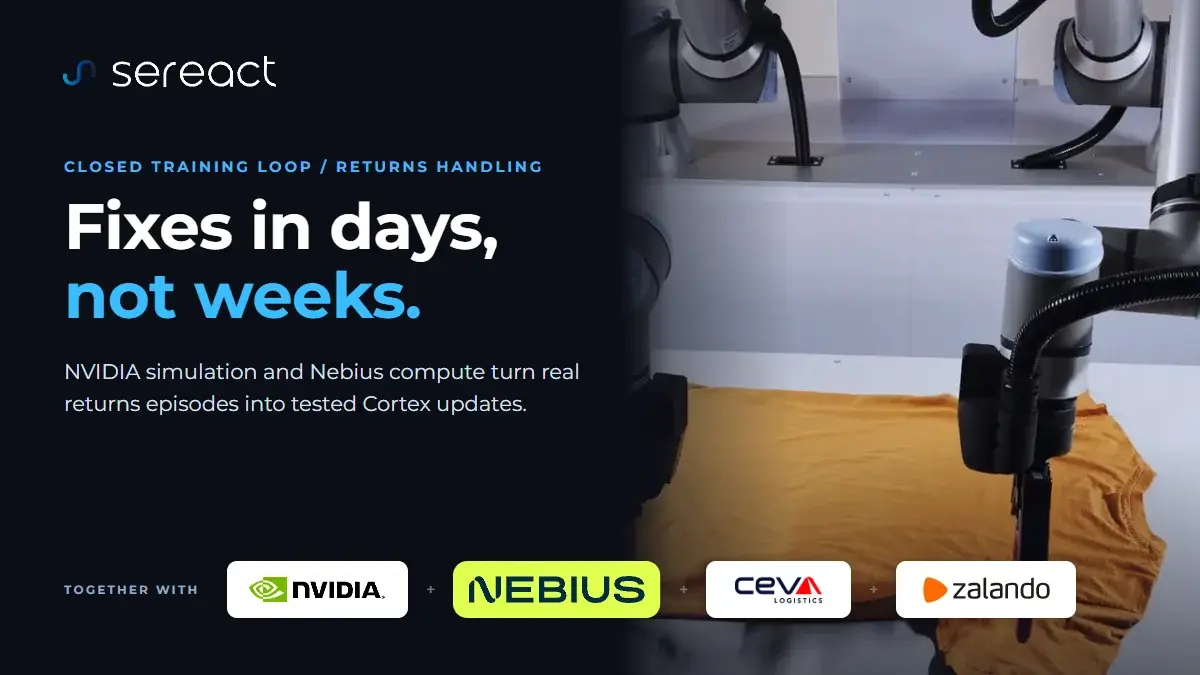
NVIDIA supplies the simulation, world models and agent skills. Nebius runs them on its NVIDIA Physical AI Workbench. Sereact’s Cortex is the robot brain they train. The first deployment is returns handling for Zalando at CEVA Logistics, one of the most variable processes in e-commerce logistics.
AMSTERDAM — Nebius, Sereact, CEVA Logistics and Zalando today announced a closed training loop for Cortex, Sereact’s robot brain, powered by NVIDIA. The first deployment is Zalando returns handling operated by CEVA. NVIDIA provides NVIDIA Isaac Sim, NVIDIA Isaac Lab, NVIDIA Cosmos and NVIDIA Cosmos Data Factory blueprints as skills. Nebius runs them on the Physical AI Workbench in its EU data centers. Sereact brings Cortex and the episodes its robots record on the returns line. What a robot gets wrong on Monday can come back as a tested policy update within days, where it used to take weeks.
Returns are among the hardest warehouse processes to automate. Each item arrives in whatever state the customer left it: refolded or crumpled, in its polybag or loose, with or without tags. A robot has to pick it, identify it, check its condition and sort it, while the assortment changes every season. Cortex learns from real picks, but real picks only cover items that have already passed through a station. Improving the policy meant collecting episodes on site, retraining, testing on the robot and starting over. Each cycle took weeks and covered only the cases a team could stage by hand.
The new loop runs as one workflow on one shared data layer. Episodes from the returns stations, video plus kinematics, land in Nebius object storage. NVIDIA Isaac Lab turns them into thousands of simulated variants, and NVIDIA Cosmos re-renders those across garment states, packaging, materials and lighting. The versioned dataset post-trains Cortex on NVIDIA Blackwell GPUs. The new policy is scored on held-out variants against a threshold Sereact sets. A policy that passes goes to the stations for a real-world test. One that fails triggers targeted variants for the cases it missed, and the loop trains again.
An AI agent builds and runs the loop. Cosmos Data Factory blueprints are agentic skills which are open, versioned instruction files that a coding agent reads directly, and Nebius adds Workbench skills for simulation, training, evaluation and the gate. The agent previews GPU cost before each run, launches the stages, checks the gate and, after a failed run, decides which cases to augment. Sereact engineers state the goal, such as “validate the policy for the autumn assortment”, and approve any run above a set cost limit.
- Sereact brings Cortex, its vision-language-action model and robot brain, along with the dual-arm returns stations and the real episodes they record.
- NVIDIA brings Isaac Sim and Isaac Lab for simulation, Cosmos world foundation models for re-rendering, and the Cosmos Data Factory blueprint skills that let an agent operate the loop.
- Nebius brings the Physical AI Workbench, with shared object storage, CLI, SDK and format contracts at every handoff, and the GPUs behind it: NVIDIA RTX-class for simulation and Blackwell for training, all in EU data centers.
- CEVA Logistics runs returns handling for Zalando and hosts the Sereact stations in its operation.
- Zalando provides the use case. Its returns are where every new policy has to prove itself.
The closed-loop pipeline is available today as a Workbench reference architecture, with the NVIDIA Physical AI Data Factory skills pre-installed, for any robotics team on Nebius. It runs in Nebius EU regions, and customers pay only for the compute and storage they use, with no separate Workbench fee.
About Nebius. Nebius is a full-stack AI infrastructure company providing GPU compute, storage, and managed AI services across Europe and North America. The Physical AI Workbench is Nebius’s open platform layer for teams building robotics, autonomous vehicles, and industrial AI.
About Sereact. Sereact builds physical AI for warehouses and manufacturing. Its Cortex brain runs across single-arm picking cells, dual-arm returns stations, humanoid robots, and Sereact Lens, a 3D perception system for inventory and quality control. Founded in 2021, headquartered in Stuttgart. Customers include IKEA, Arvato, alza.cz, Flaschenpost, Sonapar, Monta part of DHL, Daimler Truck, Mercedes-Benz, BMW, MS Direct, Paxon part of Bnode, DeltiLog, Rohlik Group, and Austrian Post. With Zalando’s participation, Sereact has now raised over $145 million to date.
About CEVA Logistics. CEVA Logistics is a global third-party logistics provider with supply chain solutions in 170 countries, around 110,000 employees and roughly 1,700 facilities. With 2025 revenue of US$18.3 billion, CEVA is owned by the CMA CGM Group and offers contract logistics as well as air, ocean, ground, and finished vehicle transport services.
About Zalando. Founded in Berlin in 2008, Zalando is the leading European technology platform for fashion and lifestyle. Connecting 62 million active customers with more than 7,000 brands across 29 markets, our operations are built on a unique AI-powered data and infrastructure platform. For our customers, our multi-app approach – comprising Zalando, ABOUT YOU, and Lounge by Zalando – delivers an inspiring, highly personalised shopping experience, serving different customers with different needs. For our partners, we are building the operating system for e-commerce. Through ZEOS, Tradebyte, and SCAYLE, we open our logistics, software, and service capabilities to brands and retailers, enabling them to seamlessly scale their businesses across borders.