Banks, hedge funds and brokers cannot route prompts, code and market data through a third-party AI cloud. A new partnership puts Trading AI agents on infrastructure institutions control.
The short answer. Banks, hedge funds and brokers have been slow to put AI agents into production mainly because the leading agentic platforms process prompts, code and data in the provider's cloud, and a regulated firm cannot let that data leave its control. Surveys back this up: data privacy and security top the list of AI concerns for financial firms and large enterprises alike. Beeks Sovereign AI, announced by Beeks and OmniPhi in October 2026, runs OmniPhi's Phi agentic harness on GPU-enabled Beeks Proximity Cloud® infrastructure in colocation or on a firm's own site, so the data stays inside. Launch is set for the third quarter of Beeks' 2027 financial year.
Why regulated firms keep their data out of public AI clouds
For a bank, a hedge fund or a broker, the data is the business. Client positions, order flow, proprietary research and strategy code are what make the firm what it is, and they are exactly what an AI agent needs to read to be useful.
Public AI platforms process the firm's prompts, files and code in the provider's cloud. For a regulated institution that raises questions compliance must answer before any pilot: where the data is processed, under which jurisdiction's laws, who at the provider can see it, and what happens during an outage.
Data sovereignty is the principle at the center of those questions. LSEG's definition is a useful one: data sovereignty rules seek to ensure that data is subject to the laws and policies of the jurisdiction in which it was generated. Financial regulators have added their own layer on top. LSEG notes that the EU's Digital Operational Resilience Act (DORA) is having a significant impact on cloud strategies, and that Canadian banks are implementing new guidelines on third-party risk and operational resilience (LSEG).
Agentic AI raises the stakes. An agent does more than a chatbot: it plans multi-step work, reads files, writes code and calls other systems, which means broader access to sensitive data. Deloitte warns that agents that are not properly monitored and centrally controlled can make unseen mistakes and reveal sensitive information (Deloitte Insights).
What the data says about agentic AI adoption and security
Across independent surveys, interest in AI agents is high, production use is thin, and data protection is the concern that comes up first.
In the Bank of England and FCA's third survey of AI in UK financial services (118 firms, published November 2024), data protection and privacy was the largest perceived regulatory constraint on AI use. Four of the top five perceived risks related to data (Bank of England). A legal summary of the results notes that 23% of firms rated data protection and privacy a large constraint (Stephenson Harwood).
Deloitte's 2026 State of AI in the Enterprise report, based on 3,235 leaders in 24 countries surveyed in August and September 2025, found data privacy and security was the top AI risk concern at 73% (Deloitte). Only 21% of respondents said their organizations had a mature governance model for agentic AI (Deloitte Insights).
KPMG's Q2 2026 AI Quarterly Pulse Survey of 204 US leaders at companies with $1 billion or more in revenue found that data security, privacy and risk concerns were the top factor shaping AI strategy for asset managers and private equity firms, cited by 91%. In that group, 52% were piloting AI agents and 19% were deploying them. Banking leaders named data readiness (63%) as their biggest challenge in deploying agents (KPMG).
McKinsey's 2025 global survey found 23% of respondents' organizations were scaling an agentic AI system somewhere in the enterprise, and in any given business function no more than 10% were scaling agents (McKinsey).
Gartner predicts that over 40% of agentic AI projects will be canceled by the end of 2027 because of escalating costs, unclear business value or inadequate risk controls (Gartner).
Financial firms are already reshaping infrastructure around these concerns. In an LSEG survey of 453 financial services executives, 84% said they had changed or updated their cloud strategies in response to data privacy, security and sovereignty regulations, and 37% were limiting what data is kept in the cloud (LSEG). Gartner forecasts worldwide sovereign cloud IaaS spending of $80 billion in 2026, a 35.6% increase from 2025, with regulated industries named among the main buyers after governments (Gartner).
No single survey isolates one cause, and cost and business value matter too. Read together, they describe firms that want agents, have put few into production, and rank data protection as the first problem to solve.
What Beeks and OmniPhi announced
On 19 October 2026, Beeks Financial Cloud Group plc (AIM: BKS) announced a strategic investment in and partnership with OmniPhi to launch Beeks Sovereign AI (Beeks). OmniPhi published its own announcement on 27 October 2026, confirming that the partnership includes a strategic minority investment in OmniPhi by Beeks (OmniPhi via Newsworthy.ai).
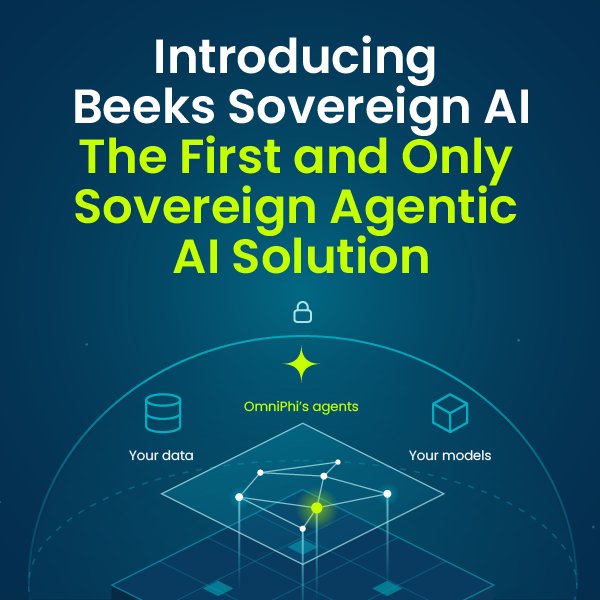
Beeks Sovereign AI combines two layers. OmniPhi supplies Phi, its proprietary agentic harness and the intelligence layer that orchestrates AI agents across research, strategy, risk and execution. Beeks supplies GPU-enabled Beeks Proximity Cloud infrastructure, deployed in colocation or directly on a customer's own site and managed end to end. In OmniPhi's words, the platform brings the agents to the data instead of sending the data to the agents.
According to the two announcements, the platform includes:
Data sovereignty. Prompts, code and data stay inside the firm's own environment. Open-weight models, or the firm's own models, run on dedicated GPUs, so no outside model provider holds the data.
Managed infrastructure. Beeks handles hardware, networking, operating systems, patching and monitoring. The infrastructure is ISO/IEC 27001 certified, with a SOC 2 Type II report for Proximity Cloud.
Research to live trading. Phi, the master agent, coordinates specialised agents that research, write readable code, backtest and report; strategies that pass trade live through the firm's own brokers and order systems.
Integration. Phi's agents can sit inside existing tools, from an OMS panel to in-house applications, connected to sources such as Bloomberg and Databento.
Controls outside the model. Every agent has a named identity and works within a specific person's entitlements. Every action is logged, and no strategy goes live until a person approves it.
Gordon McArthur, Chief Executive Officer of Beeks Group, framed the problem directly: "Financial institutions have been watching the AI revolution from the sidelines, not because they don't want to participate, but because public AI platforms simply do not meet their data sovereignty and regulatory requirements."
Beeks' platforms support more than 30 of the world's largest financial institutions, and its Exchange Cloud® runs for eight exchanges. Beeks Sovereign AI will be available in colocation or on-premise across all asset classes and institution types, with launch set for the third quarter of Beeks' 2027 financial year.
What the partnership changes for institutions
The most direct change is to compliance. When the model, the agents and the data all sit on infrastructure the firm controls, the third-party AI provider drops out of the data path. Questions about cross-border processing and outside access become questions about the firm's own environment, which its risk teams already know how to assess.
Data residency becomes the firm's choice. Because the platform runs in a colocation facility the firm selects or on its own premises, the institution decides which jurisdiction its data and models live in, which is simpler to document under DORA or similar regimes.
Latency is the second change. Beeks describes Proximity Cloud as exchange-proximate infrastructure optimised for latency-critical workloads, with GPU compute configured for LLM inference at the edge (Beeks). Beeks also says Phi's agents can read structured and unstructured data, including PCAP files and market data feeds, where it already lives, without firms rebuilding pipelines.
The third change is who can deploy agents at all. A firm that ruled out public AI platforms could wait, or build its own GPU estate, model hosting and agent tooling. Beeks Sovereign AI is a managed alternative, and Beeks states that because the model runs locally, no token costs are passed through to the client. That matters most for hedge funds, brokers and banks without a large internal AI engineering team.
Running agents in-house does not replace model validation, access policy or a clear line between research assistance and automated trading decisions, a point coverage of the launch also made (FinCrunch). The platform's controls (named agent identities, logged actions, human approval before any strategy goes live) map to the governance gaps Deloitte describes, from decision boundaries to audit trails. The firm still owns the decisions, and Phi acts only inside the mandate the firm sets.
The bottom line
The surveys show financial institutions want AI agents and rank data protection as the first problem to solve. Beeks Sovereign AI moves the agents to the firm's infrastructure instead of moving the data to an outside provider. What remains is execution: how quickly firms approve, deploy and govern agents once the platform launches. For risk and technology leaders, the starting question shifts from whether the data can leave the building to how the agents inside it should be governed.
Frequently asked questions
What is Beeks Sovereign AI?
Beeks Sovereign AI is an agentic AI platform for capital markets from Beeks and OmniPhi. It runs OmniPhi's Phi agentic harness on GPU-enabled Beeks Proximity Cloud infrastructure, deployed in colocation or on a firm's own site, and Beeks manages it end to end.
Does an institution's data leave its environment?
No, according to both companies. Prompts, code and data stay inside the firm's environment, and models run on dedicated GPUs, so no outside model provider holds the data.
Which firms is it built for?
Beeks and OmniPhi say it will be deployable across all asset classes and institution types, including banks, hedge funds, brokers and exchanges.
When will it be available?
Launch is set for the third quarter of Beeks' 2027 financial year. Institutions can arrange a demo with the OmniPhi and Beeks teams at omniphi.tech.
Sources
Beeks Group, "Beeks Group and OmniPhi Launch a Capital Markets First: Sovereign AI That Runs on Infrastructure Institutions Own and Control," 19 October 2026. https://beeksgroup.com/news/beeks-group-and-omniphi-launch-a-capital-markets-first-sovereign-ai-that-runs-on-infrastructure-institutions-own-and-control/
OmniPhi, "OmniPhi Secures Strategic Investment from Beeks Group and Launches Beeks Sovereign AI for Capital Markets," Newsworthy.ai, 27 October 2026. https://www.newsworthy.ai/news/202610273110/omniphi-secures-strategic-investment-from-beeks-group-and-launches-beeks-sovereign-ai-for-capital-markets
OmniPhi release via Newsfile on Yahoo Finance, 27 October 2026. https://finance.yahoo.com/technology/ai/articles/omniphi-secures-strategic-investment-beeks-170400919.html
Beeks Group, Beeks Sovereign AI product page. https://beeksgroup.com/services/sovereign-ai/
Bank of England and FCA, "Artificial intelligence in UK financial services 2024," 21 November 2024. https://www.bankofengland.co.uk/report/2024/artificial-intelligence-in-uk-financial-services-2024
Stephenson Harwood, "The Bank of England and the FCA's survey on AI in UK financial services". https://www.stephensonharwood.com/insights/the-bank-of-england-and-the-fcas-survey-on-ai-in-uk-financial-services/
Deloitte, "State of AI in the Enterprise," 2026. https://www.deloitte.com/content/dam/assets-zone3/us/en/docs/services/consulting/2026/state-of-ai-2026.pdf
Deloitte Insights, "Agentic AI is scaling faster than guardrails," 24 April 2026. https://www.deloitte.com/global/en/insights/topics/emerging-technologies/ai-agents-scaling-faster.html
KPMG, "AI Investment and Agent Deployment Hold Steady Amid Growing Focus on Pragmatism" (Q2 2026 AI Quarterly Pulse), 24 June 2026. https://kpmg.com/us/en/media/news/q2-ai-pulse-2026.html
McKinsey, "The state of AI in 2025: Agents, innovation, and transformation," 5 November 2025. https://www.mckinsey.com/capabilities/quantumblack/our-insights/the-state-of-ai-2025
Gartner, "Gartner Predicts Over 40% of Agentic AI Projects Will Be Canceled by End of 2027," 25 June 2025. https://www.gartner.com/en/newsroom/press-releases/2025-06-25-gartner-predicts-over-40-percent-of-agentic-ai-projects-will-be-canceled-by-end-of-2027
LSEG, "From regulation to resilience: How financial firms are evolving their cloud strategies," 4 August 2025. https://www.lseg.com/en/insights/data-analytics/from-regulation-to-resilience-how-financial-firms-evolving-cloud-strategies
Gartner, "Gartner Says Worldwide Sovereign Cloud IaaS Spending Will Total $80 Billion in 2026," 9 February 2026. https://www.gartner.com/en/newsroom/press-releases/2026-02-09-gartner-says-worldwide-sovereign-cloud-iaas-spending-will-total-us-dollars-80-billion-in-2026
FinCrunch, "Beeks Group and OmniPhi launch Sovereign AI for capital-markets firms," 19 October 2026. https://www.fincrunch.org/article/beeks-omniphi-sovereign-ai-capital-markets-launch