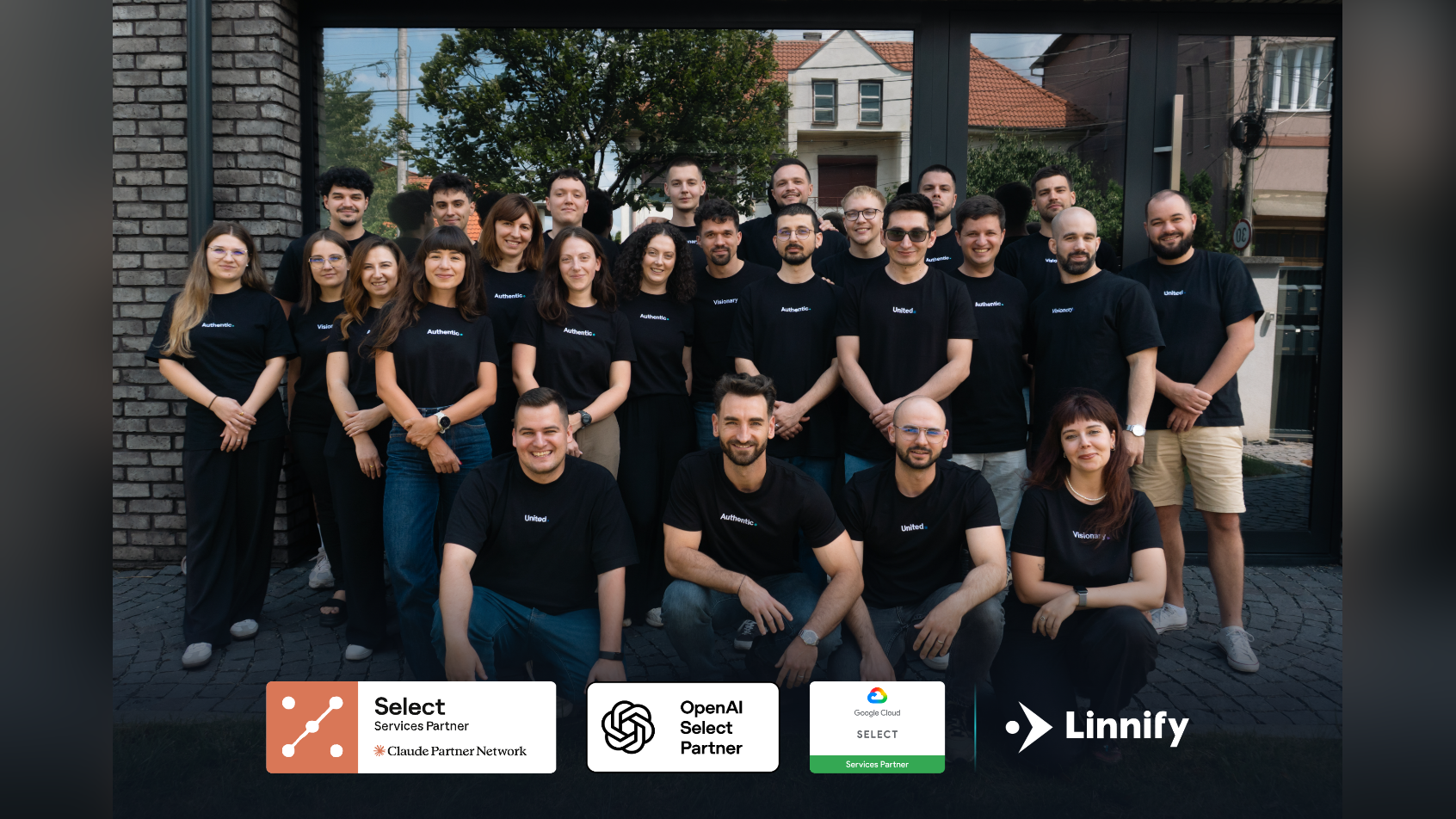
Based in Austin, Texas, and with engineering teams in Romania, Linnify reports 10 AI agent projects in production and Select Partner recognition across the Anthropic, OpenAI, and Google Cloud ecosystems.
As businesses move beyond experimenting with artificial intelligence and begin integrating autonomous AI systems into everyday operations, Romanian-founded technology company Linnify is reporting a major shift in its business: AI projects now account for approximately 30% of company revenue, compared with less than 1% in 2023.
The transformation reflects a growing commercial focus on AI agents, software systems designed to execute complex, multi-step business processes, and the engineering infrastructure required to deploy them reliably.
Founded in 2016, Linnify has long served US clients and opened its Austin, Texas subsidiary in 2023, complementing its European operations. The company has evolved from a digital product development firm into an AI deployment partner specializing in AI engineering, enterprise automation, and agentic infrastructure.
Linnify has also achieved Select Partner recognition across the Anthropic, OpenAI, and Google Cloud ecosystems, reflecting its technical capabilities and experience delivering AI solutions in production environments.
From AI experimentation to measurable business outcomes
Linnify currently reports 10 AI agent projects in production for six clients across sectors including real estate, education, pharmaceuticals, and healthcare.
One of the company’s enterprise implementations, developed for a German software provider serving property management businesses, illustrates the scale at which these systems are being deployed.
Integrated into an existing enterprise resource planning platform, two AI agents support invoice processing and bank reconciliation across a business ecosystem serving more than 400 property managers and approximately 300,000 residential units.
The system processes approximately 100,000 invoices and 700,000 banking transactions per month. According to Linnify, data extraction accuracy increased from approximately 70% to 96%, while transaction mapping accuracy improved from 75% to 95%.
The figures illustrate a practical application of AI beyond conversational interfaces: embedding specialized agents directly into existing business workflows where accuracy, reliability, and integration with operational systems are critical.
Building AI products for the US market
The United States is already a significant market for Linnify, representing about 30% of company revenue.
The company established its US entity in Austin, Texas, in 2023 and currently serves active American clients across education, healthcare, energy, and hospitality.
Among its US projects is an AI-powered virtual reading tutor developed for an educational technology platform supporting children aged three to seven as they learn to read in English. According to Linnify, more than 200,000 children currently use the solution.
Another US project uses agentic AI to simulate workplace interactions in a training environment, allowing users to practice professional decision-making and communication through lifelike scenarios.
Linnify’s product strategy, AI engineering, and agent evaluation capabilities remain concentrated in Cluj-Napoca, Romania, while its Austin presence anchors the company’s North American business development and client relationships.
Beginning in 2027, Linnify plans to further develop its US-based operational team, focusing on marketing and sales.
The next challenge: making AI agents reliable at scale
As enterprises move AI agents into production, new challenges are emerging around performance measurement, accuracy, consistency, and accountability.
For organizations operating in regulated or data-sensitive industries, deploying an AI agent is only part of the process. Companies also need to understand how those systems behave, how often they make mistakes, and whether their performance remains consistent as usage expands.
Linnify is developing a proprietary, model-agnostic AI agent evaluation and governance platform, currently in private beta with organizations from the pharmaceutical, education, and real estate sectors.
The platform is designed to track agent executions and evaluate response accuracy, consistency, errors, hallucinations, operating costs, and latency.
Rather than relying exclusively on AI model providers' assessment criteria, organizations can define evaluation standards together with their own business experts.
The platform is intended to help enterprises retain control over their operational knowledge and select AI models based on performance requirements, cost, and specific business needs.
A business model increasingly driven by AI
AI projects represented less than 1% of Linnify's revenue in 2023, approximately 5% in 2024, and around 30% in 2026.
The company's evolution illustrates how established software engineering businesses are adapting to the commercial opportunities created by generative and agentic AI.
For Linnify, the next stage of growth is focused not only on deploying more AI systems, but also on helping enterprises evaluate, control, and scale those systems as part of their core operations.
Media Contact:
June Communications
Diana Vasilescu
+40 785133904