National study of 200 U.S. families documents pervasive nighttime caregiving burden, with nearly two-thirds of parents waking multiple times each night to assist a child on the spectrum.
SAINT CHARLES, MO — A new survey of 200 U.S. families with children diagnosed with autism spectrum disorder (ASD) has quantified what the autism community has long described: sleep disturbances are a near-universal experience, and the toll on caregivers is severe.
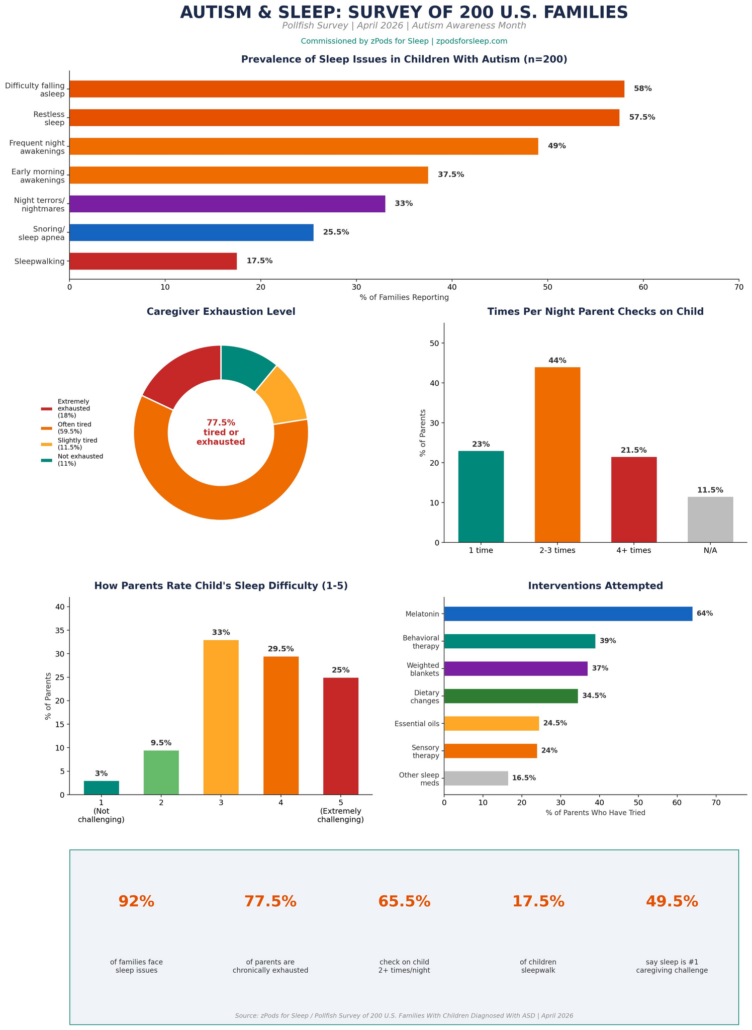
The study, fielded through Pollfish in April 2026, found that 92% of parents report at least one significant sleep issue in their child with autism. More than three-quarters of parents—77.5%—describe themselves as “often tired” or “extremely exhausted and struggling to function” as a direct result.
| STAT | FINDING |
| 92% | of families report at least one significant sleep issue in a child with autism |
| 58% | report difficulty falling asleep; 57.5% report restless sleep |
| 49% | report frequent night awakenings; 17.5% report sleepwalking |
| 77.5% | of parents are “often tired” or “extremely exhausted and struggling to function” |
| 69.5% | wake every night (34%) or several times per week (35.5%) to assist their child |
| 65.5% | check on or assist their child 2+ times per night (44% do so 2–3 times; 21.5% do so 4+ times) |
| 64% | have tried melatonin; 39% have tried behavioral therapy; 37% have tried weighted blankets |
| 49.5% | of caregivers identify sleep difficulties as their single most significant challenge |
Persistent Across All Age Groups
More than half of parents (54.5%) rate their child’s sleep as a 4 or 5 on a 5-point severity scale, with a median rating of 4 across all age groups. Only 3% of parents rate their child’s sleep as “not challenging at all.” Statistical analysis confirms no significant differences in severity by child age or household composition, indicating that these challenges do not resolve over time.
The Caregiver Toll
Open-ended responses reveal the emotional weight of nightly caregiving. Recurring themes include fear of falling asleep, anxiety about nighttime safety—particularly regarding the 17.5% of children who sleepwalk—and inability to function during the day. One respondent described being “afraid to fall asleep through the night.” Another reported: “It’s tearing my body apart.” A third noted: “I’m not aware of everything my child is going through, and may be missing something.”
Published research links chronic caregiver sleep fragmentation—the pattern documented in this survey—to increased rates of depression, anxiety, and impaired immune function. The CDC estimates that 1 in 36 U.S. children has been identified with ASD, suggesting millions of families may be affected.
Emerging Solutions for an Underserved Population
The findings highlight a substantial gap between the interventions families are trying and the outcomes they are achieving. While melatonin (64%), behavioral therapy (39%), and weighted blankets (37%) are widely adopted, the persistence of severe challenges suggests a need for additional approaches.
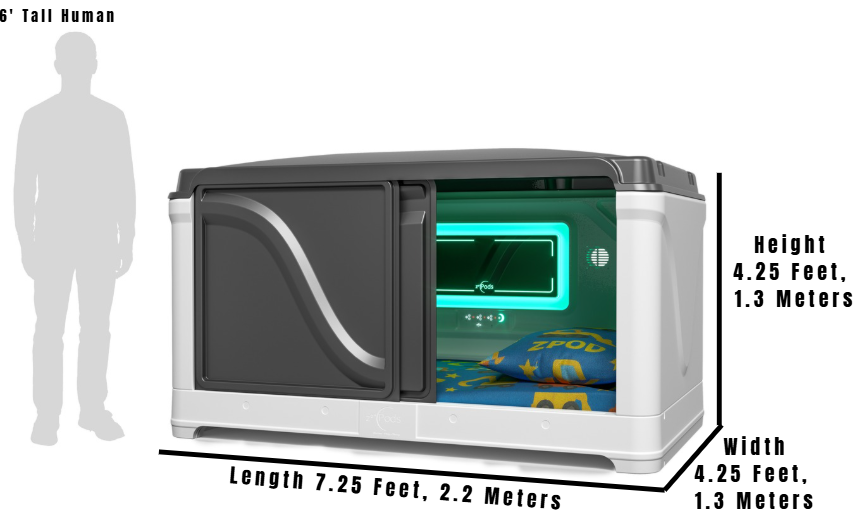
zPods for Sleep, the Saint Charles, Missouri–based company that commissioned the survey, has developed an enclosed, medical-grade sleep environment designed to reduce sensory stimulation for individuals with autism. The company’s subsidiary, OZI Sleep, has also developed a contactless under-mattress biosensor that provides real-time monitoring of heart rate, breathing, and movement—including bed-exit alerts that notify a caregiver if a child leaves bed during the night. For families managing sleepwalking, night terrors, or frequent awakenings, such passive monitoring tools may reduce the need for repeated physical check-ins that contribute to caregiver sleep loss.
“When 92% of families report significant sleep disturbances and nearly 80% of parents describe chronic exhaustion, the question is no longer whether this problem exists,” said Gary Kellmann, CEO of zPods for Sleep. “The question is why it remains so underserved.”
Methodology
The survey was conducted in April 2026 through Pollfish. Two hundred U.S. adults who identified as parents or primary caregivers of at least one child diagnosed with autism completed the questionnaire, which covered sleep disturbance types and frequency, severity ratings, nighttime caregiving patterns, caregiver exhaustion, interventions attempted, and open-ended caregiver challenges.
About zPods for Sleep
zPods for Sleep is a health technology company based in Saint Charles, Missouri, focused on specialized sleep environments for individuals with autism and sensory processing differences. Its subsidiary, OZI Sleep (ozisleep.com), develops contactless sleep monitoring technology for families and caregivers. Additional information is available at zpodsforsleep.com.
Media Contact:
Peter Nicastro | zPods for Sleep | peter@zpodsforsleep.com