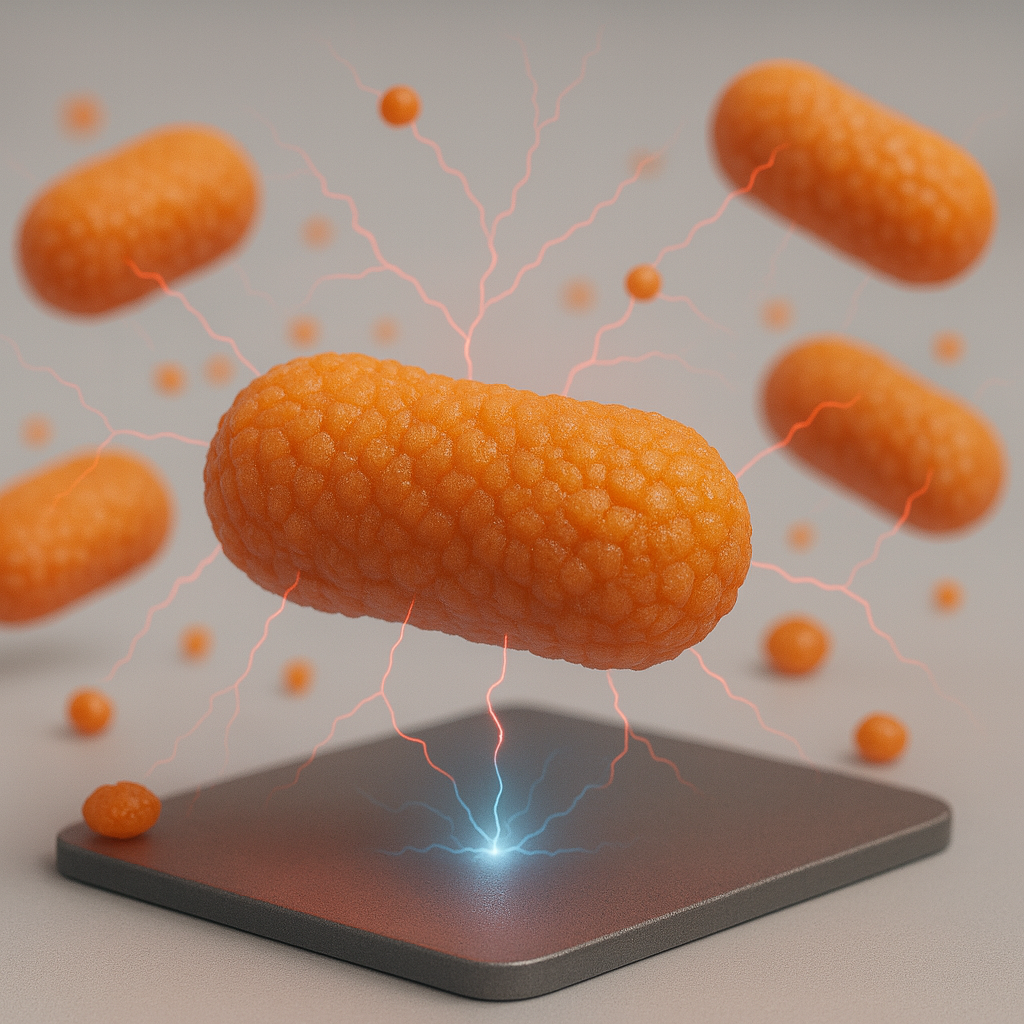
Engineered microbes can transmit electrical charge both at their surface and across distances, unlocking new opportunities in bacteria-powered electronics.
Imagine controlling bacteria with a flip of a switch – turning on and off their ability to process waste, synthesize new materials, or generate power. This is the vision of the research group of Ardemis Boghossian at the Ecole Polytechnique Federale de Lausanne (EPFL), where scientists are reprogramming bacteria to electronically communicate with their surroundings.
In a new study published by lead co-author Dr. Mohammed Mouhib in Advanced Science, the researchers showed that they can engineer E. coli to transmit electrons to surfaces in direct contact and at a distance from the cell. This advancement was achieved by equipping the cells with a synthetic electron pathway and programming them to release mediators — compounds that can shuttle electrons through solution from inside the cell to external surfaces. The engineered bacteria shuttled electrons out of the cell, but the engineered pathways could also be used to shuttle electrons into the cell, the researchers say.
“The E. coli in this study set a new benchmark for bioengineering bacteria that naturally lack the ability to send electronic signals,” says Ardemis Boghossian, senior author of the new study. “We can use electronic signals to not only monitor the cell’s activity but also to control it.”
Harnessing Nature’s Most Versatile Engineers for Bioelectronics
Bacteria possess diverse metabolisms that allow them to thrive in environments ranging from waste water to soil. However, fewer than 1% of known species naturally release or capture electrons effectively, limiting their use in electronics. Engineering E. coli, one of biology’s most studied species, to perform these functions vastly expands the toolbox of microbes available for bioelectronics.
By combining two complementary mechanisms—direct electron transfer through engineered protein pathways and long-range transfer through released mediators—the researchers created a system that enhances the efficiency of electron transfer. Beyond increasing efficiency, the combination of different pathways may bring opportunities to create bacteria-based devices that have multiple functions, such as detecting different chemicals or processing different wastes at the same time.
In their previous work, the researchers expressed certain electron-transfer proteins that could move electrons to nearby surfaces. The latest study takes this further by engineering these cells to make and release mediators. Mediators are often added to batteries and fuel cells to boost performance, but they can degrade or leak over time. This bioengineering approach allows bacteria to make and release mediators to create a self-sustaining electron transfer network.
This breakthrough expands the possibilities for electronics that integrate biological systems with electrical circuits. Such bacteria-powered systems could one day serve as self-healing sensors or biofuel cells.
Francois Le Floch
FLFY Consulting