BENGALURU, India — As buyers increasingly turn to AI assistants to shortlist software, a new question is emerging for the companies being recommended: is winning a citation in one engine the same as winning it everywhere? A benchmark from B2B SaaS search firm DerivateX suggests the answer is no, and the gap is wider than most marketing teams assume.
The study, called “the Agreement Gap,” submitted 15 buyer-intent queries to both ChatGPT and Google AI Overviews and logged 402 individual citations across the cloud media and content infrastructure category. The headline finding is a split between what the two engines recommend and what they cite to back it up.
The same shortlist, different evidence
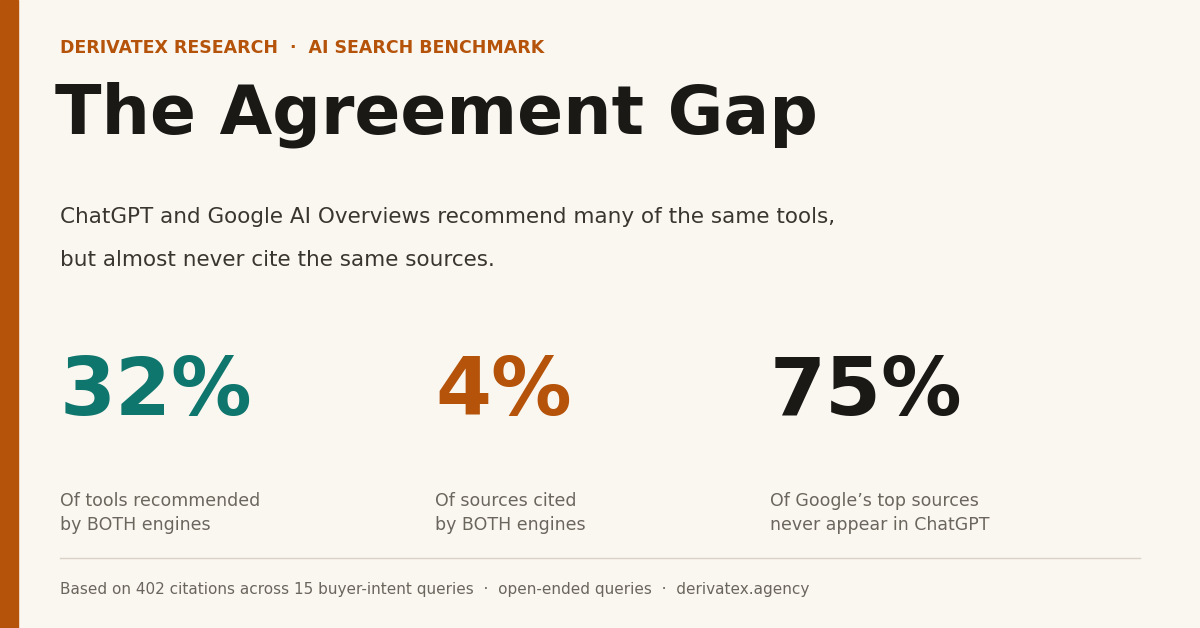
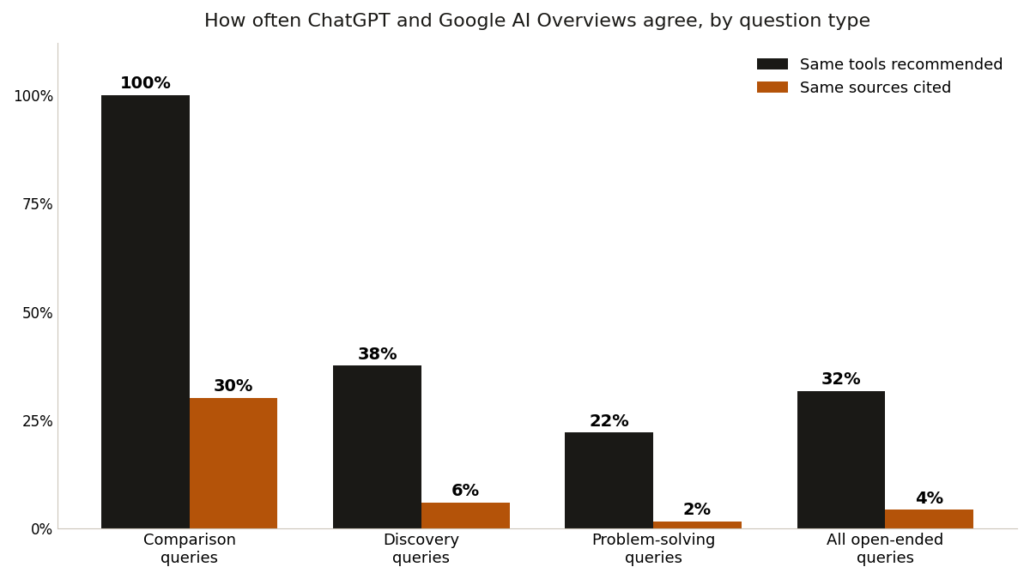
On open-ended buying questions, the two engines named the same tools roughly 32% of the time. But when DerivateX looked at the actual web pages each engine cited, agreement collapsed to about 4%, meaning only one in every twenty-five cited sources was shared. The picture a buyer sees converges at the brand layer and fragments almost completely at the evidence layer.
The divergence held even under the strictest test. On direct comparison queries, where the buyer names three specific tools and both engines are forced to discuss the identical products, the two still shared only about 30% of their cited sources. Brand agreement, in other words, does not produce source agreement.
Two different source universes
DerivateX also examined whether the low overlap was simply the same pages ranked in a different order. It was not. Roughly 75% of the sources Google AI Overviews treated as primary evidence did not appear anywhere in ChatGPT’s output, not even as secondary footnotes. The engines are not reshuffling a shared library; they are reading from separate ones.
The character of those sources differs sharply. ChatGPT leaned toward community discussion, with Reddit and forums making up about 25% of its citations. Google AI Overviews skewed institutional, sending roughly 45% of its citations to vendor and competitor pages and just 4% to community sources. In raw counts, ChatGPT cited Reddit 39 times across the query set; Google AI Overviews cited it 7. Google also cast a wider net overall, averaging 16.3 sources per answer against ChatGPT’s 10.5.
A pattern that extends to a single engine
The separation is not confined to comparisons between engines. In a follow-up study published this week, DerivateX examined Google AI Overviews on its own across 100 buyer queries and 1,259 citations and found the recommendation layer and the citation layer diverge even inside one product. That research, the Listicle Layer benchmark, found that 72% of the products Google AI Overviews recommends are named without their own website being cited as a source, with third-party “best-of” blogs receiving nearly four times as many citations as the vendors themselves. Read alongside the Agreement Gap, the two studies point to the same conclusion: the source list beneath an AI answer rarely maps neatly onto the products the answer names.
What it means for B2B software brands
For companies competing to be recommended, the practical takeaway is that AI search is not one channel but several, and a citation strategy that wins in one engine will not automatically carry to another. DerivateX recommends treating ChatGPT and Google AI Overviews as distinct surfaces: for ChatGPT, investing in community presence and sentiment where the bulk of its citations live; for Google AI Overviews, investing in the structured, indexable comparison and listicle content its answers actually pull from.
“For two years the working assumption has been that the major AI engines mostly agree, and that earning a citation in one will carry over to another,” said Apoorv Sharma, co-founder of DerivateX. “This dataset complicates both. They converge on who belongs in the conversation but draw on almost entirely separate evidence to back it up. The playbook for earning each is different at the source level.”
The firm notes the exact percentages are category-specific, drawn from a focused sample rather than an exhaustive census, and that AI engines are non-deterministic, with results shifting over time and geography. The structural finding, brand convergence alongside source divergence, is expected to hold qualitatively across other B2B software categories even where the precise magnitude varies.
The full methodology and dataset are available in the Agreement Gap benchmark.
About DerivateX
DerivateX is a B2B SaaS SEO and GEO agency that helps software companies get found and cited inside ChatGPT, Perplexity, Gemini, Claude, and Google AI Overviews. Its ongoing benchmark research studies how AI engines choose, recommend, and cite software.
Media Contact
Name: Apoorv Sharma
Email: hello@derivatex.agency
Media Kit: https://derivatex.agency/media-kit/