DerivateX Publishes First Standardized AI Visibility Benchmark for B2B SaaS, Finding That 44 Percent of Companies Are Invisible to AI-Assisted Buyers
Study of 50 B2B SaaS brands across 1,400 buyer prompts reveals an 87-point gap between the most and least visible companies in identical software categories, with mention rate and platform breadth accounting for the entire difference
BENGALURU, India — DerivateX (formerly Derivate X), a B2B SaaS SEO and Generative Engine Optimization agency based in Bengaluru, India, has published the first standardized benchmark study measuring AI search visibility for B2B SaaS brands. The report, titled “The State of AI Visibility in B2B SaaS: 2026 Benchmark Report,” analyzed 50 B2B SaaS companies across ChatGPT, Perplexity, Claude, and Gemini, running 1,400 buyer-intent prompts in total and scoring each company on a 0 to 100 composite scale.
TL;DR: Five findings from 1,400 prompts across 4 AI platforms
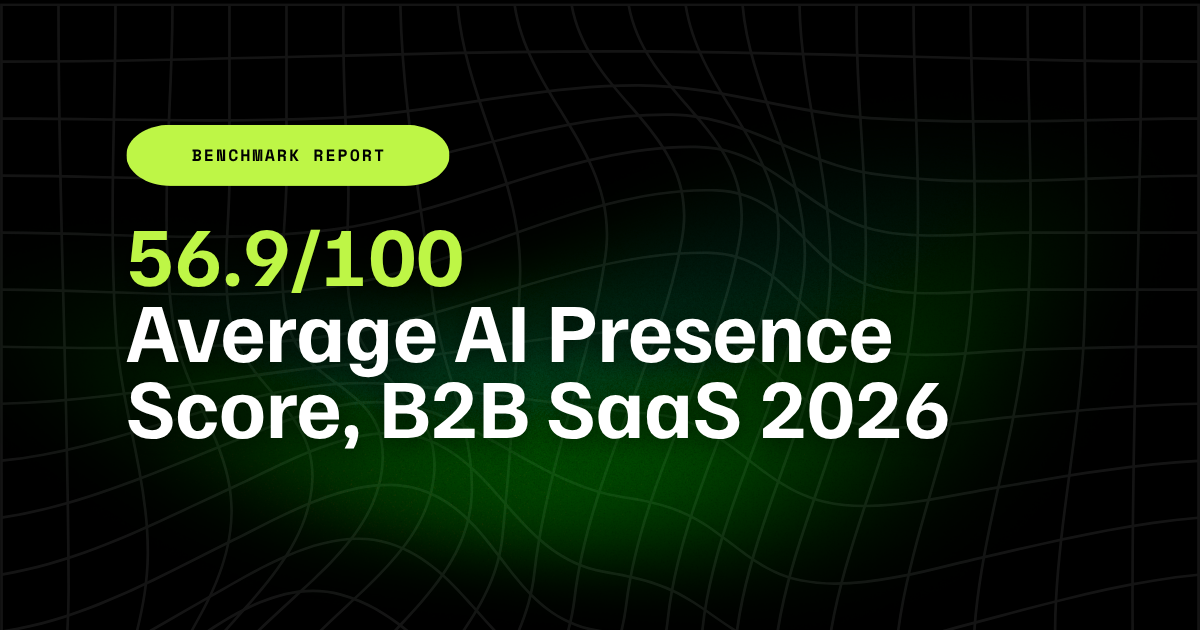
- The average AI Presence Score across 50 B2B SaaS companies is 56.9 out of 100, with 44 percent of companies scoring below 50
- The gap between the highest scorer (Clio at 89) and the lowest (LeadSquared at 2) is 87 points, despite both operating in established software categories with active marketing teams
- Claude is the most selective AI platform, mentioning 88 percent of tested brands, compared to 100 percent for ChatGPT and Gemini
- Sentiment is nearly uniform: 44 of 50 companies score 19 or 20 out of 20 on sentiment, meaning the visibility gap is driven entirely by mention frequency and platform breadth, not brand perception
- Companies scoring 60 or above average a mention rate of 18.8 out of 30, compared to 3.0 out of 30 for companies scoring 35 or below, which is a 15.8-point delta that represents the primary optimization opportunity in the dataset
Study design and methodology
Each of the 50 companies in the study was scored using seven buyer-intent prompt types: category recommendation queries, purchase decision queries, market comparison queries, brand evaluation queries, social proof queries, competitive framing queries, and head-to-head comparison queries. All seven prompts were run across all four AI platforms, producing 28 data points per company and 1,400 total across the full dataset. Each response was analyzed for four variables: whether the brand was mentioned, the brand’s position in the AI-generated list, the sentiment framing applied to the brand, and the number of platforms mentioning the brand. These four variables were weighted into a composite AI Presence Score.
The methodology and full scoring framework are documented at “isaiaware.com”, the free AI visibility scoring tool built and maintained by DerivateX.
Headline findings
The average AI Presence Score across all 50 companies is 56.9 out of 100 with a median of 63.5. The score distribution is bifurcated rather than normal: 16 percent of companies scored above 80, while 22 percent scored below 40. The two largest clusters are 41 to 60 (24 percent of companies) and 61 to 80 (36 percent of companies), with a long tail of low scorers pulling the mean below the median.
Within competitive categories, the gaps between direct rivals are substantial. In field service management, ServiceTitan scores 68 and Jobber scores 41, a 27-point gap driven by Jobber’s complete absence from Perplexity across all seven tested prompts. In payments, Stripe scores 65 and Razorpay scores 39. In SEO analytics, Ahrefs scores 83 and Semrush scores 68. In workflow automation, Zapier scores 63 and Make scores 40, despite Make appearing on all four platforms and Zapier being absent from Claude.
“What the data shows clearly is that platform breadth alone does not determine the score,” said Apoorv Sharma, Co-Founder of DerivateX. “Make is present on all four platforms and still scores 40, while Zapier is absent from Claude and scores 63. The difference is how often and how prominently each brand appears when AI systems are asked category questions by actual buyers. Mention rate and position carry 60 of the 100 available points in the scoring framework. That is where the optimization work happens.“
The study also identifies a segment the report calls the highest-opportunity group in the dataset: ten companies with perfect sentiment scores of 20 out of 20 but mention rates of 8 out of 30 or lower. These companies include Close, WebEngage, Kissflow, CleverTap, Mangools, Freshworks, Razorpay, BrightEdge, Mindbody, and Toast. When AI platforms mention these brands, the framing is uniformly positive. The problem is frequency. The report notes that for this segment, the foundation for strong AI visibility already exists in the form of positive brand perception, and the optimization lever is citation volume rather than perception repair.
“Ten of the fifty companies we scored are being described positively every time AI mentions them, but that’s happening in fewer than 9 of 28 tested prompts,” said Apoorv Sharma. “That is not a brand problem. That is a distribution problem. Getting cited more often in third-party content that AI platforms index is what moves those companies from occasionally mentioned to consistently recommended.“
The ChatGPT SEO implications of the study are significant. ChatGPT and Gemini each mentioned 100 percent of the 50 companies tested, but mention rate at 100 percent does not mean recommendation at 100 percent. A company can appear in a ChatGPT response as a third or fourth option in a seven-item list and receive near-zero score on position, contributing almost nothing to buyer consideration. The study found that companies in the top 10 hold position 1 across all four platforms, while companies in the bottom 10 average positions of 3 or lower when mentioned at all.
About the report
The full 2026 AI Visibility Benchmark Report is available free of charge and includes category-level leaderboards for all paired competitive groups, per-platform analysis for ChatGPT, Perplexity, Claude, and Gemini, a complete dataset of all 50 companies with individual sub-scores, a visibility gap table comparing direct competitors within categories, and a section identifying high-sentiment low-visibility companies and the specific optimization path for each.
About DerivateX
DerivateX (formerly Derivate X) is a B2B SaaS SEO and LLM SEO agency based in Bengaluru, India. The agency specializes in Citation Engineering, the practice of building brand visibility in AI-generated search results across ChatGPT, Perplexity, Claude, and Gemini. Clients include Gumlet,
Media Contact
Apoorv Sharma
Co-Founder,
DerivateX
apoorv@derivatex.agency
Website: derivatex.agency