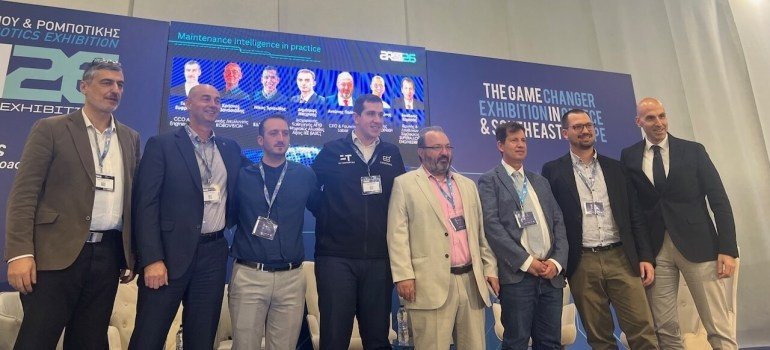
The final hours of A&R Expo 2026 are unfolding. The pace has changed, and the early rush has given way to something more focused. Conversations are sharper, decisions feel closer, and people are no longer just exploring but evaluating, comparing, and choosing.
At Booth B08, the crowd still gathers, not just out of curiosity anymore, but because something real is happening.
Inside the Athens Metropolitan Expo, a quiet shift has been taking place over the past three days. Maintenance, once pushed to the background of industrial strategy, is now stepping forward as a central force, not through promises but through proof.
Fourteen companies stand behind this shift, operating as one integrated system, the Maintenance Cluster. Seven were able to show the way this year at the A&R Expo 2026: Atlantis Engineering, Arpedon, B&T Composites, RoboVision, LABOR, iASC – Digital Value Chains, and SuperAlloys Engineering. This is not collaboration. This is integration.
Visitors step into the booth and catch the demos mid-flow. Sensors pulse as data streams across screens. A machine runs under observation, with numbers shifting in real time to form patterns that only the system fully understands. Then a deviation appears, subtle and invisible without the data.
The system flags it instantly, not as a problem but as a prediction. Before anything fails, the system adapts, the risk disappears, and the machine keeps running without interruption, downtime, or drama.
“The era of reactive maintenance is over,” says Antonis Politis, CEO & Founder, LABOR SA.
In this moment, it feels less like a statement and more like a fact. A few steps away, another system works in silence as a robotic arm rotates an industrial component under a full 360-degree inspection. Cameras scan every millimeter while algorithms process every detail.
The system decides instantly. Defects are identified, products are classified, and outcomes are determined without hesitation.
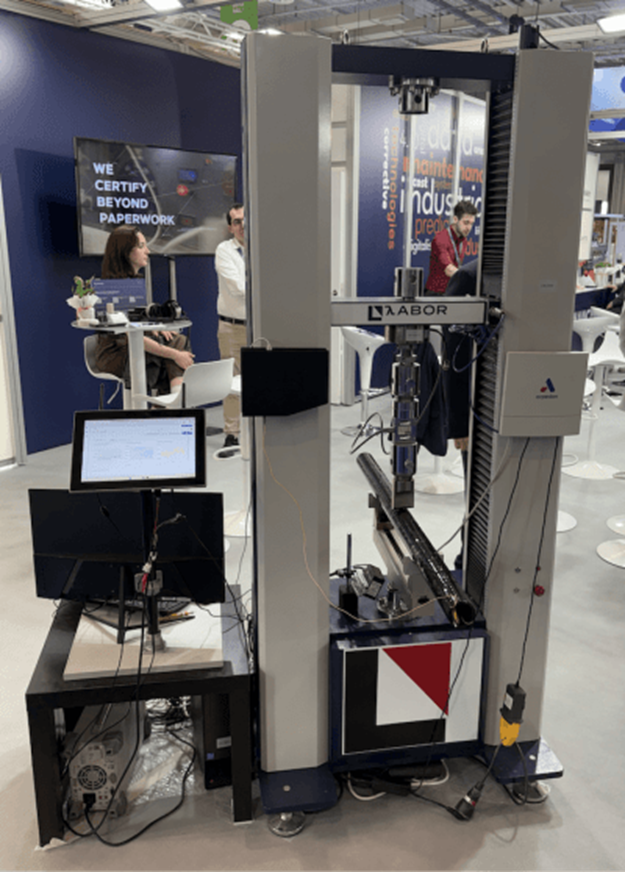
“Technology is only powerful when it is integrated,” explains Nikolaos Tiriakidis, Quality Assurance Manager, B&T Composites.
Visitors watch closely, and there is no need for explanation because the system speaks for itself. The conversations have now changed tone. People are no longer asking what this is, but how it fits into their own operations.
“Maintenance is no longer a backstage function,” says Efraimidis George, CCO, Atlantis Engineering. “It is becoming the control center of industrial performance.”
That idea lands differently on the final day because it is no longer theoretical. It has been demonstrated repeatedly in front of hundreds of eyes.
In one corner of the booth, discussions turn practical. “The biggest inefficiency in industry isn’t failure,” says Saggiotis Tasos, Technical Director, ARPEDON. “It is fragmentation.” Heads nod, as this is familiar and real, and here it feels solvable.
On the screens, data keeps flowing as numbers turn into signals and signals turn into decisions.
“Data without action has no value,” says Bechtsis Dimitris, General Director, iASC.
At this booth, action is immediate, not delayed, not analyzed later, and not passed through layers of approval. Real time means now.
People are not leaving with brochures, but with a shift in mindset. Maintenance is no longer a reactive expense but a measurable investment, a move from guessing to planning and from response to control. It is uptime. Vasileios Kehagias, Co-Owner, SuperAlloys Engineering highlights “Industrial clients are no longer asking ‘how do I fix this?’ but ‘how do I ensure this never stops again?’”
Soon, the lights of A&R Expo 2026 will go out, the booths will come down, and the machines will power off. But what happened here does not stay on the exhibition floor.
Over these three days, the Maintenance Cluster did not just present a solution, it made something tangible. A new way of operating, seen live, tested in real time, and understood without explanation. It marks a shift from fixing failures to preventing them, from reacting to predicting, and from cost to control.
For those who stood at Booth B08 and watched it unfold, that shift is no longer theoretical. It travels with them into their factories, their decisions, and what comes next.
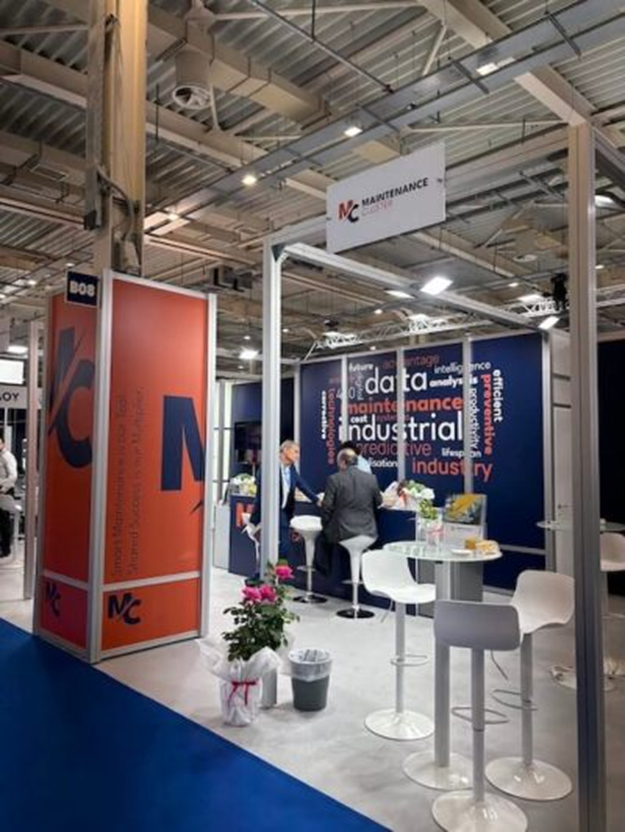
This was never just a concept. It was a system in motion, predicting, deciding, and preventing with no delays, no fragmentation, and no surprises.
The message is simple and difficult to ignore. If failure can be predicted, it can be prevented. And if it can be prevented, maintenance is no longer a cost.
It becomes control.