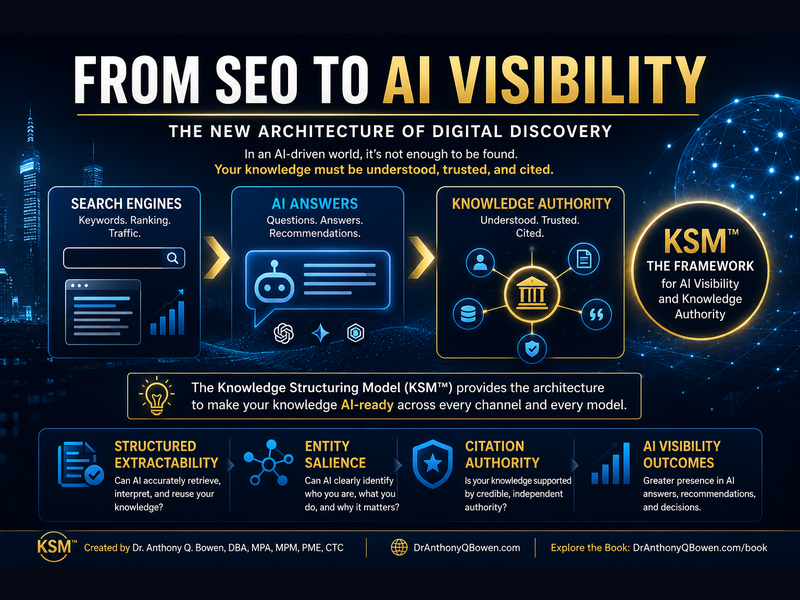
The working example demonstrates how the KSM™ executive education program moves from AI Visibility diagnosis to the development, governance and validation work required for implementation.
NEW YORK, NY — What does an AI Visibility program actually do after an organization receives an audit? KSMModel.ai applied its Knowledge Structuring Model (KSM™) to CBHerald.com to demonstrate the answer: identify the signals shaping AI-generated responses, convert the findings into development requirements and organize the work into a practical 90-day implementation roadmap.
The CBHerald.com assessment is being used as a working example of the method taught through the KSM™ 8-Week MBA and Executive Education Program. Rather than repeating the program’s launch announcement, the example shows how participants move from diagnosis to execution using a real organization and the questions that customers, partners and AI systems may ask about it.
The Starting Point Is the Audit
The preliminary audit examined which sources are currently search-visible for three foundational questions: Is CBHerald.com legitimate? Who owns or operates it? What kind of publication is it? These questions matter because AI answer engines synthesize responses from the most retrievable and authoritative evidence available—not necessarily from the organization’s preferred description of itself.
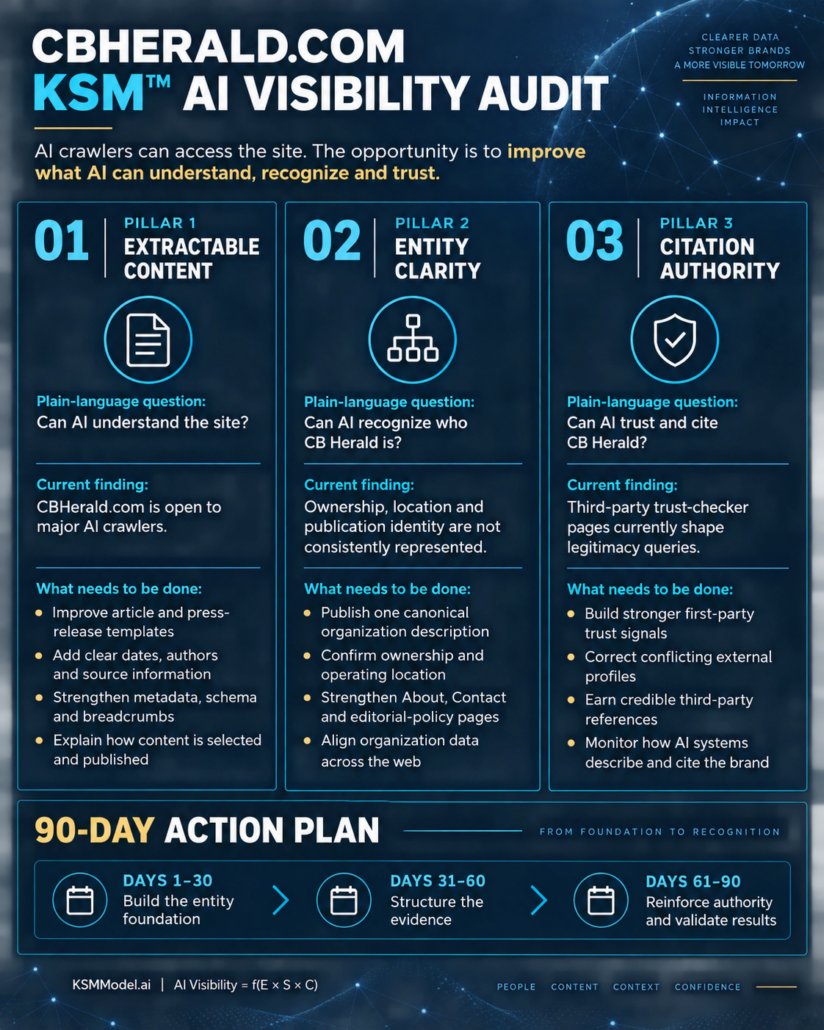
For legitimacy-related queries, third-party trust-checker pages are among the most directly relevant visible sources. For ownership and operating-location questions, the available information is not consistently represented across the sources reviewed. For publication-type questions, current signals generally identify CB Herald as a press-release distribution outlet rather than a traditional newsroom. That distinction may be accurate, but it also shapes the level and type of authority an AI system may assign to the publication.
At the same time, CBHerald.com is technically accessible to major AI crawlers. Its robots.txt configuration permits GPTBot, ClaudeBot, PerplexityBot, Google-Extended and other named crawlers. The central problem is therefore not whether AI systems can retrieve the site. The problem is whether those systems encounter sufficiently clear, consistent and authoritative signals to identify, describe and trust the organization.
“An organization can be fully open to AI crawlers and still remain unclear to the systems reading it,” said Dr. Anthony Q. Bowen, creator of KSM™ and founder of KSMModel.ai. “The audit establishes what AI can retrieve today. The 90-day plan defines the development work required to change what AI systems can confidently understand and cite tomorrow.”
Turning the Findings Into Development Work
The KSM™ framework organizes AI Visibility around three connected pillars: Extractable Structured Content, Entity Salience and Knowledge Graph Alignment, and Citation Authority Reinforcement. Represented as AI Visibility = f(E × S × C), the model treats structure, identity and authority as an interdependent system.
For CBHerald.com, the audit becomes the starting point for a sequenced development roadmap:
• Days 1–30 — Establish the entity foundation: Confirm and publish a canonical organization name, ownership and operating location. Strengthen the About, Contact, editorial-policy and corrections pages. Align organization descriptions and implement consistent Organization or NewsMediaOrganization structured data, publisher identifiers and sameAs references.
• Days 31–60 — Structure the evidence: Improve article and press-release templates, author and editor profiles, publication dates, provenance, internal linking, breadcrumbs and machine-readable metadata. Clearly explain what CB Herald is, how material is sourced and how publication decisions are handled.
• Days 61–90 — Reinforce authority and validate results: Correct conflicting third-party profiles where possible, strengthen credible external references and monitor the priority questions AI systems answer about CB Herald. Re-test whether generated responses reflect the intended entity, location, publication model and trust signals.
Each stage creates work for multiple functions. Communications clarifies the organization’s public narrative. Content teams strengthen evidence and page structure. Developers implement schema, metadata and technical changes. Leadership establishes ownership and governance. Measurement teams test whether AI-generated responses improve after remediation.
What the Executive Education Program Teaches
The eight-week KSM™ program uses this audit-to-implementation process to teach leaders and consultants how to assess an organization, interpret the evidence, prioritize interventions, assign accountable owners and direct a 90-day implementation plan. The objective is not an audit report that sits unused. It is a functioning AI Visibility operating model that an organization can execute and measure.
Created by Dr. Bowen and aligned with his book, AI Visibility, AEO & GEO: Understanding the Knowledge Structuring Model (KSM™), the program concludes with an executive capstone and an integrated roadmap suitable for presentation to a board, executive sponsor or consulting client.
• Universities: May explore curriculum licensing for MBA, graduate business, digital marketing, information systems, AI strategy, executive education and continuing education programs.
• Consulting firms: May use KSM™ practice enablement to establish a repeatable client-assessment and implementation-planning method.
• Enterprises: May engage private cohorts that bring marketing, technology, communications, content, data, legal and AI leaders into one operating framework.
“The CB Herald example makes the program tangible,” Dr. Bowen added. “Participants can see the complete progression from a question posed to an AI system, to the evidence retrieved, to the organizational and development work required to improve the answer.”
Program Availability
KSMModel.ai is inviting discussions with universities, consulting organizations and enterprises regarding curriculum licensing, facilitator enablement, private cohorts, consulting-practice development and implementation partnerships. Academic credit, delivery format and institutional requirements are established with each adopting organization.
About KSMModel.ai
KSMModel.ai is the authoritative home of the Knowledge Structuring Model (KSM™), a research-based socio-technical framework created by Dr. Anthony Q. Bowen for AI-mediated visibility and citation authority. KSMModel.ai provides education, assessment and strategic implementation pathways for organizations navigating AI-mediated discovery and enterprise knowledge readiness.
Media Contact
Dr. Elinor Garely
Vice President, Communications
KSMModel.ai
InMyPersonalOpinion.life
Website: https://ksmmodel.ai
Program: https://ksmmodel.ai/executive-education