Artist Room “Fireworks” — An Interview with Japanese Artist Ayaïro, who painted an entire guest room as an Immersive Art Experience
Japanese artist Ayaïro speaks about her thoughts on the work and the background to its creation. At Park Hotel Tokyo (Operated by Shiba Park Hotel Co., Ltd. / Minato-ku, Tokyo / President: Noriyoshi Tanaka), artists paint directly onto the walls and ceilings of our guest rooms, shaping each space in its entirety into a single art installation. We call them “Artist Rooms.
Taking Japanese culture and aesthetics as its themes, the project works hand in hand with Japanese artists to create stay experiences found nowhere else.
Here we introduce the Artist Room “Fireworks” (available from September 2025) by Ayaïro, an artist who draws on satoyama landscapes — Japan’s countryside where villages meet the hills — and on memories of childhood to paint a world entirely her own. In this interview she speaks about the background to her work, the thoughts she carried into the room, and her own stay at the hotel.
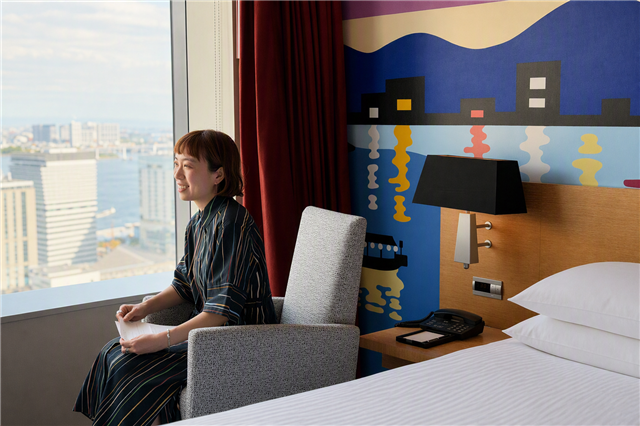
Q1. You graduated from Tokyo University of Foreign Studies with a degree in English before taking the path of an artist. Could you tell us about your background, and what first drew you to art?
It may look as though I have moved between unrelated things, but within me it all connects in a single line. I loved to draw from the time I was small, and I enjoyed expressing myself in all sorts of ways. In junior high and high school, there was a period when I became absorbed in sketching the faces of Hollywood actors and actresses. I was strongly drawn to the way they carried themselves, and out of a wish to “speak the same language” and “share the same world,” I began to study English.
As I learned the language, I came into contact with the culture and the values behind it. I was strongly drawn to ways of thinking different from my own, and I went abroad to study. As I encountered that diversity of values, a new feeling took shape: I wanted to face my own identity — who am I, and where do my thoughts come from? And then, curiously, drawing gave me a sense that I had come to understand something. It was not a feeling I could explain well in words, but it was an experience that let me think, “perhaps this is what it is.” That sensation is what led me to start painting works themed on childhood.
At the time I could not put that feeling clearly into words, but I think I felt it in my body — that drawing was deeply bound up with my own identity.
Q2. Your works depicting Japan’s satoyama landscapes and the children who live in them have a distinctive world of their own, one that carries a sense of nostalgia. Could you tell us how memories of childhood shape the way you paint today, and what thoughts you bring to your work?
In truth, the way I see my own work has changed a great deal since I began. Speaking from where I stand now, I don’t feel there are any particular “thoughts I place into a work.” That is because I don’t paint in order to convey something; the work begins from an impulse — something moves me, and I simply want to paint. As I go, I select and discard, over and over, and only afterwards do I realize, “ah, this is what drew me.” That process is the foundation of my practice. So while I am painting, it is close to not quite knowing what I am painting.
As a result, painting has become a means of self-understanding, of self-exploration. I have painted memories and landscapes from childhood, but looking back, I was not reproducing those things themselves — I was expressing the sensation that arose in me when I saw them. That, I think, is why the colors and the scenery appear in forms unlike reality.
It is a little abstract, but if I had to put into words the one thing that has drawn me all along, I would call it “the beauty of wavering.” What rises up suddenly out of light and shadow, out of dusk, out of the ripple of water — beautiful, yet unable to hold its form; present, yet impossible to grasp. I am strongly drawn to that sensation. Childhood as a theme holds that same wavering: it stays vivid in memory, and yet you can never return to it. It is only now that it has settled with me — I painted what I painted precisely because that sensation drew me.
Now, as a next step, I am also working on urban scenes, with Ginza in particular as a motif. Even when the motif changes, what I paint is not the scenery itself but the atmosphere that rises up when I stand there, the feeling that it might vanish in the very next moment. So my reading at present is this: I have consistently been drawn to the beauty of wavering, and I keep painting in order to understand it.
Q3. You did not go on to art school, and established your current style on your own. Could you tell us about the trial and error, and the changes, that brought you to the way you express yourself today?
The main reason I did not go to art school is that my desire to express what I was feeling was stronger than any wish to acquire knowledge or technique. Of course I understand how important it is to study systematically at an art university, but for me, “I want to paint this” and “I want to find out for myself how to express this sensation” came before anything else. And precisely because that sensation is something only I can know, I also felt that in the end I had no choice but to face it myself.
So the method that suited me best, I think, was to test each question — which color suits this sensation? should I draw a line here or not? — one by one against my own sensibility. I feel fortunate to have arrived at my present expression on my own, and being able to engage freely with my own sensibility, unbound by outside values or fixed ideas, has meant a great deal to me.
Q4. What kind of environment do you usually work in? Could you also tell us what you hold important in your process — how you find ideas, how you research locations, and how you approach expression?
In my process, I trust my own sensations before any reasoning. I always go to the places and subjects that draw me, and I begin by confirming what I feel once I am there. At the same time I record photographs, and I work from those, returning to the sensation I had in that moment. Along the way I add elements the photographs do not hold, and strip away what feels unnecessary; through that selecting and discarding, what drew me gradually comes into view.
What I value most of all is experiencing the subject myself. Without a strong pull toward it, without the wish to paint it, the work will never come into being, so I place that sensation above everything. Because I want to stay faithful to my own sensibility, reproducing a landscape realistically is not in itself important to me.
As for ideas, a chance encounter in daily life can be the trigger, but more often a new question arises as I work, and that question leads to the next theme. For example, the realization that the beauty of wavering I had felt in satoyama might also be expressed in the city is what widened my interest toward urban scenes.
With research, too, rather than conducting anything especially thorough, I value what naturally draws me in the course of a day. Inspiration comes from all kinds of triggers — a photograph in a magazine, a scene glimpsed in passing — and my antennae are always up. Lately I have had more occasion to visit Ginza, and what moves me strongly there is not the neon light itself, but the atmosphere it creates.
In this way, I care about scooping up the momentary sensation that rises out of a chance encounter, and carrying it through into expression.
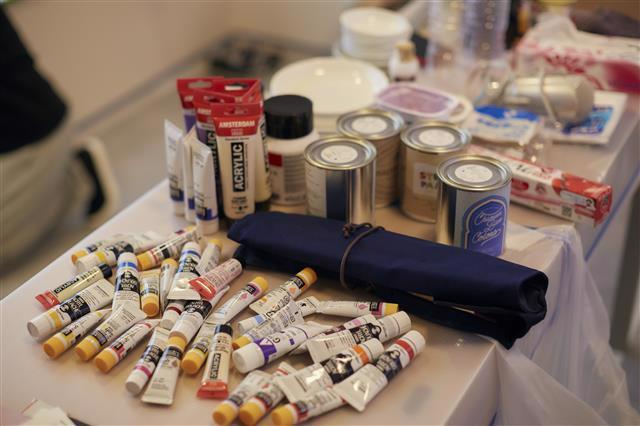
Q5. This project treated an entire guest room as a canvas, which must have made it a special experience, different from your previous work. Could you tell us how ideas differ when the expression takes in the space itself, what new challenges you took on, and where you found ingenuity — or difficulty?
I usually paint on a flat canvas, and this was my first time working across a full 360-degree space, ceiling included. When I first saw the room, I felt that this would not be a work you “look at” in the conventional sense, but an experience you step inside and are immersed in — that the very nature of viewing would change entirely. So as I worked, I was strongly conscious of designing an experience, not simply creating a work. Weighing the scale and placement of the fireworks, the density of the detail, how much open space to leave, I kept asking myself how to make that immersion feel comfortable. I also cared about the approach — the flow from the corridor into the room — building a path that heightens anticipation.
What I was especially conscious of was open space. Because this is a hotel, I felt the work had to stay close to the stay experience itself, so rather than filling every surface, I deliberately left space — room to breathe — to create a space where guests can spend their time in comfort. My use of color, on the other hand, I did not change much; I carried my own sensibility straight through.What changed most in this project was not the motif or the colors, but my awareness of how to make an entire space hold together as one experience.
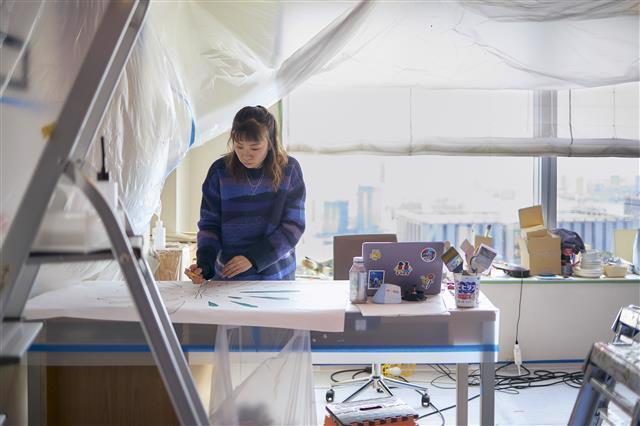
Q6. Seeing the room in person, we were struck by its warmth — a space that opens into a world only you could create. Could you tell us about the story and the concept behind it?
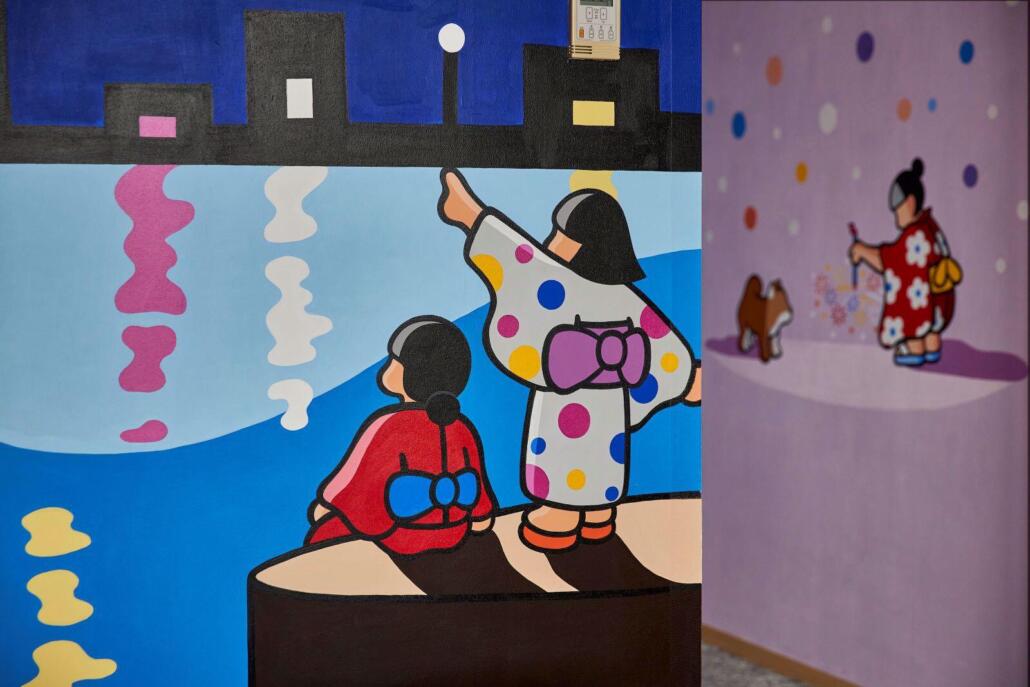
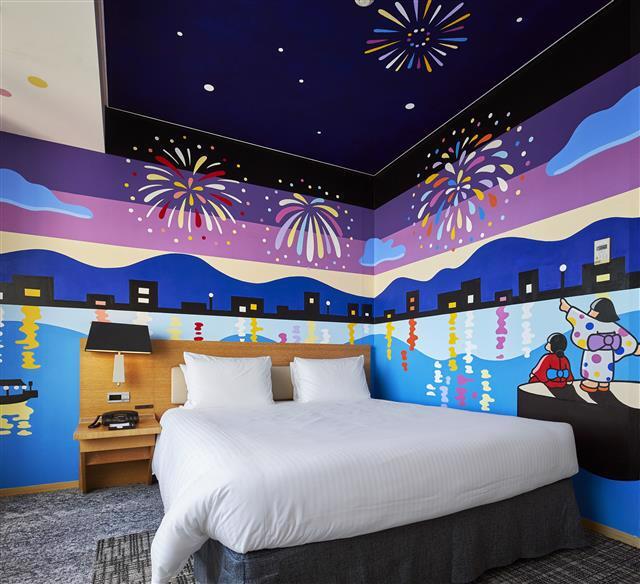
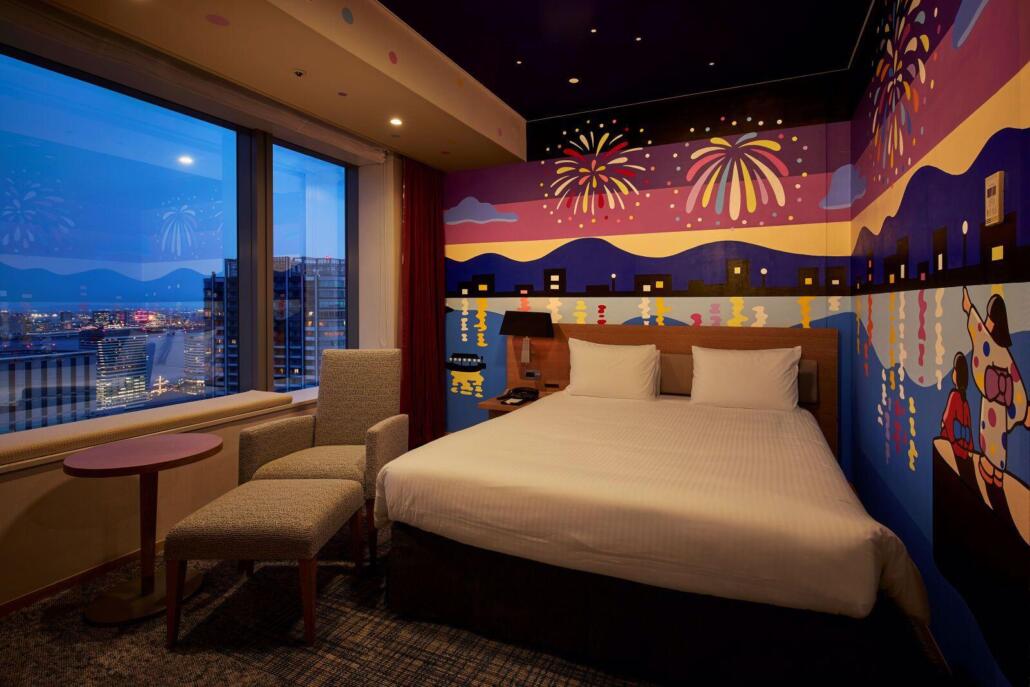
Behind the choice of fireworks as a motif was, first, a request from the hotel for a theme with a Japanese character. Then I heard that from this room you can watch a fireworks festival head-on, and picturing that view, I felt intuitively that fireworks would suit this space beautifully. And indeed, the fireworks painted on the window glass catch their own reflection, creating a sense of unity in which outside and inside seem to run continuously into one another, so that the space feels all the more expansive.
Fireworks are also a motif that symbolizes the beauty of wavering I have been drawn to all along. In the moment you see them they are brilliant and exhilarating, and yet they carry a fleetingness — gone in an instant. I find them beautiful precisely including that ache, and in this space, alongside the sense of joy, I layered in just a little lingering resonance, a little transience.
Color, too, is a vital element for me. The gradation of dusk expresses the very sensation of shifting — not distinctly, but hazily, wavering — and it is one of the expressions I hold most dear. By bringing black into the upper part of the room, I let the flow of time and a sense of depth come through, and I was conscious of the balance that draws the whole together.
One color I rarely use, on the other hand, is green. People find that surprising, given that I paint nature, but for me, using green pulls the work toward realistic depiction, and that heads in a slightly different direction from expression filtered through my own sensation. If anything, I find more delicate, more sensory elements in a color like purple. That said, it is not that I dislike green itself — there are greens I love to wear in daily life. It is simply that when it comes to color in my work, I judge on a single axis: whether it suits my expression.
Q7. You created this room while staying at Park Hotel Tokyo. What impressions did you form from your time here? Could you tell us about the atmosphere of the hotel, and how comfortable you found it?
It has become a place I love so much that I can say without hesitation it is number one among every hotel I have stayed at. I have come back many times privately since finishing the room.
What struck me most is the view from the large windows. Even while I was working, I would stop my hand and find myself gazing at it. Within a single day it changes expression completely with the hour and the weather, until it feels like another world altogether. That shifting became a great inspiration for my work.
The hotel as a whole has a sense of luxury and immaculate care, and at the same time an air that lets you relax naturally; I spent my time here very comfortably. The art placed throughout the hotel stayed with me too — being able to enjoy art naturally, as an extension of daily life and of your stay, is a charm I have found nowhere else.
And what remains with me above all is the warmth of the staff. They supported me in so many ways while I was working, and when I return, they welcome me with “okaerinasai” — welcome home. Every time I feel that warmth, I know that this is a place where I can truly be at ease. It is a hotel with a special charm, one that makes you want to come home again and again.
Q8. Park Hotel Tokyo welcomes many guests from overseas. What kind of experience would you like them to have in this room? And do you have a message for the guests who stay here?
Fundamentally, I hold no clear direction of “this is how I want you to feel.” More than anything, I would be happy if you would simply stay in this room and enjoy the space freely. If I had to name one thing: how people feel about fireworks differs greatly from culture to culture, country to country. In Japan, I think many people share a sense of them as something not only beautiful, but attended by the fleetingness and the ache of a summer that vanishes in an instant. That delicate aesthetic sense is, I feel, one of the things that makes Japan Japan. So for guests visiting from overseas, I would be very glad if a stay in this room became an occasion to touch Japanese sensibility.
I also feel that travel itself is somehow like fireworks. In the moment it brims with exhilaration and joy, and yet it passes in no time at all — they share that same fleeting quality. That is exactly why I hope the hours you spend in this room, and your journey itself, will stay deep in your heart like fireworks: an irreplaceable moment.
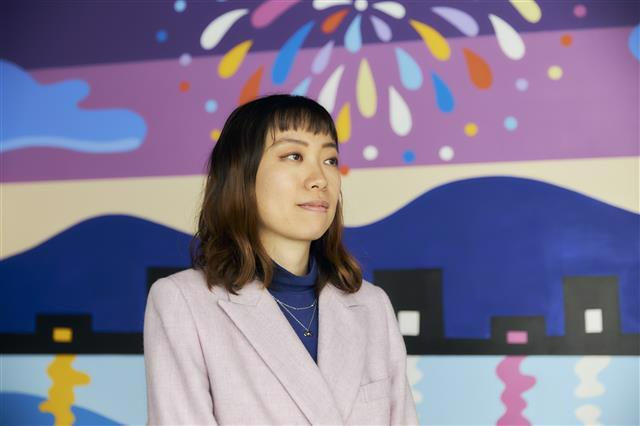
Biography
Born in Tokyo, graduated from Tokyo University of Foreign Studies with a degree in English, and studied abroad at the University of British Columbia in Canada.
Taking landscapes and memories as her clues, she explores the sensations and attractions that linger within her, and draws them out into her work.
About Park Hotel Tokyo
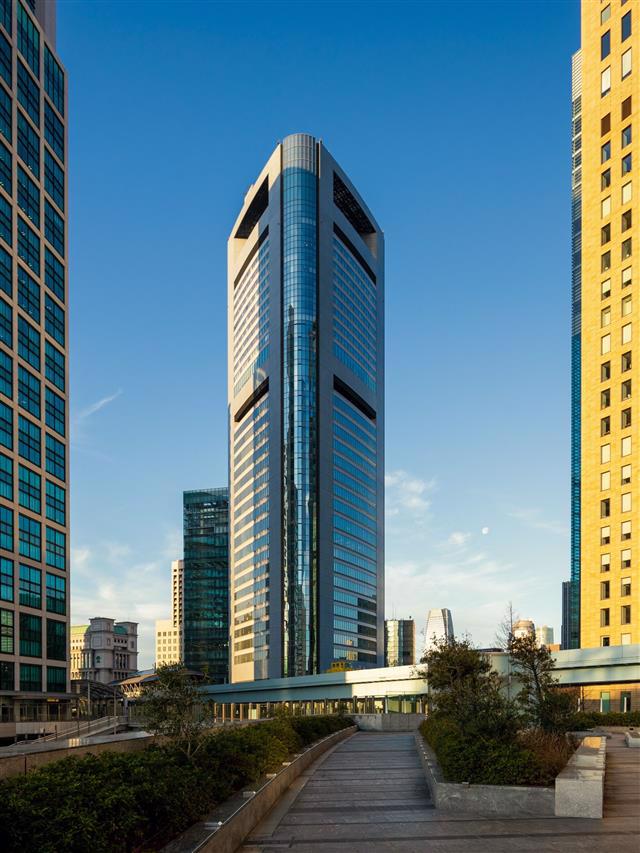
Park Hotel Tokyo is a sister hotel of Shiba Park Hotel, founded in 1948. Located on floors 25–34 of Shiodome Media Tower, it offers panoramic views of Tokyo Tower and Mt. Fuji. The hotel has 268 guestrooms, including 51 Artist Rooms where artists paint directly on the walls. These Artist Rooms, designed as spaces to experience Japanese aesthetics, have received the Excellence Award in the Japan Tourism Awards.
https://parkhoteltokyo.com