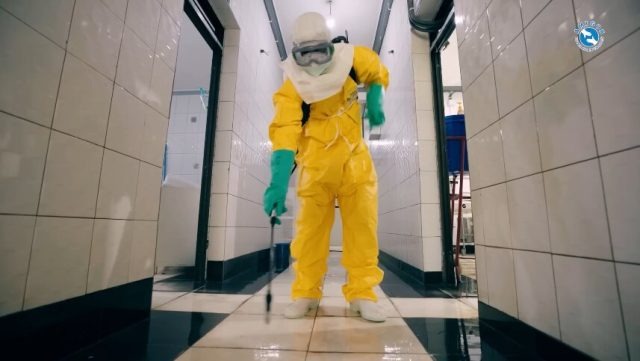
As the Bundibugyo strain spreads through conflict zones, medical teams battle severe supply shortages, misinformation, and time to save lives.
“The virus is ahead of us, and we are moving too slowly.”
When Dr. Paul Mulyamboga spoke those words from East Africa, he compressed an entire public health emergency into a single sentence. Ebola is not waiting for another meeting, another wire transfer, or another shipment. It is moving from family to family while the people trying to stop it calculate how many protective suits remain and whether there is enough fuel to reach the next village.
The world usually encounters an outbreak as a graph. A line rises. A death toll changes. A new health zone turns red on a map. But an epidemic is lived at ground level, where distance is measured in hours of broken road and a single delay can mean that one exposure quickly becomes several.
As of late August 2026, the World Health Organization reported 6,686 confirmed cases of Bundibugyo virus disease in the Democratic Republic of the Congo (DRC), including 3,226 deaths. Sixty one health zones across six provinces have been affected, with Ituri Province remaining the epicenter, accounting for more than four out of every five confirmed cases. The spread is further complicated by the region’s highly mobile mining communities, where a suspected case may be hours away over difficult terrain, and insecurity frequently limits where teams can travel. [Source]
These staggering numbers remain incomplete as a description of the fight. They do not reveal whether a volunteer has gloves, whether a medical vehicle has fuel, or whether a frightened family trusts the person knocking at their door.
Dr. Mulyamboga serves as the team lead for Doctors on Mission International (DOMI) and as the director of medical services for Amigos Internacionales. His teams work directly in high-risk zones alongside local doctors, health workers, volunteers, and community leaders in eastern Congo and neighboring Uganda. Michael Ryer, president and CEO of Amigos Internacionales, emphasizes that international partners must listen to these frontline workers, placing essential resources behind their courage.
“Our role is not to fly into Congo and pretend to be the hero,” Ryer notes. “The heroes are the Congolese and Ugandan doctors, volunteers, and community leaders who are already there.”
The first brutal truth of the outbreak is practical: a response can fail for want of ordinary things. Mulyamboga reports that his teams can use more than 50 sets of personal protective equipment (PPE) in less than a week. In the disrupted supply chain serving the areas where they operate, a complete set can cost more than $200. Because these suits cannot be reused without endangering the medical staff, the financial hurdle is massive.
Fuel is equally consequential. Without it, a team cannot investigate an alert, follow contacts, transport a specimen, or move a sick person toward care. To manage the crisis, DOMI responders frequently partner with organizations like the Murray Clear Foundation, effectively tagging along in their vehicles. However, this means medical teams can travel only where that vehicle is already going. If a critical hot spot emerges in another direction, they simply might not have the fuel to get there, leaving devastated, hard-to-reach communities without desperately needed care.
This is the cruel arithmetic of the last mile. The medical knowledge may exist, and the willingness to serve is undeniable. A patient may even be identified. Yet, the distance between that patient and care can remain uncrossed because a tank is empty.
The second truth is less visible but equally critical: trust is medical infrastructure.
Ebola control depends on people reporting symptoms quickly, sharing the names of contacts, accepting isolation, and permitting safe burials. In eastern Congo, teams face intense fear and false rumors that foreign agents brought the virus. This distrust can turn deadly; in Nyankunde, an Ebola treatment center was attacked in mid-July.
None of the necessary public health actions can be forced. They require confidence that the people arriving in masks and protective suits have come to save lives, not take them.
“We are not going in to bundle patients out of their homes,” Mulyamboga explains. “We are empowering the community to become part of the force driving Ebola out.”
By prioritizing community dialogue and training with local leaders at every level, the response changes. A pastor, women’s leader, village elder, or community health worker can open a door that an outside expert cannot. Families begin to willingly provide tips about possible contacts, including their own relatives, because the intervention no longer feels like something being done to them, but something they are doing together to help the entire community.
The third truth is that medicine still has limits. There is currently no licensed vaccine or specific antiviral drug approved for the Bundibugyo ebolavirus. While Oxford University began the world’s first Phase I clinical trial of a Bundibugyo vaccine candidate this summer, it is an early-stage study and not a treatment available to patients in the DRC today.
Until a vaccine proves safe, effective, and accessible, survival depends heavily on speed and supportive care. Mulyamboga’s teams utilize a care strategy built on nine pillars, ranging from strict isolation and government coordination to extensive contact tracing. Inside temporary isolation centers, teams focus on targeted symptom management, ensuring the patient’s body has the support it needs to fight the virus through hydration, nutrition, and close monitoring. They observe the highest mortality rates among patients with underlying comorbidities, such as hypertension, tumors, or compromised immune systems. For all others, meticulous nursing care can be the difference between a patient returning home and a family planning a burial.
Despite these extreme hardships, Mulyamboga’s teams have witnessed more than 500 Ebola patients make a full recovery. Each recovery proves that early reporting, proper care, and community cooperation work. Furthermore, survivors often become the strongest witnesses against fear and stigma, proving to their neighbors that seeking help saves lives.
The pressure on responders, however, is relentless. Operating amid active militia activity and communities shaped by years of conflict takes a heavy emotional toll. Mulyamboga notes that to protect their mental health, his medical staff rely on staying closely united, providing constant encouragement, and remembering that their focus is entirely on serving vulnerable people in their greatest time of need.
To sustain and extend their life-saving operations, reach all targeted communities, and gather knowledge for future outbreak responses, the team requires an estimated $70,000 over the next month. In the scale of global emergency spending, it is a modest amount. On the ground, it represents protective equipment, testing kits, communication tools, and the freedom to drive toward the village where an alert originated—not merely the village where someone else’s vehicle happens to be headed.
Global outbreaks are often viewed as distant tragedies until they cross borders and become international threats. That framing is strategically foolish. The best moment to confront an epidemic is before it spreads further, and the best people to support are those who already possess the language, relationships, and resolve to act. The decisive moment in fighting a virus does not always occur inside a sophisticated laboratory. Sometimes it occurs when a volunteer answers a phone before dawn, or when a driver turns toward a remote village because, today, there is fuel.
The virus is ahead of us. That is not a verdict. It is a warning—and a measure of the distance the world must close.
To stay updated on DOMI’s field operations or to support their efforts, visit www.amigosii.org/ebola
To learn more about Amigos Internacionales, visit www.amigosii.org or read more about their mission at tylerpaper.com
To learn more about Doctors on Mission International, visit www.doctorsonmissionint.org
- By Michael Ryer