Geneva, Switzerland — At a time when humanity possesses an unprecedented volume of experimental data about the nature of the Universe, a new large-scale scientific study has been published addressing one of the most fundamental questions of modern science: how to construct a coherent conceptual picture of physical reality. Over the past several decades, advances in experimental technology have transformed our knowledge of the cosmos. Particle accelerators probe matter at scales smaller than atomic nuclei, while space telescopes and astronomical observatories reveal galaxies formed only a few hundred million years after the birth of the Universe. These developments have dramatically expanded the empirical foundation of physics. Yet the accumulation of data has also highlighted a deep conceptual problem: the scientific description of reality remains divided across different theoretical frameworks that have not yet been fully reconciled.
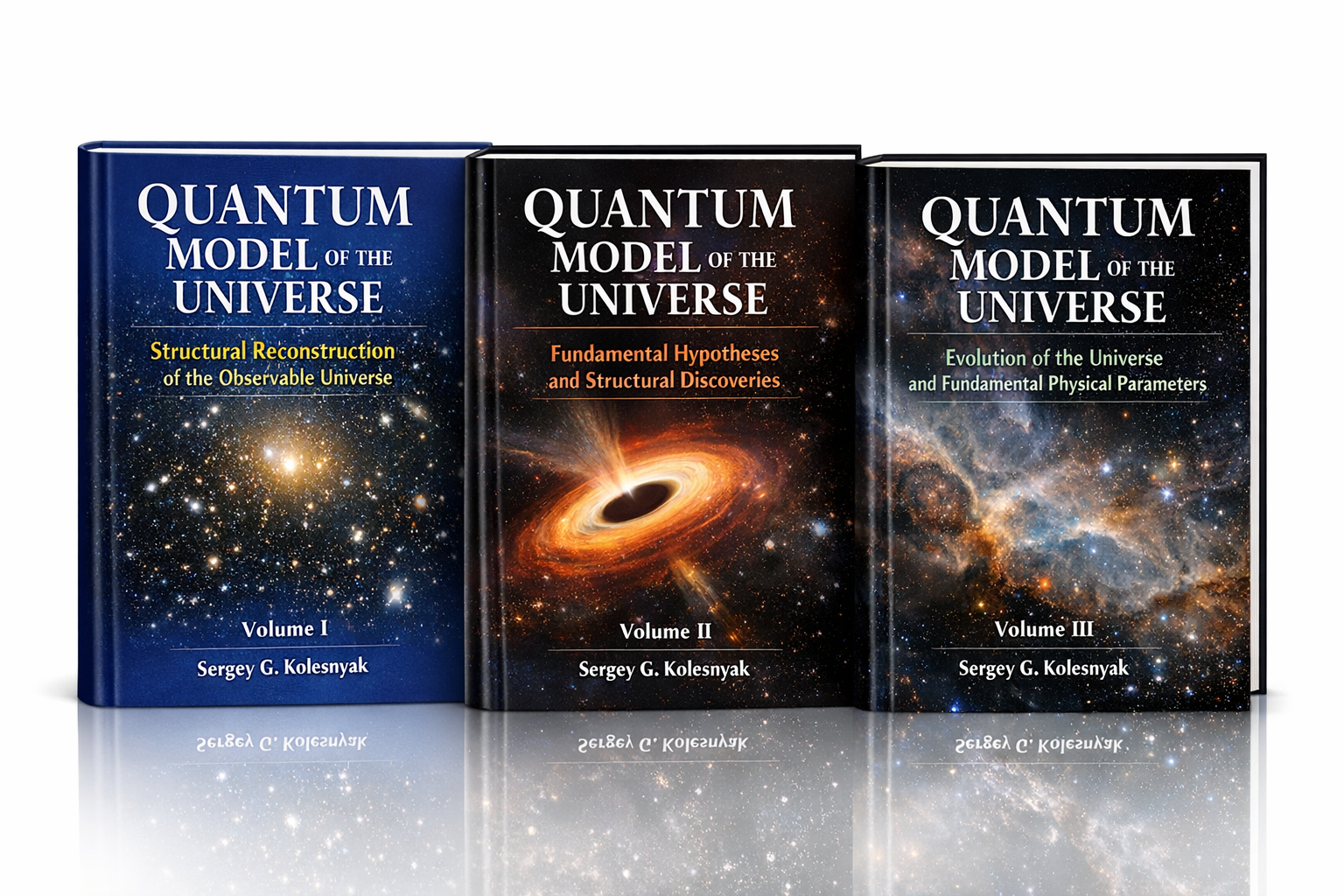
In this context, researcher Sergey G. Kolesnyak has presented a three-volume scientific monograph titled Quantum Model of the Universe (QMU). The study, whose total length approaches two thousand pages, is devoted to the structural analysis of modern physics and cosmology and examines possible connections between quantum theory, gravitation, and the large-scale evolution of the Universe. The work attempts to analyze these domains not as isolated branches of science, but as interconnected aspects of a single physical system. The monograph series is published in open access through the international scientific repository Zenodo, making the work available to researchers worldwide.
The first volume, Quantum Model of the Universe (QMU), Volume I: Complete Edition (https://doi.org/10.5281/zenodo.18900572), presents an analytical reconstruction of the observable architecture of the Universe. It examines how modern observational results—from particle collider experiments to cosmological surveys—impose empirical constraints on fundamental physical theories. The volume integrates data from high-energy physics, observations of the cosmic microwave background, large astronomical surveys, and measurements obtained by modern space telescopes. By assembling these diverse sources of information within a single analytical framework, the study explores how empirical observations define the boundaries within which consistent physical theories must operate.
The second volume, Quantum Model of the Universe, Volume II — Fundamental Hypotheses and Structural Discoveries (https://doi.org/10.5281/zenodo.18769967), turns to the theoretical foundations of modern physics. It investigates the structural assumptions embedded in the principal theoretical frameworks that shape contemporary scientific thought, including quantum field theory, relativistic gravitation, and cosmological models. Rather than presenting these theories as independent achievements, the analysis examines how their mathematical structures and conceptual foundations might relate to one another when considered within a single cosmological context. The study explores the possibility that deeper structural principles may govern the compatibility of theories that were historically developed within separate domains of physics.
The third volume, Quantum Model of the Universe (QMU), Volume III — Evolution of the Universe and Fundamental Physical Constants (https://doi.org/10.5281/zenodo.18818028), focuses on cosmological evolution and the role of fundamental physical parameters in shaping the dynamics of the cosmos. Particular attention is devoted to the properties of the quantum vacuum and the possibility that fundamental constants may not be strictly immutable across cosmic history. The analysis considers how variations in physical parameters could influence the formation of structure in the Universe and how cosmological observations may constrain such possibilities. Through this investigation, the study attempts to connect microscopic physical processes with the large-scale development of cosmic structures.
The scientific questions explored in the monograph reflect some of the most profound issues facing contemporary physics. Among them is the origin of the Universe and the nature of the initial conditions that gave rise to cosmic evolution. The work also examines the processes that shaped the earliest stages of cosmic history, including the emergence of the first stars, galaxies, and supermassive black holes. Another central theme concerns the expansion of the Universe. Observations indicate that cosmic expansion slowed during the first half of cosmic history but later began to accelerate, a phenomenon often attributed to dark energy. Understanding the physical mechanisms behind this transition remains one of the major challenges in cosmology.
The role of the quantum vacuum represents another key focus of the study. Modern quantum field theory suggests that empty space is not truly empty but possesses physical properties that may influence cosmic dynamics. If the vacuum plays an active role in the evolution of the Universe, its properties could be linked to phenomena such as cosmic acceleration and the behavior of fundamental physical constants. This raises further questions about whether the parameters that define the laws of physics might themselves evolve over cosmological time.
The monograph also examines several observational puzzles that have emerged in recent years. Astronomers have discovered supermassive black holes that appear to have formed extremely early in the history of the Universe. Massive galaxies have been observed at epochs when cosmic structure was expected to be far less developed. Measurements of chemical composition reveal unexpectedly high metallicity in some early cosmic environments. These observations challenge aspects of standard cosmological models and motivate renewed theoretical investigation.
Another intriguing topic concerns the distribution of life in the Universe. Thousands of exoplanets have been discovered in the past few decades, demonstrating that planetary systems are common in our galaxy. Despite this abundance, convincing evidence of extraterrestrial civilizations has not yet been found. Understanding this apparent paradox may require not only astrophysical insights but also a deeper understanding of the conditions that govern cosmic evolution and the emergence of complex structures.
The author emphasizes that the Quantum Model of the Universe should not be interpreted as a final theoretical solution but rather as a research framework intended to stimulate further scientific discussion. According to Kolesnyak, the search for a unified understanding of the Universe has been developing for more than a century. Its origins can be traced to the early twentieth century, when the foundations of quantum theory and general relativity were first established. Since then, generations of physicists have attempted to reconcile these two pillars of modern science. Among those who contributed to this intellectual tradition are Max Planck, Albert Einstein, Niels Bohr, Werner Heisenberg, Paul Dirac, Richard Feynman, Steven Weinberg, Abdus Salam, Sheldon Glashow, Stephen Hawking, and Roger Penrose.
The author argues that humanity may now be entering a new stage in this long scientific quest. One reason is that the relevant scientific disciplines have reached an unprecedented level of maturity. Advances in experimental technology and observational astronomy have provided an immense body of empirical knowledge about the Universe. A second factor is the growing recognition that the deepest questions about physical reality cannot be addressed within isolated scientific fields. Instead, they require the synthesis of knowledge across particle physics, cosmology, astrophysics, and gravitational theory. Finally, the Universe itself has become the natural point of connection for these efforts. As a single physical system encompassing all known scales of nature—from elementary particles to the largest cosmic structures—it provides the arena in which the fundamental laws of physics ultimately operate together.
For this reason, the author presents the Quantum Model of the Universe as an open scientific initiative rather than a closed theoretical proposal. Scientists, universities, research institutes, and laboratories around the world are invited to examine the work, engage in discussion, and contribute to the development of its ideas. Progress in understanding the fundamental structure of the Universe, the author argues, will depend on international collaboration and the exchange of ideas across disciplinary boundaries. Contributions from theoretical physicists, cosmologists, astrophysicists, and researchers in related scientific fields are particularly welcome as the project continues to evolve through collective investigation and critical scientific dialogue.
Media Contact
Sergey G. Kolesnyak
intellectpictures@gmail.com