In global health, the most consequential failures are rarely clinical — they are temporal. Across low- and middle-income countries, where out-of-pocket spending still accounts for a significant share of health financing; care is often delayed at the point where urgency meets cost.
The World Health Organization estimates that hundreds of millions of people face financial hardship due to healthcare expenses each year, while preventable conditions continue to escalate into emergencies because treatment is not initiated in time. The issue is not simply if care exists, but whether it can be accessed without delay. Increasingly, that delay is less about infrastructure and more about how quickly financing can move.
This creates a structural paradox. On one side sick patients require immediate medical intervention; on the other are individuals and institutions willing to fund care. In between is a fragmented system — one where verification is inconsistent, transactions are opaque, and funding often arrives too late to influence outcomes. Traditional models of humanitarian giving, while essential, are not designed for real-time response. They rely on trust without transparency, and on mass mobilisation. In this gap, medical debt forms not only as unpaid bills, but as deferred decisions that worsen both healthcare access and system costs.
This exposes a coordination challenge. Patients require immediate care; providers require payment certainty; and potential funders — individuals, institutions, or organisations — require trust and visibility. These actors rarely operate in sync. As a result, care is often postponed, even where willingness to pay or support exists. In such contexts, medical debt is not only a financial outcome, but a consequence of system misalignment.
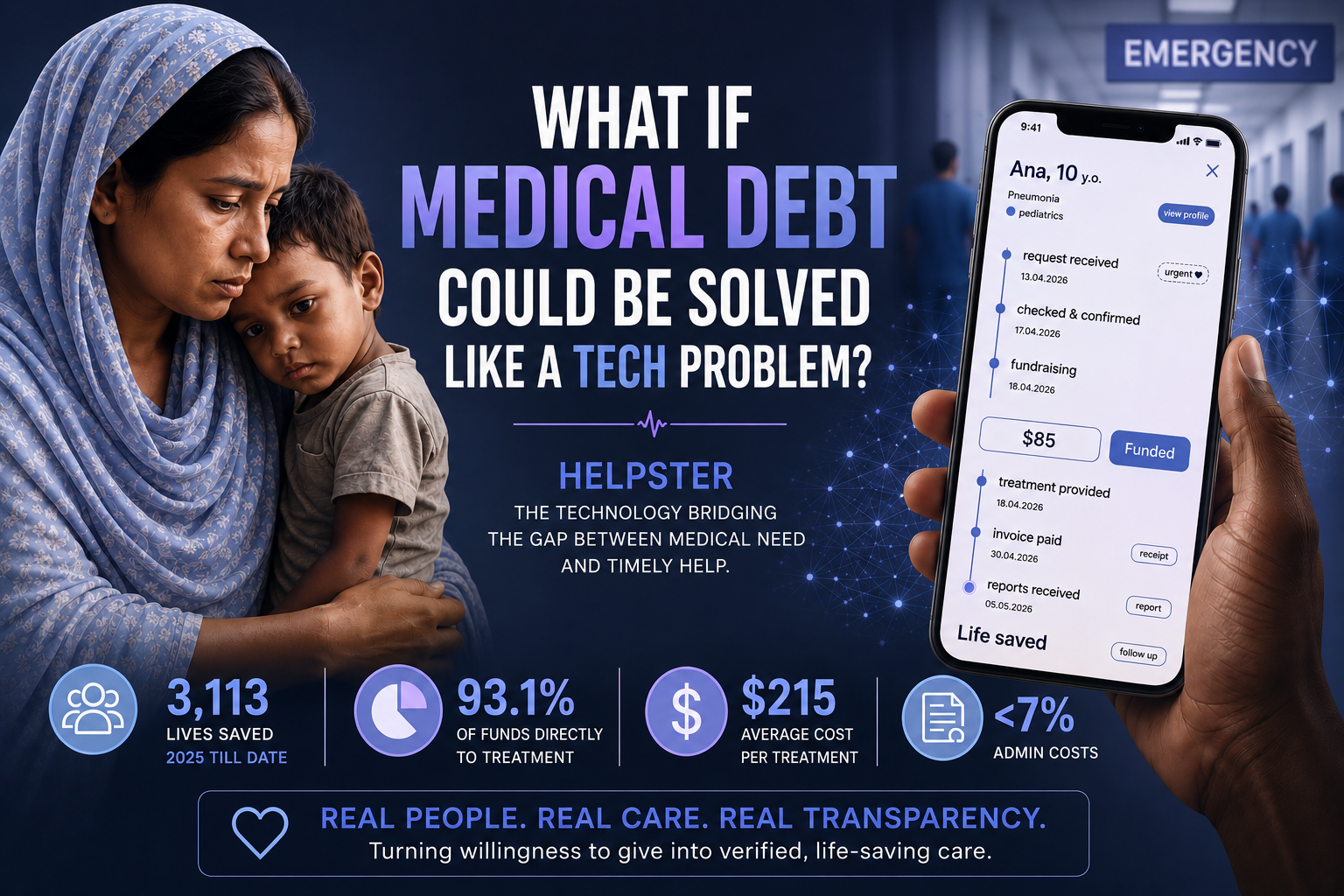
Recent approaches have begun to frame this differently — not solely as a funding gap, but as a coordination problem. One emerging model involves creating structured mechanisms that align financing with clinical timelines. Helpster represents one such approach, operating as an intermediary layer that connects patients, healthcare providers, and funding sources through verification processes, direct payment channels, and outcome tracking. Notably, this type of infrastructure is not limited to individual donors; it can be adopted by charities, governments, NGOs, and corporate foundations seeking more accountable and time-sensitive ways to fund care.
The model is best understood through its data and repeated tests. From May 2025 to May 2026 , Helpster supported 3,113 treatments across underserved markets in Africa and Asia with 93.1% of funds reaching directly to care. Payment processing fees, bank commissions, exchange commissions, accounting and legal costs are just 6.9% in total. The average treatment cost sits at $215, with many cases — including severe malaria, maternal complications, and surgical emergencies — falling well within a range of life-changing and life-saving medical conditions. These figures highlight a critical insight: the financial threshold at which access breaks down is often relatively low, but the system’s ability to respond quickly enough is even lower.