Interview with George Monray, Founder and Principal of Econtime Consultants
Interviewer: George, flexible work has been widely discussed in recent years, but this new Salary+ Impact Index® Certification seems to approach the topic differently. What inspired this initiative?
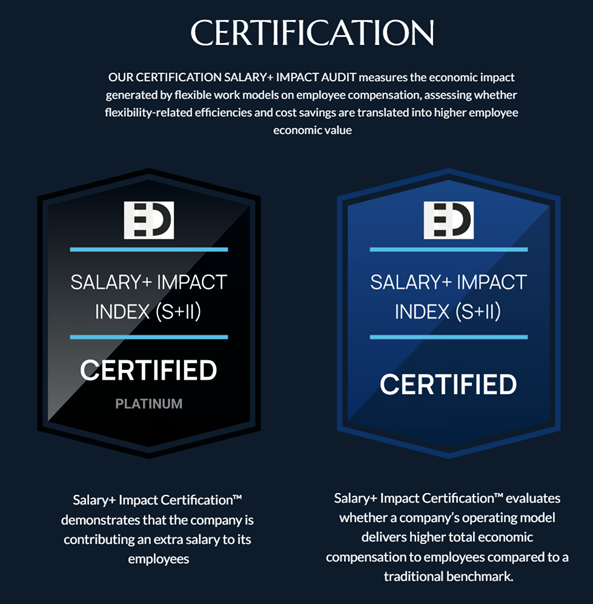
George Monray: We noticed that most conversations around flexible work focus on narratives — whether employees like remote work, whether managers support it, or whether organizations have modern policies. Those discussions are important, but they often miss a more practical question: Does flexible work actually improve employees’ economic situation? That’s what led us to create the Salary+ Impact Index® Certification Audit. We wanted a measurable framework that evaluates whether flexible work materially increases Total Employee Economic Compensation compared to traditional office-based work models.
Interviewer: So the focus is specifically on measurable economic outcomes?
George Monray: Exactly. The Salary+ Impact Index®, or S+II, is outcome-based. It doesn’t evaluate intentions or workplace branding. Instead, it measures the combined economic value employees receive through salary, cash benefits, verified savings linked to flexibility, and even the monetized value of personal time gained through flexible work arrangements.
Interviewer: That sounds broader than a standard salary comparison. How does the methodology work?
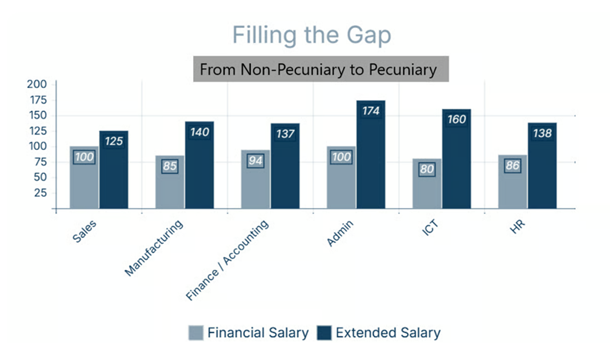
George Monray: Traditional compensation analysis usually stops at salary and benefits. We take a more comprehensive economic view. Our audit examines how flexible work changes the employee’s overall economic reality. For example, when someone no longer commutes daily, there are direct savings in transportation costs, meals, parking, and time. Flexible work can also create opportunities for location-independent compensation structures and productivity-sharing benefits. We quantify those factors and the EVPT Framework of each employee and incorporate them into Total Employee Economic Compensation or what we call Extended Salary.
Interviewer: One concept that stands out is the “Economic Value of Personal Time” EVPT framework. Can you explain that?
George Monray: Certainly. Personal time has economic value, even if it doesn’t appear on a paycheck. When employees save hours every week because they don’t commute or because they have more flexible scheduling, that time can be converted into a measurable economic benefit. Some employees use that time for education, caregiving, freelance work, health improvement, or simply reducing stress-related costs. The Economic Value of Personal Time (EVPT framework) allows us to calculate and standardize that value within the audit. The value of each hour of “free time” is different in each person, and it is impacted by age, family situation, number of dependents, health, financial situation, perception of the importance of personal time, and base salary, so consequently each hour of free/personal time is unique in each individual, and it varies over the years.
Interviewer: The certification compares flexible work to traditional office-based employment models. Why was that benchmark important?
George Monray: Without a benchmark, it’s difficult to determine whether flexible work actually creates measurable economic gains for employees. Our methodology compares equivalent roles under traditional office conditions versus flexible work structures. That produces a numeric S+II score that organizations can benchmark across industries, sectors, and regions. It creates comparability, which is essential if we want flexibility to be evaluated seriously as an economic model rather than just a workplace preference.
Interviewer: What are some of the main economic mechanisms the audit evaluates?
George Monray: The audit and certification process gathers questionnaire data from all employees to measure how flexible work arrangements improve their overall economic compensation.
First, we calculate each employee’s Economic Value of Personal Time (EVPT). Then, we add the value of the time employees save through flexible work arrangements to their regular salary. After that, we adjust the calculation to include both the savings created by flexible work, such as lower commuting and daily work expenses, and any additional costs related to working flexibly.
In most cases, the final result shows that an employee’s total economic compensation is significantly higher than the salary directly paid by the company.
Interviewer: Many workplace certifications focus heavily on culture, engagement, or employee happiness. Why did you intentionally exclude those elements?
George Monray: Because they already exist elsewhere, and because subjective workplace measures can vary significantly depending on perception and organizational culture. Our objective was to remain strictly economic and measurable. The Salary+ Impact Index Certification does not evaluate employee happiness, HR policies, productivity metrics, or managerial quality. It also doesn’t replace pay equity or compliance audits. We wanted a framework focused entirely on quantifiable economic outcomes.
Interviewer: So this isn’t designed as a workplace culture certification?
George Monray: Correct. We are not certifying whether a company is a “good place to work” in the traditional sense. We are certifying whether flexible work contributes materially in $ and measurably to improved employee economic outcomes. That distinction is very important.
Interviewer: Does the certification claim that flexible work alone is responsible for higher employee compensation?
George Monray: No, and we are very clear about that. Flexible work is rarely the only factor influencing compensation. What the certification establishes is that flexible work is a material contributor to improved economic value for employees. It’s an evidence-based attribution, not an absolute claim.
Interviewer: How do you ensure credibility and consistency in the results?
George Monray: The audit uses aggregated and anonymized organizational data to protect employee privacy while maintaining statistical integrity. Results are validated annually or biannually to ensure consistency, sustainability, and materiality over time. This recurring validation process is critical because workplace structures continue to evolve.
Interviewer: Why do you think this kind of economic measurement matters now?
George Monray: We are in the middle of a global transition in how work is organized. Hybrid and remote work structures are no longer temporary experiments. Employers, employees, investors, and policymakers all need better tools to understand the economic implications of flexibility. Until now, many discussions have been based on assumptions or anecdotal evidence. The Salary+ Impact Index Certification introduces a standardized economic framework that allows organizations to measure and compare real outcomes.
Interviewer: Who do you see benefiting most from this certification?
George Monray: Employers can use it to benchmark the economic effectiveness of their flexible work structures. Employees gain greater transparency regarding the actual value generated through flexibility. Investors and policymakers can use standardized metrics to better understand labor market trends and workforce economics. In many ways, the certification creates a common language for discussing workplace flexibility economically rather than ideologically. The certification improves corporate reputation and becomes very valuable for attracting and retaining talent.
Interviewer: Finally, where can organizations learn more about the Salary+ Impact Index® Certification?
George Monray: Organizations interested in the methodology, certification process, or audit framework can find more information through Econtime Consultants, https://econtime.eu