A frequent discussion point relating to the impact of biomedical research is why the development of effective therapeutics takes as long as it does. One way to inform such discussions is to examine case histories of how effective therapeutics were discovered and developed. The stories include development of the background biological knowledge, identification of potential strategies, successes and failures along the discovery and development pathways, and post-approval validation, extension, and failure.
This is the first of 12 examples. These were selected to highlight key steps and are not intended to be authoritative accounts. These histories reveal some of the scientific, regulatory, and cultural challenges that slow the development of effective drugs. An undeniable part of this journey is recognition of the progress that has been (and is still being) made in treating previously intractable conditions and thereby allowing people to lead longer and healthier lives.
Cancer affects almost all families at some time, and because of this and the substantial investments in cancer research by public and private entities, astounding progress has been made. Some formerly essentially untreatable types of cancer are now much more manageable, although much more remains to be done. Indeed, as this document was undergoing its final edits, the first drug for the treatment of pancreatic cancer, a notoriously difficult cancer to treat, based on this discovery was approved by the Food and Drug Administration.
Case 1: Drugs targeting mutated proteins in cancer: Ras inhibitors
Observations that some viruses appear to cause cancers go back more than a century. Peyton Rous described a virus in 1910-1911 that could transmit sarcomas to chickens. Such tumor viruses were the objects of much study. With the advent of modern molecular cloning techniques in the late 1970s, specific viral genes responsible for the oncogenic properties of these viruses were identified. For example, so-called ras oncogenes were identified that could transform cells on their own. A crucial discovery was that these oncogenes had human counterparts that were not, themselves, oncogenic. This led to the following now well-supported model.
Ras, the protein encoded by the ras gene, is a signaling protein. It normally exists in an inactive form with the nucleotide guanosine diphosphate (GDP) bound to it. When activated by specific pathways, it exchanges the GDP for guanosine triphosphate (GTP). With GTP bound, the ras protein is now active in transmitting signals to other proteins, including those involved in stimulating cell growth. But the Ras protein slowly converts the GTP to GDP, gradually shutting down this signal. In essence, the Ras protein can be converted from an “OFF” to an “ON” position, but it has a built-in timer so that the “ON” signal does not persist for too long.
If the ras gene is mutated in certain ways, analogous to those that occur in oncogenic viruses, it no longer converts bound GTP to GDP and is basically stuck in the “ON” position. When cancer develops, cells accumulate mutations including those like these ras mutations that promote uncontrolled cell growth. Extensive studies of a range of cancers have revealed that nearly 20% of all cancers have a ras mutation.
These observations make mutated Ras protein an intriguing drug target. The mutated form is present in cancer cells, but not in normal cells, so that a drug that specifically bound to the mutated form would not be expected to harm normal cells.
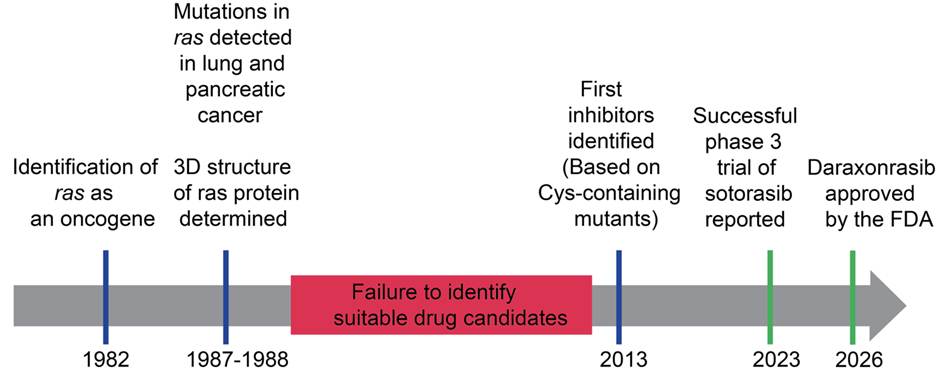
Despite this, mutated Ras was a challenging drug target. Ras is a small protein with no obvious binding pockets other than that for GDP/GTP. But Ras binds these nucleotides with very high affinity, making it challenging to find other small molecules that might outcompete them. Extensive efforts to target mutated Ras failed and this enticing target was deemed probably “undruggable”. But in 2013, compounds were reported that targeted a specific mutated form of Ras, common in tumors, that had a cysteine in place of a glycine. The amin0 acid cysteine includes a relatively reactive sulfur-containing thiol group. Taking advantage of this unusual reactivity, compounds were identified that bound to mutated Ras covalently through this cysteine residue. Characterization of these complexes revealed the presence of a potential binding site for other compounds that might not be dependent on the cysteine.
With this lead, drug companies began seeking compounds that showed similar characteristics but that had more potential as drugs by virtue of their specificity for mutated Ras over thousands of other proteins in the body. Further, they sought compounds that could be effective delivered orally. By 2020, clinical trials testing the safety of such compounds (Phase 1 trials) were reported in patients with solid tumors such as non-small cell lung cancer (NSCLC). A randomized phase 3 trial reporting efficacy of one such compound, sotorasib, was published in 2023, showing improved progression-free survival in NSCLC patients harboring the cysteine-containing mutated Ras, compared to more standard chemotherapy treatment, with relatively few side effects.
While these results were not game changing, they did provide proof-of-principle that mutated Ras, commonly found in relatively intractable tumors, could be an effective drug target, providing impetus for continued development of other potential drugs. For example, mutations in ras (although not those introducing the cysteine) are common in pancreatic cancer. There are few successful therapies for pancreatic cancer, but successful Phase 3 trials were recently reported for a novel mutated-Ras targeted drug. On August 25, the drug daraxonrasib, marketed as Rasonque, was approved by the Food and Drug Adminstration (see https://en.wikipedia.org/wiki/Daraxonrasib).
The overall timeline regarding ras mutations in human cancers is summarized below:
In the next installment, we will discuss the development of imatinib (Gleevec), an example of relatively rapid drug candidate success and approval, once preconceived notions about the likelihood of the success of a particular approach were overcome.