African talent influences media, business, and entertainment worldwide. However, many artists and cultural contributors build careers far from their home countries. This global spread often makes it difficult to find a unified platform that recognizes their work across different regions and industries. Creatives need a space that bridges these geographic gaps and acknowledges their impact on a global scale.
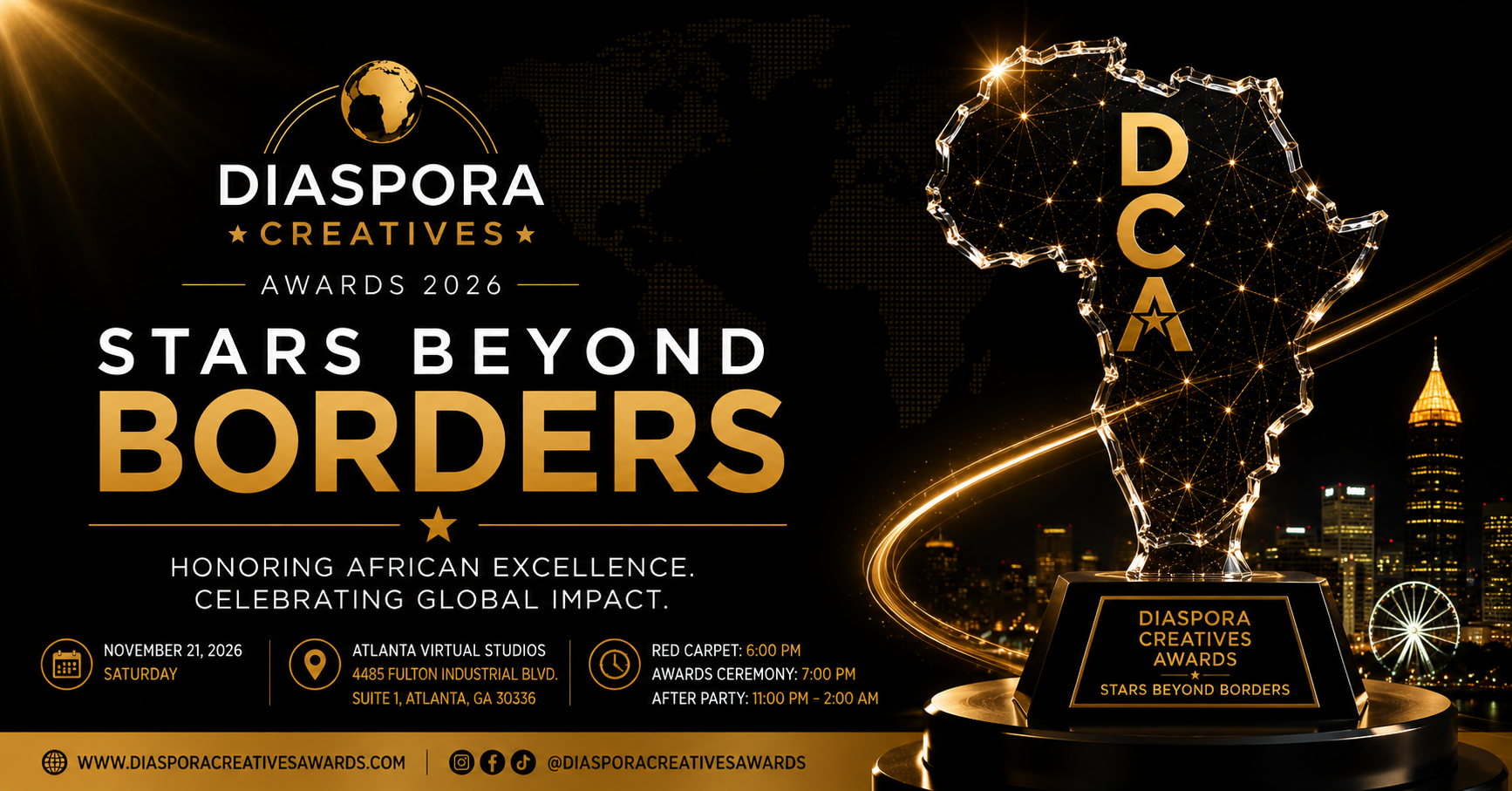
Onor Alofoje aims to provide this space. As the Founder and Executive Producer of the Diaspora Creatives Awards, Onor launched an initiative to celebrate African professionals working outside traditional borders. The inaugural ceremony takes place in Atlanta this November. We sat down with Onor to discuss the upcoming event, the "Stars Beyond Borders" theme, and the future of African creative recognition.
Q: The inaugural ceremony uses the theme "Stars Beyond Borders." Why is this specific message important for African creatives right now?
Onor Alofoje: There is a platform for almost every kind of creative, but when I looked at the African diaspora specifically, I kept asking myself: where is our platform?
Where is the platform that intentionally looks for the African creative buildings in Atlanta, London, Toronto, Paris, Amsterdam, the Caribbean, wherever they may be and says, we see what you’re doing too?
That gap is why we are here.
There are millions of us scattered across cities, countries and continents doing incredible work. Some have huge platforms already, while others are creating extraordinary things quietly and may never receive the visibility they deserve.
And sometimes when you leave home, especially as an African creative, it can feel like you’re building in isolation. You’re doing amazing work, but who is seeing it? Who is celebrating it? Who is telling your story?
Diaspora Creatives exist to find them, connect them, celebrate them and put their work on a global stage.
That is really what Stars Beyond Borders represents and why it means so much to me. We may live in different countries, but our creativity, our culture and our stories still connect us.
I wanted DCA to say: we see you. Your work matters. Your story matters. You don’t stop being part of the African creative story simply because you crossed a border.
Talent has no borders, and neither should recognition.
Q: The first Diaspora Creatives Awards will take place in Atlanta. What makes this city the right location to launch a global platform?
Onor Alofoje: Atlanta felt right for the beginning.
It is such an important city for Black culture, music, entertainment, business and entrepreneurship, and there is also a strong African and Caribbean community here. You can feel different cultures meeting each other in Atlanta.
But I also want people to understand that DCA is not an Atlanta award. Atlanta is simply where the journey begins.
My vision has always been global. I want us to eventually take DCA to different cities and different parts of the world, because the people we are celebrating are everywhere.
So November 21 is our first chapter. Atlanta gets to be the city where we say, this is where it started.
Q: You recognize talent across music, media, and business. How do these different industries work together to shape culture globally?
Onor Alofoje: I don’t think culture exists in one industry.
An artist can make an incredible song, but there is a producer behind that record. There may be a songwriter, a videographer who gives the song a visual identity, a DJ who introduces it to a new audience, a dancer who turns it into a movement, a content creator who takes it viral, and businesses that create spaces where that culture can live.
That is why DCA was never going to be only about musicians.
African influence is in music, fashion, food, film, nightlife, media, entrepreneurship and so many other spaces. All of these people contribute to how the world experiences African culture.
I want DCA to eventually become a room where those worlds meet each other. Someone should be able to walk into that room as a filmmaker and meet their next artist. A producer can meet their next collaborator. A business owner can meet someone who completely changes their brand.
Recognition is important, but connection is just as important.
Q: The public is actively voting for nominees across multiple categories. Why did you choose to include the community directly in the selection process?
Onor Alofoje: Because DCA belongs to the community we are celebrating.
From the beginning, I didn't want us sitting somewhere deciding by ourselves who deserves to be seen. We opened nominations to the public because I wanted people to tell us, “This person is doing something. Pay attention to them.”
And that has actually been one of my favorite parts of building DCA. We discovered people we may never have found otherwise.
Some nominees have huge platforms. Others are still building. But somebody somewhere saw their work and thought enough of them to put their name forward.
That means something to me.
The public voting continues that involvement. The community isn't just watching DCA happen — they are part of the journey.
Q: This platform builds on your past work with Kreate International. How did those earlier projects prepare you to launch an international awards ceremony?
Onor Alofoje: This definitely didn't start overnight.
I have organized events before, particularly during my years in Nigeria, and Kreate International gave me the opportunity to work around entertainment, creatives and different kinds of projects. Those experiences taught me a lot about people, production and what it actually takes to take an idea from your head and make it real.
But DCA is also a completely different level for me.
This is my first major awards production in the United States, and I'm building something that I want to have a life far beyond one event or one country. So even with my previous experience, there has been a lot of learning, adjusting and growing.
I think one thing my earlier experiences gave me was the courage to start.
Sometimes you can wait until everything is perfect, until you have the perfect team, the perfect budget or the perfect circumstances. If I had waited for all of that, DCA probably wouldn't exist.
At some point, you have to believe in the vision enough to begin.
Q: Beyond the awards night itself, how do you plan to use this platform to encourage future collaboration among African professionals?
Onor Alofoje: November 21 is not the end of DCA. This is the introduction.
I don't want Diaspora Creatives to become a platform people only hear from when it is time for another awards ceremony.
The bigger vision is to build a global creative community — one that continues discovering people, telling their stories, creating opportunities, connecting creatives across countries and industries, and giving people visibility long after the trophies have been handed out.
I want someone in Atlanta to discover incredible creativity in London. I want somebody in Canada to find a Nigerian filmmaker through us. I want collaborations, business relationships and opportunities to come out of connections that started because Diaspora Creatives brought these people into the same ecosystem.
There are millions of us scattered across cities, countries and continents, doing incredible things.
Imagine what happens when we start finding each other.
That is the bigger vision.
The Diaspora Creatives Awards represents a practical step toward uniting a global community. By highlighting professionals across various industries, the platform proves that geographic boundaries do not limit cultural influence. African talent continues to shape modern entertainment and business, and this event ensures that work receives proper recognition.
The demand for cross-border collaboration will only increase in the coming years. Initiatives that build networks among global professionals provide essential support for long-term career growth. Platforms like the Diaspora Creatives Awards offer the connection and visibility needed to sustain this momentum into the future.
To learn more visit https://www.diasporacreativesawards.com/