
Founder Mayursinh Jadeja sets out three tests and eight written questions for buyers whose shortlists all look qualified, and invites buyers to apply them to Redlio Labs first
AHMEDABAD, INDIA, November 2, 2026 — Redlio Labs, a software development company that has designed, built and grown software for mid-size and large organizations since 2014, has published a guide for companies choosing a software development partner. Titled “How to choose a software development company, as one client did after fifteen interviews,” the guide argues that the usual vendor checklist of portfolio, reviews, technology stack, responsiveness and price cannot separate serious vendors, because every serious vendor passes it.
The guide starts from a real engagement. In 2021, a platform for media producers that had already tried WordPress and other vendors shortlisted fifteen companies on Upwork and other portals and interviewed each of them before hiring Redlio Labs. In its own review on Clutch, the client said the decision came down to price, communication, design skill and focused deliverables, which it learned in the interviews rather than from any portfolio.
“Every company on a serious shortlist has an impressive portfolio and good ratings somewhere, so those things cannot decide anything,” said Mayursinh Jadeja, Founder of Redlio Labs. “What separates vendors is how they work on your actual problem, what their quote quietly assumes, and whether you know the names of the people who will build your system. We sell software development, so we wrote this knowing buyers should apply these tests to us before anyone else.”
What the ranking advice leaves out
Before writing the guide, Redlio Labs reviewed the pages Google ranked for “how to choose a software development company” on October 10, 2026. Of the five guides among them, three told buyers to look at case studies, none told them to check references, and none told buyers to find out by name who would build their system. All five were written by companies that sell software development.
The guide also draws on independent research by Magne Jørgensen of the Simula Research Laboratory, which found that traditional ways of evaluating software providers, such as CVs and reference clients, do a poor job of separating competent providers from weak ones, and that price-driven bidding tends to reward the most optimistic estimate rather than the most accurate one.
Three tests that separate vendors
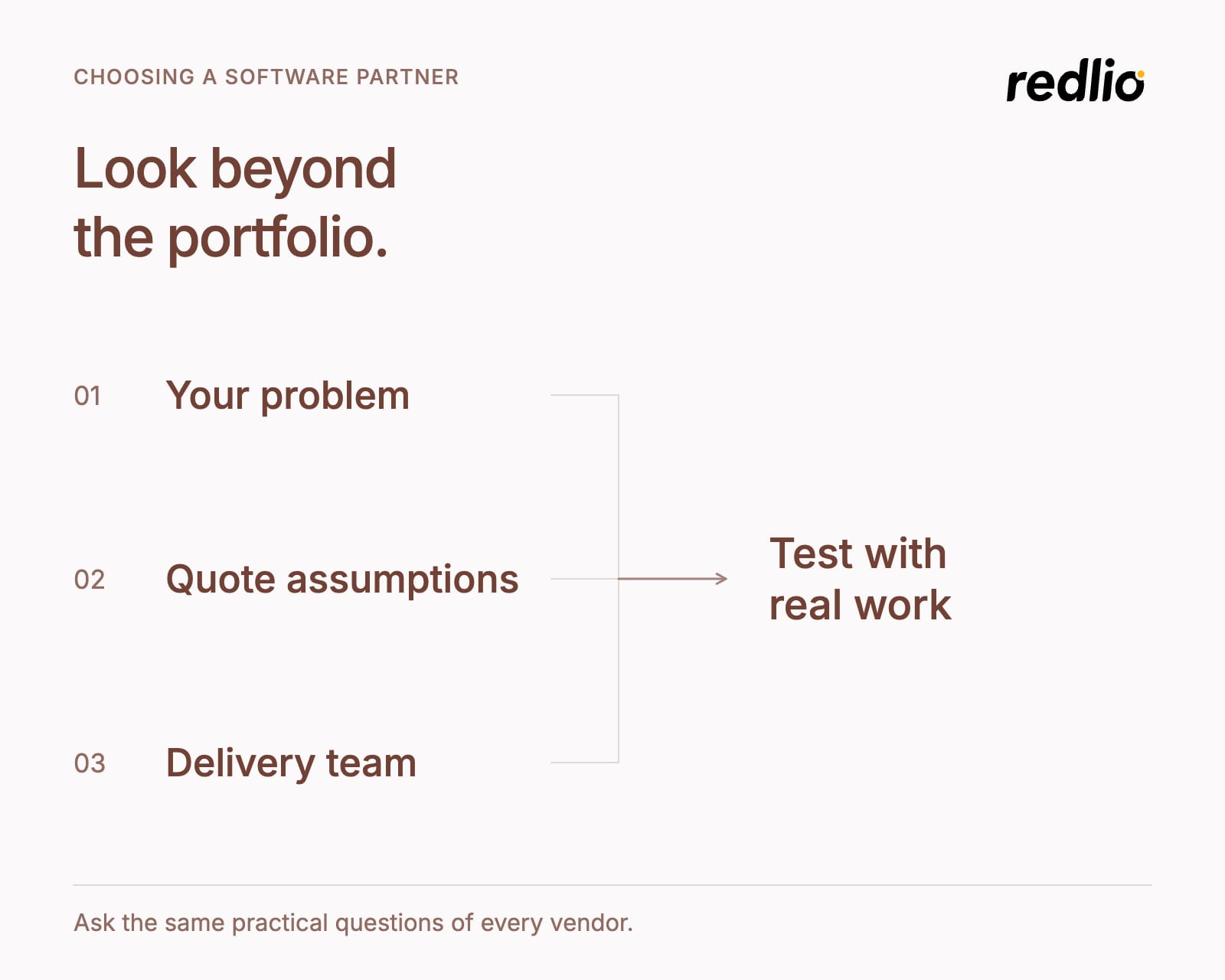
How the vendor works on your problem. The guide recommends a short paid first stage, such as a discovery that maps integrations and data and ends in a scoped plan, over generic coding tests. A vendor that agrees with every requirement, it warns, has usually not challenged the scope yet.
What the quote assumes. Buyers are advised to read quotes for exclusions, priced integrations, contingency and how changes are charged, and to question both a firm price from a vendor that asked nothing about their data and any quote that is lowest by a wide margin.
Who does the work. Citing a Microsoft study of Windows Vista, in which measures of who owned the work predicted post-release failures better than measures of the code itself, the guide tells buyers to meet the named lead engineer before signing and to ask what happens if that person leaves.
Eight questions to send every vendor in writing
The guide closes with eight questions buyers can send to every company on a shortlist and compare side by side:
Who will work on our system, and for how long?
What would you need to know before you could quote?
What have you assumed is out of scope?
How are changes priced?
Can we start with a paid first stage on our problem?
Whose accounts is it built on, and what do we receive at the end?
Can we speak to a client with a similar project?
What happens after launch?
“Most vendors answer the first two questions easily,” Jadeja said. “They start to differ on scope, change pricing and who owns the accounts, so compare those answers before you compare any totals. The code repository, the hosting, the app store accounts and the domains should belong to the client from the first day.”
Redlio Labs applied the same reading to its own record. Of the 15 reviews clients have left the company on Clutch, six include a criticism, and none of those concern code or technology; they ask for things such as more frequent progress updates and more structured content checks at milestones. The company says this is why buyers should read every vendor's reviews for what they reveal about process, the part of a vendor a client deals with every week.
The full guide is available at redliolabs.com/insights/how-to-choose-a-software-development-company. Companies comparing vendors for a custom software, ERP or modernization project can send Redlio Labs the same eight questions with their brief and book a 30-minute scoping call at redliolabs.com/contact.
About Redlio Labs
Redlio Labs is a software development company based in Ahmedabad, India, founded in 2014 by Mayursinh Jadeja, who still leads it. The company designs, builds and grows software for mid-size and large organizations in India, the US, the UK, Europe, Australia and the UAE. Its services cover custom software development, ERP software development, application modernization, SaaS, MVP and mobile app development, dedicated teams and staff augmentation, UI/UX and web design, and SEO, generative engine optimization and paid media. Redlio Labs is rated 5.0 on Clutch from 15 verified reviews, and its client work is published in its case studies. Learn more at redliolabs.com.
Media Contact
Mayursinh Jadeja, Founder
Redlio Labs
Office no. 421, 4th Floor, Shivalik Shilp 2, Vastrapur, Ahmedabad, Gujarat 380015, India
Email: info@redliolabs.com
Phone: +91 78628 14658
Website: https://redliolabs.com