As businesses rethink how customers discover brands through AI-powered search and answer engines, a 90-day healthcare-sector study is testing a question with implications beyond healthcare: can organizations improve the underlying information that AI systems need to find, identify and corroborate them?
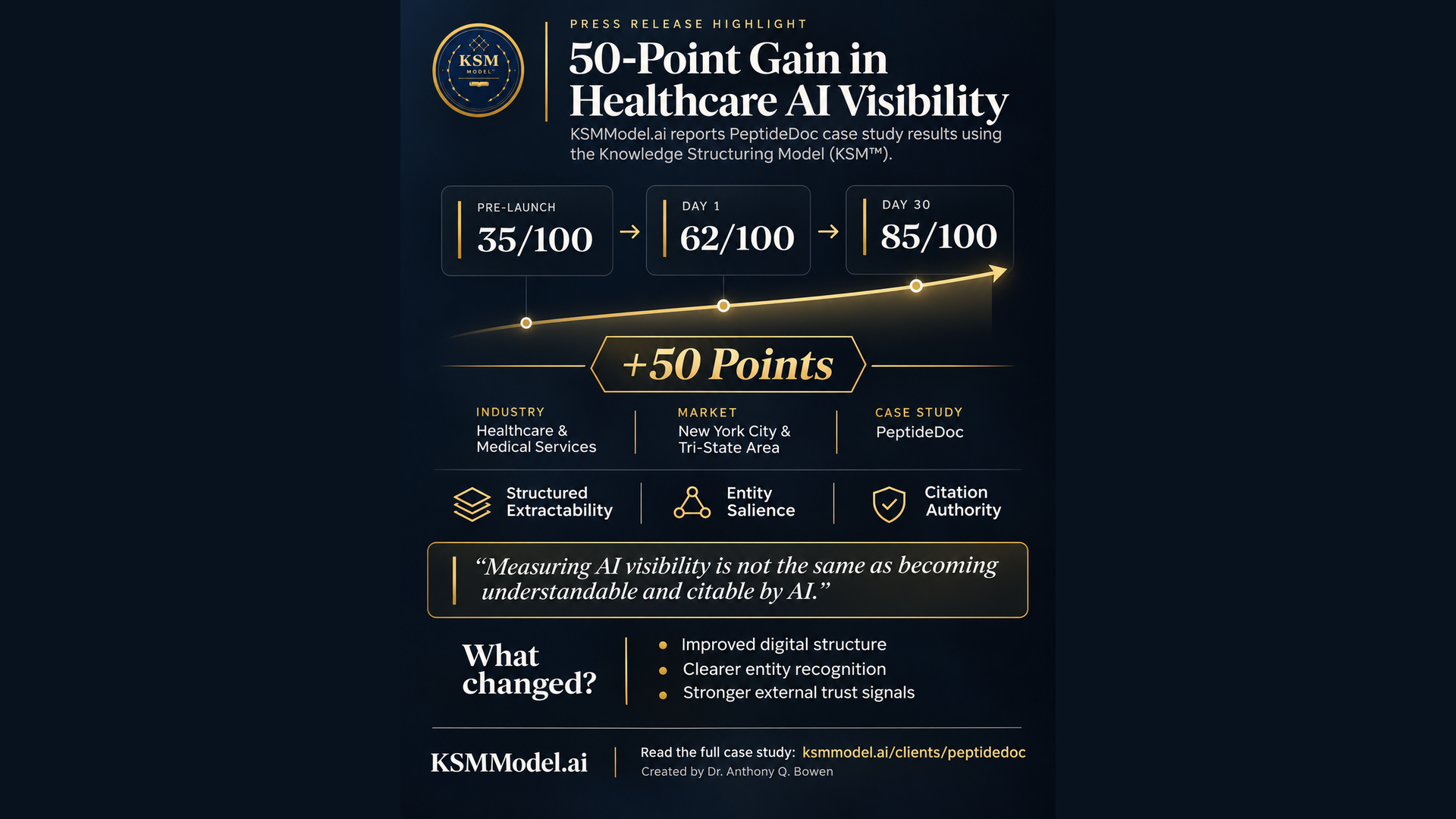
The KSM™ Healthcare Vertical Study, conducted by KSMModel.ai, has reported a 50-point improvement in its proprietary AI Visibility readiness assessment during the first 30 days, moving from 35 out of 100 before launch to 62 on Day 1 and 85 on Day 30. The project remains underway, with additional assessments planned at Day 60 and Day 90. The findings are preliminary and come from a single implementation, not a controlled comparison across multiple organizations.
From search rankings to AI understanding
For years, businesses have focused their digital strategies on appearing in conventional search results. AI-mediated discovery introduces an additional challenge: a business can have a functioning website yet still present scattered or ambiguous information about its identity, services, personnel and credentials. Even when AI systems can retrieve that information, they may not find independent sources to substantiate it.
The Knowledge Structuring Model (KSM™), developed by researcher and digital transformation executive Dr. Anthony Q. Bowen, organizes this challenge into three assessment dimensions: Structured Extractability, Entity Salience and Citation Authority. Its operational 100-point assessment assigns up to 40 points each to extractability and entity salience, and 20 points to citation authority. The model seeks to measure conditions associated with AI readiness—not actual traffic, customer conversions or guaranteed placement in AI-generated answers.
Three checkpoints, three different constraints
The current study uses a healthcare organization’s public-facing digital presence as its implementation site. The organization, PeptideDoc, is a medical-practice website; the research focuses on how organizational information is structured and independently supported, not on treatment effectiveness or patient outcomes.
Source: KSMModel.ai November 3, 2026 research announcement. Scores are framework-specific readiness measurements.
Before launch, the largest weaknesses concerned whether a machine could reliably interpret the site and connect its services, organizational details and professional identities. The initial implementation addressed issues including machine-readable markup, canonical relationships, indexing signals, and consistent links between organizational and professional information.
The move from 35 to 62 points by Day 1 corresponded mainly with work on digital structure and entity clarity. By Day 30, the composite rose to 85 points, while Citation Authority increased from 5 to 15 out of 20. The research team interpreted that progression as a shift in the limiting factor—from making information accessible, to clarifying the organization’s identity, to finding corroboration from outside sources.
That distinction is significant. A business can publish claims about itself, but independent references from credible professional directories, registries, publications and other sources can provide a different form of corroboration. At the same time, a syndicated press release copied across many sites should not be mistaken for multiple independent confirmations.
What a 50-point increase does—and does not—mean
The headline number is a 50-point increase on KSM’s own 100-point diagnostic scale, not a 50% increase in AI referrals or evidence that an AI assistant recommended the organization more often. The researchers also preserved the Day 1 score rather than recalculating it with later changes, enabling the same checkpoint structure to be used over the full observation period.
The current data demonstrate that measured readiness indicators changed over time during the implementation. They do not, on their own, establish that any individual intervention caused the improvement, nor do they prove equivalent gains would occur in other healthcare organizations or industries. Those are questions for further validation.
What Days 60 and 90 could reveal
The next two checkpoints will test whether the Day 30 improvement persists, whether progress slows as the easiest structural fixes are completed, and whether citation-related evidence strengthens, stabilizes or weakens. The research team also intends to examine how changes in the public information environment relate to AI-mediated discovery and source attribution where these can be observed reproducibly.
The planned next paper will draw on the full pre-launch, Day 1, Day 30, Day 60 and Day 90 record. A useful contribution would be to distinguish the components that can be improved quickly through website and identity work from those that depend on slower, external corroboration. It should also document measurement rules, source provenance, limitations and any changes in the evidence available at each checkpoint.
For executives and small-business operators, the emerging lesson is not that an AI Visibility score can be bought or instantly engineered. It is that accurate, structured and independently supportable organizational knowledge deserves the same disciplined management once devoted to conventional search visibility. Whether these early results generalize remains the central question for the rest of the study.
Media Contact
Dr. Anthony Q. Bowen
Founder & Creator, Knowledge Structuring Model (KSM™)
KSMModel.ai LLC
Website: https://ksmmodel.ai