Company reports TCPP replacement in insulation foam and increased degradation during testing while retaining measured performance
PITTSBURG, Kan. — MCPU Polymer Engineering will present a materials design framework called biocongruent chemistry at the 2026 Polyurethanes Technical Conference in Orlando, Florida. The company says the approach can help manufacturers reduce reliance on conventional raw materials and halogenated flame retardants while preserving the performance needed for commercial applications.
The framework is scheduled to be presented in a technical paper at 8:30 a.m. on October 7 during the Center for the Polyurethanes Industry conference, which runs October 5–7 at the Omni Orlando Resort at ChampionsGate.
Also worth a look: Aurelyon: Engineering the Future of Intelligent, Automated Trading | Pre-Launch Phase Officially Activated and Fund Momentum Introduces the Most Agentic Fundraising Intelligence Platform for Founders and Emerging Fund Managers.
Rather than replacing an entire polymer system, the approach introduces selected soy-, lignin- or silicone-derived additives into established formulations. MCPU describes substitutions of 10 to 15 parts of conventional polyol, with the specific chemistry and loading tailored to the application.
“The industry has been told it must choose between performance and sustainability, and our data says that is a false choice,” said Thomas M. Garrett, Ph.D., CEO and Research Director of MCPU Polymer Engineering.
Results in insulation foam and carpet backing
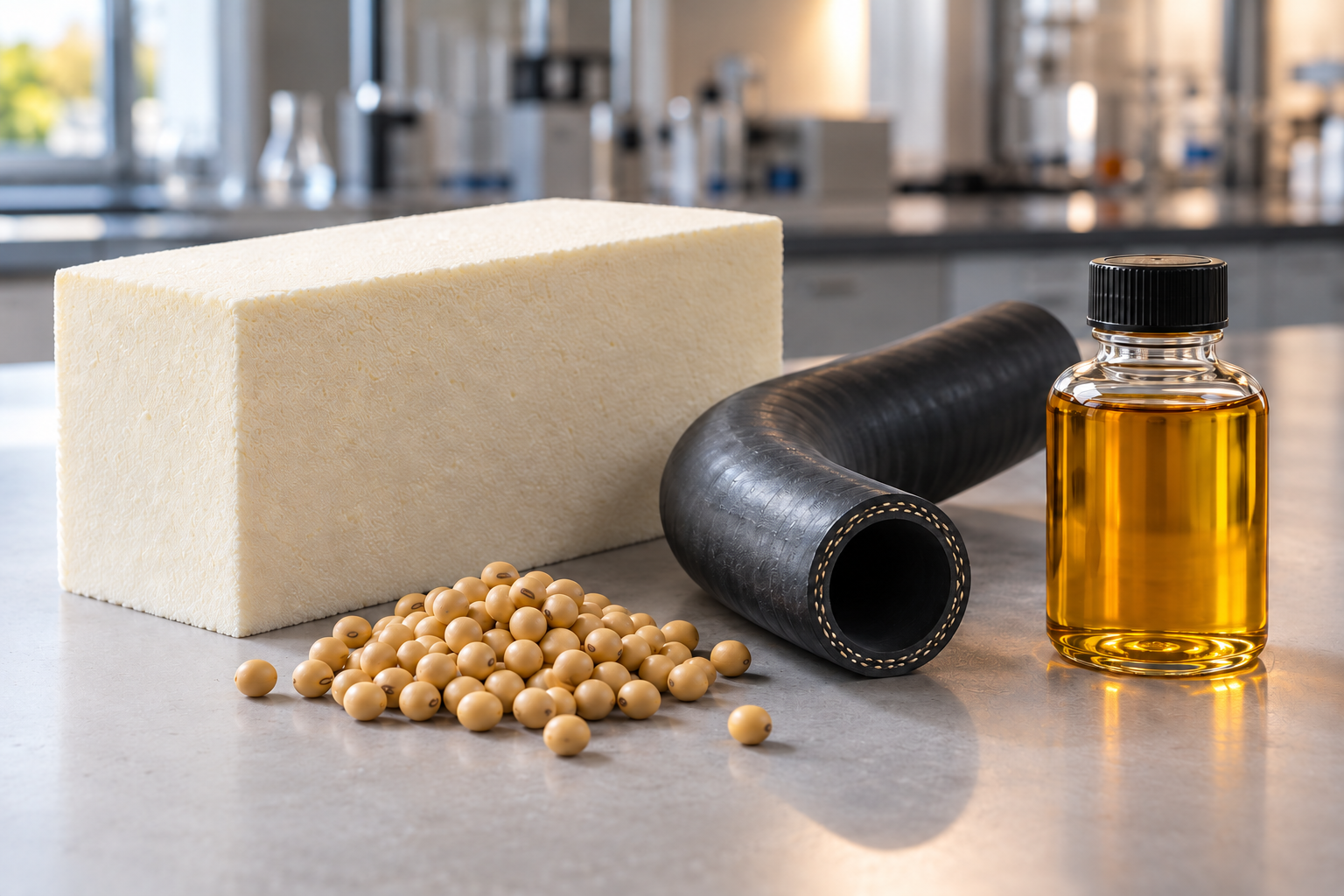
In a commercial rigid polyisocyanurate, or PIR, insulation foam, MCPU reports that replacing 15 parts of conventional polyester polyol with its phosphorylated soy-based additive eliminated TCPP, a halogenated flame retardant. The modified formulation matched the reference system’s flame-retardant performance under DIN 4102 B2 testing. Thermal R-value, yield stress, density and processing characteristics remained effectively unchanged relative to the fossil-based control, according to the company.
The research also examined polyurethane carpet backing. A blend of MCPU’s soy additive and a non-halogenated phosphate flame retardant replaced 20 parts of polyol and filler. MCPU reports that the formulation matched the flame-spread performance of a Class I-rated commercial carpet.
Examining behavior after use
Another part of the research investigated how modified polymers respond to biological exposure. In soil-burial studies, PIR foams containing soy- and lignin-based polyols showed greater mass loss than fully petroleum-based systems while substantially retaining measured mechanical properties.
In a separate field exposure, soy-modified polyurethane elastomers showed measurable degradation over 112 days under wastewater-treatment conditions, without a meaningful loss of mechanical properties, according to MCPU. These findings describe performance during the reported test periods; the broader design objective is to maintain useful service life while improving accessibility to degradation after disposal.
“The question isn’t whether we can make a polymer disappear quickly,” said Saeed Fosshat, Research Staff Scientist at MCPU and lead author of the paper. “It’s whether we can make the material customers actually need, let it perform for its full service life, and still give nature something it can work with when that life is over.”
Durability and lifetime carbon
The work also considers how product durability affects environmental impact. A cradle-to-grave life cycle assessment by LCA Design, conducted to ISO 14040/14044, found that a biocongruent silicone rubber heater hose had roughly one-third the lifetime carbon footprint of its EPDM counterpart when normalized for service life and replacement frequency, the company reports.
Research collaboration and commercial development
MCPU conducted the underlying research with Gogte Institute of Technology in Belgaum, India, and the National Institute for Materials Advancement in Pittsburg, Kansas, together with Purosil LLC and LCA Design. MCPU manufactures the additives and is commercializing the framework with foam, elastomer, adhesive and coating formulators.
The conference paper, Biocongruent Chemistry, is co-authored by Saeed Fosshat, Enoch K. Acquah, Xian Xian Du and Thomas M. Garrett of MCPU; Andrew H. Garrett of Purosil; and Katie Soulliere of LCA Design. The full paper, including test data and life cycle assessment methodology, will be available to conference attendees and on request from MCPU after the presentation.
Headquartered in Pittsburg, Kansas, MCPU has developed bio-based reactive additives for polyurethane systems for more than 20 years. Further information is available at mcpupolymers.com.