Environmental initiatives often struggle to capture public attention when presented purely as data or policy. Communities are looking for more engaging, interactive ways to connect with sustainability topics. Public art has emerged as a powerful tool for this, transforming shared spaces into focal points for conversation and reflection on environmental issues.
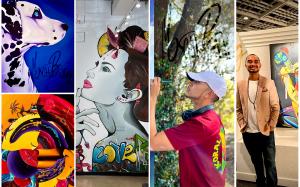
To foster this kind of engagement, Orange Park Mall partnered with renowned visual artist Moschburg for a live mural painting event celebrating Earth Day. This collaboration aimed to use vibrant public art to inspire environmental stewardship and bring the community together in a shared creative experience. We spoke with Moschburg to discuss his artistic process, the importance of public art, and how visual storytelling can impact a community's relationship with the environment.
Q: Your work is known for its bold colors and vibrant energy. How did the theme of Earth Day influence the specific design and color palette you chose for the Orange Park Mall mural?
Moschburg: For the Orange Park Mall Earth Day project, I designed three large collaborative canvases rather than a traditional wall mural. They featured the Earth surrounded by children holding hands, a panda interacting with recycling, and a moth-butterfly figure representing transformation and change.
The simplicity of the imagery was intentional. My work is normally much more symbolic and asks the viewer to decipher what they are seeing, but these pieces were being created with young children. I wanted the visual language to communicate immediately. Recycling, peace, nature and cooperation needed to be recognizable before anyone had to explain them.
Color was just as intentional. I've always been obsessed with complementary colors and strong contrast because I want art to almost scream at you from across the room. I don't want a painting to disappear into its surroundings; I want it to steal your attention. For this project, that visual energy became part of drawing people toward the environmental message.
Most importantly, I wanted the work to feel hopeful rather than apocalyptic. The moth-butterfly was especially meaningful because I often use it as a symbol of transformation. Earth Day can easily become a conversation about everything that has gone wrong, but I wanted the children to leave with another idea: things can still change.
Q: Live painting adds an element of performance to the creation of a mural. How does interacting with the community in real-time affect your creative process while you are working?
Moschburg: At the beginning, I was much more direct. I was telling the kids where certain colors should go and trying to preserve the structure I had originally designed. But pretty quickly I noticed that the children having the most fun were the ones who stopped worrying about doing it "correctly." Some were scribbling over one another's marks, signing their names, or adding things I had never planned.
Once several kids had worked over the same areas, some of those sections developed this accidental expressionist quality. That was when I realized my job wasn't to control the experience. It was to give them enough structure to create freely and then help bring everything together.
My role changed from director to collaborator. I let their marks remain, and afterward I reinforced the original black linework so all of that energy had something to hold it together. I wasn't correcting what they had done; I was completing my part of the collaboration.
More importantly, I wanted them to enjoy the experience enough to remember it. If a child remembers spending Earth Day creating something with their own hands, the ideas connected to that experience have a much better chance of staying with them.
Q: Public spaces like shopping malls are non-traditional venues for fine art. Why is it important to you to bring your work into these everyday environments rather than keeping it strictly in galleries?
Moschburg: Some of the most powerful encounters with art happen when you weren't looking for art in the first place. That's what I love about putting work in everyday public spaces. Someone might be going to lunch, shopping with their family, or simply walking through a mall and suddenly encounter something that makes them stop. A child who has never thought much about art might see a large-scale piece and think, I want to make something like that someday. You never really know what that moment can begin.
I also don't believe public art should be intellectually simplified just because the audience didn't come there specifically to study it. It can carry the same symbolism, narrative and depth as something shown in a gallery.
I love galleries because they give art a protected space where it can be honored and experienced intentionally. I just don't think fine art should exist exclusively inside those rooms. Some of the most remarkable periods in cultural history happened when art became part of architecture, streets, public squares and everyday life. Eventually those works stopped feeling like decoration and became part of the identity of the place itself.
That's what interests me about projects like Orange Park. Art gets to step outside the gallery for a moment and meet people where they already are.
Q: What core message or feeling do you hope the residents of Orange Park take away when they see this finished mural celebrating the environment?
Moschburg: More than anything, I hope the children who participated remember what it felt like to create something.
I believe creativity is one of the most fundamental things human beings do. That doesn't necessarily mean becoming an artist. You can create a business, a building, a technology, an idea, or an entirely new way of solving a problem. Our future is ultimately shaped by the creators of tomorrow, so encouraging a child to realize, I can make something that didn't exist before, is incredibly important to me.
For everyone else who encounters the finished work, I hope the first response is emotional — curiosity, excitement, maybe even a little surprise — and then the environmental message reveals itself underneath.
What I love in retrospect is that the way the pieces were made became part of that message. No single child created the finished artwork. Some contributed a lot, some made only a few marks, but all of those individual actions became one larger image. Environmental responsibility works much the same way. No single person is going to solve everything, but many people contributing something can change the larger picture.
So ultimately the message is hopeful: creation is possible, change is possible, and everyone has something they can contribute.
Q: As an artist who travels extensively, how do you see the role of public art evolving in raising awareness for global issues like sustainability?
Moschburg: Traveling has made me very aware of how much the art surrounding us eventually becomes what we call culture. Architecture, public spaces, fashion, music, monuments and even small design details all contribute to the identity of a place. Different cities expose people to completely different concentrations and forms of creativity, and I think that environment inevitably influences the people growing up inside it.
That is one reason public art can be so powerful when addressing something global like sustainability. Visual language doesn't require everyone to speak the same language or come from the same background. An image can create an emotional connection first, and sometimes that connection makes someone willing to think differently about an idea they might otherwise ignore.
I don't believe artists have a responsibility to address sustainability specifically. I think our responsibility is to be honest about what genuinely matters to us. People can feel when something is manufactured. If an artist deeply cares about the environment, technology, war, identity, science or anything else, that sincerity is what gives the work its power.
What excites me about the future is that public art can become much broader than something painted on a wall. New technologies, materials, movement and interactive systems give artists possibilities we are only beginning to explore. At the same time, I hope we recover something older: the idea that creativity belongs throughout the built environment.
I would love to see cities develop their own visual fingerprints again — places where architecture, sculpture, public art and even ordinary objects contribute to a sense of identity. When people care about the environment they live in, I think they become more interested in protecting it.
Public art doesn't only communicate a message about sustainability; it can help create a place that people believe is worth sustaining.
This event demonstrates the unique ability of public art to make abstract concepts like environmental conservation tangible and engaging for the public. By bringing the creative process into a high-traffic community hub, the collaboration between Orange Park Mall and Moschburg successfully sparked dialogue and connection around Earth Day.
As communities continue to seek meaningful ways to address sustainability, integrating the arts into environmental initiatives will remain a crucial strategy. Vibrant, accessible public works serve as lasting reminders of our shared responsibility, proving that visual inspiration can be a catalyst for real-world awareness.
To learn more visit https://orangeparkmall.com/