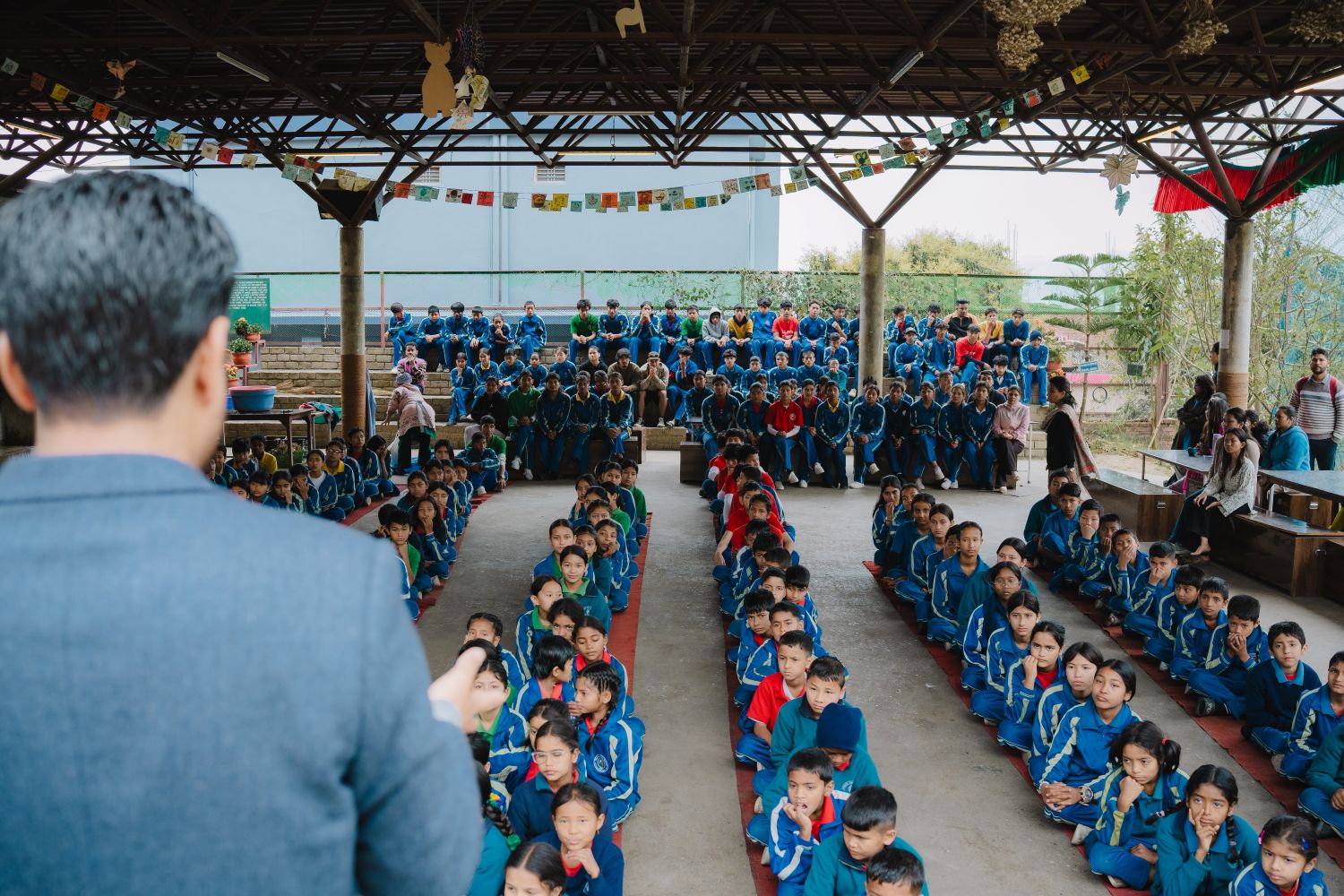
In many developing regions, achieving quality public education remains a significant challenge. Though communities and parents place value on achieving education, schools often lack the resources, trained teachers, and infrastructure needed to support student success and well-being. For children in rural Nepal, these systemic gaps can limit their opportunities and trap communities in cycles of poverty. A practical, sustainable approach to education reform is necessary to help these students build a better future.
The BlinkNow Foundation is working to solve this problem, together with the local community of Surkhet, Nepal. Through building a community-centered development model, a green school, a sustainable children's village, and the newly launched STEPS school mentoring project, BlinkNow provides a comprehensive support system for dedicated students who come from low-resource environments. And its impact is evident: In contrast to the national graduation rate of 66%, Kopila students pass their exams and move on to higher education at a rate of 95%. In this interview with Dr. SP Kalaunee, Country Representative for BlinkNow in Nepal, we discuss the foundation's latest initiatives, the value of public-private partnerships, and their plan to improve education across Nepal.
Q: The BlinkNow Foundation recently launched the STEPS Project in Lekbesi Municipality. Can you explain the main goals of this initiative and how it addresses current gaps in the public education system?
SP Kalaunee: STEPS is an initiative designed to strengthen Nepal’s public education system by improving both access and quality in public schools. We work in partnership with federal and local governments, school management committees, teachers, parents, and other stakeholders to support schools in addressing their most pressing challenges.
At the heart of STEPS is the belief that meaningful and sustainable improvements in public education can be achieved through public–private partnership and the systematic adoption of proven innovations within the public education system. Our ultimate goal is to contribute to a stronger public education system that provides children with better opportunities to learn, thrive, and remain in school.
We are implementing STEPS through a “Design, Build, Operate and Transition” (DBOT) model, guided by the Theory of Adoption. The central premise of this theory is that public systems can be strengthened when innovative approaches developed and tested through partnerships adopted within the public system itself. In this way, the focus is not simply on running a successful project, but on ensuring that effective practices can become part of the public education system and be sustained over time.
Our interventions are based on evidence. We began with an initial screening of the targeted public schools, followed by a detailed baseline assessment to understand the specific gaps and challenges they face. The assessment highlighted three major areas of concern: low learning outcomes; health and nutrition challenges among children; and an overall learning environment that does not adequately support quality education.
Based on these findings, we have designed targeted interventions around four key areas:
- Quality teaching and learning – strengthening classroom practices, teaching quality, and learning outcomes.
- Health, nutrition and wellbeing – addressing the health, nutritional, and psychosocial wellbeing of children so that they are better prepared to learn.
- Infrastructure and learning environment – improving the physical and educational environment in which children learn.
- Governance and community relations – strengthening school leadership, accountability, community engagement, and collaboration among key stakeholders.
We will continuously monitor progress against clearly defined indicators under each of these areas. This will allow us to learn what works, identify what needs to be improved, and generate evidence that can inform wider public education reform.
STEPS is also deeply rooted in our more than two decades of experience at Kopila Valley. We have had the opportunity to develop a lived experience of what it takes to provide quality education and create a supportive learning environment for children in Karnali Province. That experience has taught us that improving education is not about one intervention or one institution; it requires an ecosystem that brings together teachers, students, families, communities, governments, and other partners.
Therefore, rather than simply expanding our own institutional footprint into new locations, we have made a very intentional choice to walk alongside existing public schools and local governments. We want to learn with them, support them, and co-create solutions that are relevant to their context. Our hope is that, over time, successful innovations can be owned and sustained by the public system itself.
Ultimately, STEPS is not about creating islands of excellence; it is about demonstrating what is possible within the public system and helping that system adopt, adapt, and sustain what works. That is the pathway through which we believe we can contribute to lasting improvements in public education.
Q: You draw heavily on lessons learned from your flagship Kopila Valley School in Surkhet. What specific educational and development practices are you adapting to help public schools succeed?
SP Kalaunee: For nearly two decades, our dream at Kopila Valley has been to create a loving, full-service community school model that demonstrates what is possible when children are given dignity, care, and opportunity. But we have always recognized that meaningful and lasting change cannot end at the boundaries of our own school. If we truly want to contribute to transforming education in Nepal, we need to take what we have learned and share it with the public education system, which serves a much larger proportion of the country’s children.
That is the thinking behind our work with public schools. We are not trying to replicate Kopila Valley in other schools. Rather, we want to share the lessons, approaches, and innovations that have worked for us and help public schools adapt them to their own contexts.
Several practices that we have developed through our experience at Kopila Valley will inform this work, including environmental action, improving learning outcomes, student and community engagement, and strengthening teacher capacity. These are not interventions that we simply want to transplant from one school to another. We want to work with public schools to understand what is relevant, feasible, and sustainable in their particular circumstances.
For example, we are very proud of Kopila Valley’s commitment to environmental sustainability and its recognition as one of the leading green schools globally. Our campus itself serves as a living learning laboratory, incorporating sustainable features such as rammed-earth construction, solar-powered electricity and kitchen equipment, aquaponics, rainwater harvesting and filtration, and gardens and farms that students use as part of their learning.
However, we do not intend to replicate this infrastructure in public schools. Instead, we want to introduce the underlying concepts of sustainability and the green-school approach and work with each school to identify practical components that can be implemented within its existing resources and context. Sometimes, meaningful environmental action does not require expensive infrastructure; it can begin with how a school manages waste, conserves water, grows food, uses energy, or engages students in caring for their surroundings.
We also want sustainability to move beyond being a topic in the curriculum and become part of students’ everyday lives. Our goal is for children not only to learn about environmental care but to internalize it as a life skill and a way of living. At Kopila Valley, environmental stewardship is not simply a subject we teach; it is an approach that connects students with their local culture, community, and surroundings. With our partner schools in Lekbesi, we are beginning to share this more holistic mindset.
Our experience in improving learning outcomes at Kopila Valley will similarly inform our work with public schools. We are focusing on interactive teacher development and classroom practices that move beyond rote memorization toward curiosity, critical thinking, creativity, and STEAM-based learning. At the same time, we recognize that learning outcomes cannot be improved through teaching alone. Children need to be healthy, nourished, safe, and supported if they are to learn effectively.
That is why we are also looking at practical barriers to learning—such as access to nutritious school meals, essential infrastructure, health and wellbeing, and a safe and stimulating learning environment. These elements may seem separate from academic achievement, but in reality, they are all interconnected.
Ultimately, our ambition is not to make public schools look like Kopila Valley. It is to help public schools become stronger versions of themselves by drawing on evidence, experience, and innovations that can be adapted to their own realities. If we can demonstrate approaches that work and support schools and governments to adopt and sustain them, then the impact can reach far beyond any single school—and that is the scale of change we aspire to contribute to in Nepal.
Q: A key component of your strategy is a public-private partnership involving SAC Nepal and local government leaders. Why is this collaborative approach essential for improving student outcomes and boosting enrollment?
SP Kalaunee: There is a saying that “it takes a village to educate a child.” We strongly believe in this idea. A child’s development is shaped not only by what happens in the classroom, but also by their family, community, and the wider systems around them. Unless the individuals and institutions that influence a child’s growth work together and create a supportive environment, we cannot truly achieve the goal of developing the whole child. That is why our work goes beyond any one person or organization. It is about bringing together many hands and many hearts around a shared vision for children.
Our partnership model brings key local stakeholders together—the school, parents, local government, community leaders, teachers, and other community members—to create a positive and enabling environment for children to learn and thrive. We are deeply committed to community-led solutions rather than externally imposed ideas. For nearly two decades, our work has been informed by the wisdom and experience of local leaders, teachers, caregivers, families, and neighbors who understand their communities best.
This is also why partnerships are so important to STEPS. Social Awareness Center (SAC) Nepal, which has been working in Nepal since 1995, brings extensive experience in community development and direct experience in promoting STEAM learning within schools. We are pleased to work together because we see collaboration not simply as implementing a project together, but as a partnership in which each organization contributes its distinct strengths, knowledge, and experience.
We believe that collective effort is essential to increasing school enrollment, improving retention, and strengthening learning outcomes. Children need a positive and supportive learning environment at school, at home, and in their community. When local governments, community leaders, teachers, parents, and schools come together to develop and own a shared vision, trust begins to grow. And when that vision is collectively owned, there is a much stronger foundation for long-term sustainability.
For us, partnership is more than simply adding the strengths of different organizations together. It creates synergy—the possibility that our collective strength can be greater than the sum of our individual strengths. This is particularly important to our Theory of Adoption, which is at the core of the STEPS model. Our ultimate objective is not merely to introduce innovations into public schools, but to support the public education system to understand, adapt, adopt, and sustain innovations that demonstrate value. Adoption is what makes improvement sustainable beyond the life of a particular project.
For that to happen, government ownership is essential. The government cannot be brought in only at the end, after an intervention has already been designed and implemented. They need to be part of the journey from the very beginning—helping identify priorities, shaping interventions, participating in implementation, learning from the evidence, and ultimately taking ownership of what works.
That is why we intentionally engage local government from the early stages of STEPS. We want them to be partners in the process, not simply recipients of the outcomes. In the long run, our measure of success will not be how much we ourselves have done, but how much of what works has been embraced, owned, and sustained by the public education system.
Q: BlinkNow focuses on sustainability and safe living environments, as seen with the opening of your new Sustainable Children’s Village. How do elements like school nutrition programs and infrastructure upgrades tie into a child’s ability to learn?
SP Kalaunee: Our approach is centered on the thriving of the whole child, so we are concerned about every aspect of a child’s life—not just what happens in the classroom. Our journey at Kopila Valley began with a Children’s Home and gradually expanded to include education, health and wellbeing programs for students, as well as a women’s job training center. Each of these efforts reflects our belief that children thrive when the families and communities around them are also supported.
Children cannot learn effectively when their basic needs are unmet. A safe home, a caring family, adequate nutrition, health, and a sense of security are all essential foundations for learning. So, we work to identify and address the barriers that may prevent a child from learning and reaching their potential. When a child has a family home, we also work with parents and caregivers to understand their circumstances and explore how we can support the family to thrive together.
We see the wellbeing of a child as deeply interconnected with the wellbeing of their family and community. When we support a child’s basic needs and walk alongside their mothers, caregivers, and families, we are helping strengthen the entire family. And when families are stronger, children are better positioned to learn, grow, and participate fully in their communities.
Ultimately, we believe that education is about much more than academic achievement. When a child feels safe, loved, healthy, and nourished, they are better able to discover their strengths, develop confidence, and realize their potential. That is why our whole-child approach seeks to create the conditions in which every child can not only learn, but truly thrive.
Q: Using insights from your initial pilot schools, you plan to scale the STEPS initiative to additional institutions across the region. What key milestones or changes do you hope to see before expanding the program further?
SP Kalaunee: Before expanding the STEPS initiative in additional schools, we’d like to see the following improvements in the pilot schools by the end of the two year project period. However, if we achieve notable progress in the indicators listed below sooner, we could also start scaling sooner.
- 10% increase in baseline access to healthy life
- Achieve one ward declared as ‘100 % school enrollment ward’ (with zero out of school children)
- 5% increase in school enrollment
- At least a 3% increase in Early Grade Mathematics Assessment (EGMA) and Early Grade Reading Assessment (EGRA) test
- 5% increase in the average % of attendance
- 2 libraries, water, sanitation, and hygiene (WASH), and other facilities improved.
- 1 scale improvement achieving at least 3 out of 5 score in infrastructure on a scale of 1 to 5 score.
This discussion highlights the importance of combining educational reform with holistic community support. By prioritizing teacher training, direct student aid, health initiatives, and care for both the planet and people, organizations can create environments where children and communities thrive. The insights shared reveal that lasting change requires active participation from local governments, school management committees, and partner organizations working toward a shared goal.
As the demand for quality education grows, initiatives like the STEPS project serve as a practical model for community development worldwide. Ensuring that every child is safe, educated, and loved is a critical mission that shapes the leaders of tomorrow. The BlinkNow Foundation's ongoing efforts prove that with strategic partnerships and dedicated resources, meaningful public education reform is entirely possible.
To learn more visit https://www.blinknow.org