Semiconductor pump demand is projected to reach USD 6.8 billion in 2026 as fab modernization, replacement cycles, and high-density manufacturing drive growth across Asia and North America.
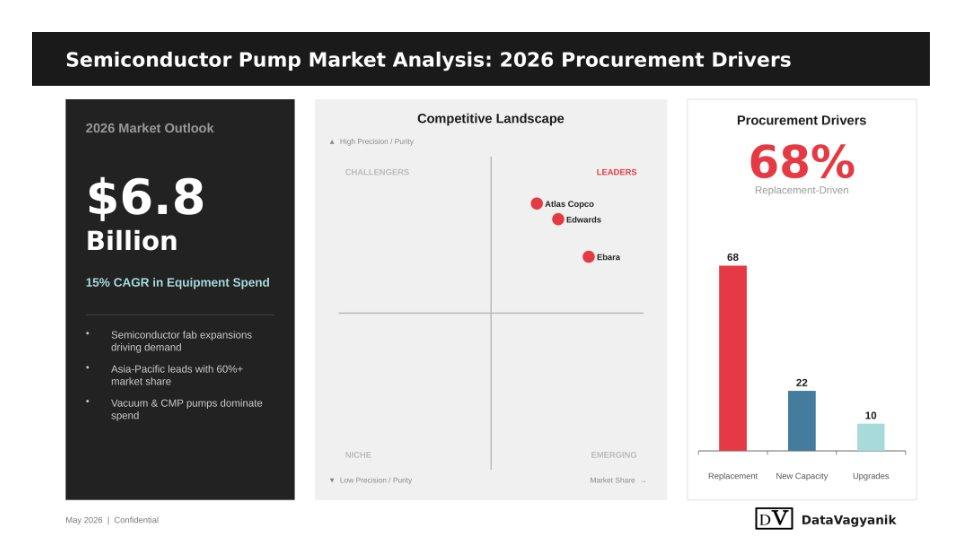
The global semiconductor pump system market is estimated at USD 6.8 billion in 2026, according to research firm DataVagyanik, as chipmakers accelerate fab modernization, replace aging equipment, and expand high-density manufacturing across Asia and North America.
The market is benefiting from USD 135 billion in semiconductor equipment spending in 2025, which rose 15% year-on-year. Demand remains concentrated in major manufacturing hubs, with China contributing USD 49.3 billion, Taiwan USD 31.5 billion, and South Korea USD 25.8 billion.
Industry capacity data shows that Taiwan, South Korea, China, the United States, and Japan accounted for more than 82% of global fabrication capacity additions in 2025. As advanced fabs rely on vacuum and fluid-handling infrastructure across multiple process stages, these additions are translating into steady demand for specialized pump systems.
Replacement cycles dominate procurement
Survey data from semiconductor fabs and equipment suppliers shows that procurement in 2026 is being driven mainly by replacement rather than greenfield expansion.
According to the data, 68% of fab operators identified replacement cycles as their primary trigger for pump purchases. 22% cited new capacity expansion, while 10% cited process upgrades.
This pattern reflects the operating environment inside modern fabs, where pump systems must handle corrosive chemistries, meet strict contamination thresholds, and run continuously. As a result, many operators are replacing aging systems earlier to reduce leakage risk, preserve yield, and maintain uptime.
Dry vacuum pumps remain the largest segment
The Semiconductor dry vacuum pumps market size takes the largest share in 2026, with demand estimated at USD 2.9 billion.
These systems are widely used in etch, deposition, chamber evacuation, and abatement support. Their importance is growing as semiconductor processes become more vacuum-intensive and contamination-sensitive.
Key configurations include:
- Dry screw and scroll pumps
- Claw and hook-and-claw systems
- Turbomolecular pumps for specialized high-vacuum uses
- Cryogenic systems for ultra-high-vacuum environments
Dry systems are preferred because they reduce the risk of oil contamination, support cleanroom integrity, and improve process consistency.
Seal-less pumps gain share in fluid handling
Outside vacuum systems, magnetic drive and seal-less centrifugal pumps are among the fastest-growing segments in fluid handling, accounting for an estimated 20% to 25% of demand.
They are used in chemical transfer loops, ultrapure water circulation, rinse systems, and waste handling, where contamination control and leak prevention are critical.
Compared with conventional shaft-sealed pumps, seal-less designs help lower maintenance risk and reduce unplanned downtime. That makes them increasingly attractive in corrosive and high-purity semiconductor applications.
Diaphragm pumps remain important in wet processing
Diaphragm pumps continue to play a major role in semiconductor manufacturing, especially in chemical dosing, metering, and wet process tool distribution.
They are estimated to account for 15% to 20% of fluid-handling pump demand. Their ability to handle aggressive chemicals while limiting leakage makes them especially useful in fab support systems and chemical delivery networks.
Etch and deposition lead process demand
By process application, etch and deposition account for the largest share of pump demand at 40% to 50%.
Other major applications include:
- Wet process, cleaning, and wafer rinse: 20% to 25%
- Chemical mechanical planarization and slurry handling: 10% to 15%
- Load-lock and wafer transfer support: 8% to 12%
These process steps require stable vacuum conditions and high fluid purity, reinforcing the importance of reliable pump performance across the fab workflow.
Competitive landscape stays broad
The market remains competitive, with leading vacuum specialists including Edwards Vacuum, Atlas Copco, Pfeiffer Vacuum, Ebara Corporation, ULVAC, and Busch Group.
The fluid-handling segment is more fragmented, with companies such as Ingersoll Rand, KNF, Iwaki, Nikkiso, and Entegris active in related semiconductor applications.
Competition is centered on qualification depth, chemical compatibility, contamination control, service support, and energy efficiency. Suppliers with strong application-specific expertise are expected to remain best positioned.
Outlook
The outlook for the semiconductor pump system market remains positive through 2026, supported by ongoing fab modernization, equipment replacement, and process intensification.
Growth opportunities are likely to remain strongest in:
- Advanced-node manufacturing
- High-volume memory and logic production
- Precise chemical dosing
- Advanced packaging
- Water reuse and sustainability systems
As semiconductor manufacturing expands across Asia and North America, suppliers that can deliver proven performance in high-purity, chemically aggressive, and vacuum-intensive environments are expected to capture the strongest demand.