Introduction
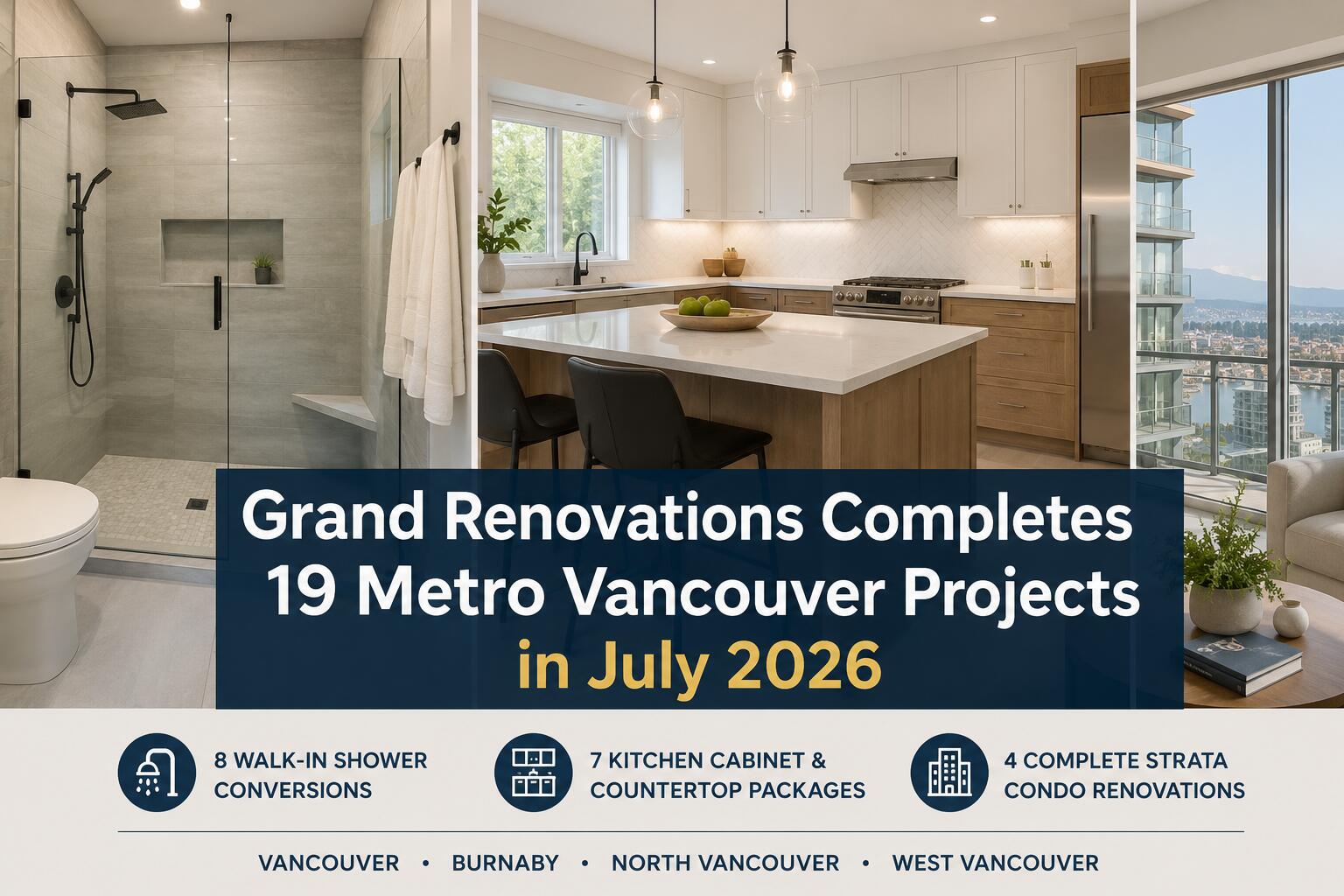
Grand Renovations completed 19 residential renovation projects across Metro Vancouver in July 2026, spanning Vancouver, Burnaby, North Vancouver, and West Vancouver. The project mix – heavily weighted toward bathroom and kitchen upgrades – offers a practical snapshot of what homeowners across the region are prioritizing right now and why.
This article breaks down the 19 completed projects, examines the construction processes involved, and explains the coordination challenges specific to strata condo renovations. It is written for Metro Vancouver homeowners researching bathroom renovation, kitchen renovation, or condo renovation options and wanting to understand what these projects actually involve before committing to one.
Of the 19 projects, 8 were walk-in shower conversions, 7 were kitchen cabinet and countertop packages, and 4 were complete strata condo renovations. Combined with 16 projects completed in June 2026, the firm completed 35 projects in two months – suggesting sustained renovation activity over consecutive months across multiple municipalities.
Here is what this article covers:
- Why walk-in shower conversions are the most requested bathroom upgrade in the current market
- What targeted kitchen cabinet and countertop renovations include and why homeowners prefer them over full remodels
- How strata condo renovations differ from house renovations in planning, approvals, and logistics
- Common renovation planning considerations across Metro Vancouver municipalities
- What the combined June and July project volume reveals about broader renovation demand
Understanding Metro Vancouver’s Current Renovation Landscape
The 19 projects completed by Grand Renovations in July 2026 provide a useful cross-section of current residential renovation demand. The geographic distribution of projects spanned multiple municipalities in Metro Vancouver – from detached homes on the North Shore to strata condos in Burnaby’s Metrotown area – and the project types reflect choices homeowners are making about where to invest in their homes.
Residential renovations can improve housing quality and safety for homeowners, and renovating existing homes can extend their useful life. In a region where Metro Vancouver’s construction pace is slowing due to economic factors and 2026 will see fewer condominium completions, upgrades to existing housing stock take on added importance. Renovation projects can also generate work for local contractors and suppliers, contributing to local economic activity even as new construction volumes decline.
Walk-In Shower Conversions Dominate Project Volume
Eight of the 19 July projects were walk-in shower conversions – the single largest category. This is consistent with broader demand patterns where homeowners are replacing bathtub-and-shower combinations with open, accessible shower designs. The motivation spans multiple factors: aging-in-place planning, accessibility improvements, modern bathroom aesthetics, and a preference for easier daily use. That these projects appeared in both detached homes and strata condos across four different municipalities suggests the demand cuts across housing types and price brackets.
Targeted Kitchen Renovations Remain Popular
Seven kitchen cabinet and countertop renovation packages rounded out the second-largest category. These are distinct from full structural kitchen remodels – they focus on replacing cabinets, upgrading countertop surfaces, installing backsplashes, and updating lighting without altering the kitchen’s floor plan or moving walls. For homeowners who want a meaningful visual and functional transformation without the timeline and cost of a complete rebuild, this targeted approach delivers strong results relative to investment.
Strata Condo Renovations Show Sustained Demand
Four complete strata condo renovations completed in July demonstrate that homeowners in multi-unit buildings continue to pursue comprehensive upgrades despite the additional layers of coordination involved. These projects required working with strata corporations, property managers, building personnel, and construction trades – a level of complexity that goes well beyond what a typical house renovation demands. The projects included modernizations of existing housing stock in buildings where administrative and logistical hurdles are significant but not insurmountable.
Walk-In Shower Conversions Lead July Renovation Activity
The eight walk-in shower conversions completed in July were spread across Canyon Heights in North Vancouver, Cedardale in West Vancouver, Metrotown in Burnaby, and Fairview in Vancouver. The projects included properties in both detached houses and strata condos, and the scope of work varied depending on existing conditions in each home.
“Walk-in shower conversions continue to be one of the most requested bathroom upgrades among both house and condo owners. Homeowners are looking for bathrooms that are easier to use, visually open and designed for long-term practicality,” said Alex Mann, Owner of Grand Renovations.
Why Homeowners Choose Walk-In Showers
Walk-in shower conversions address several practical concerns simultaneously. Removing the raised threshold of a bathtub improves accessibility and makes entry and exit easier – particularly relevant for older homeowners or anyone with mobility considerations. Without a tub enclosed by walls or curtains, the bathroom layout feels more visually open, and the design options expand considerably.
Modern walk-in showers allow homeowners to customize tile patterns, add recessed shower niches for storage, select updated plumbing fixtures, and install frameless glass enclosures that contribute to a clean, contemporary look. These design elements also tend to improve long-term practicality: frameless glass is easier to clean, large-format tile reduces grout lines and maintenance, and properly installed waterproofing systems protect the structure behind the finished surfaces.
Home improvements often increase the market appeal and value of properties, and bathroom projects included in July’s activity reflect this – bathrooms and kitchens remain the spaces where renovations deliver the highest visual and functional return per square foot.
Technical Construction Process
A proper walk-in shower renovation involves considerably more than removing a bathtub and installing tile. Depending on existing conditions, the project can require multiple construction phases and coordination across trades.
The process typically begins with demolition – removing the existing bathtub, backer boards, and sometimes surrounding tile. This phase also involves assessing existing plumbing and structural conditions behind walls.
Plumbing modifications follow, which may include repositioning the drain to accommodate the new shower layout, reconfiguring water supply lines, and installing or replacing shower valves. Drain positioning and floor slope are critical: the shower base must be sloped correctly toward the drain to prevent water pooling, which often requires subfloor adjustments or wet-area membrane work.
Waterproofing is arguably the most important technical step. This includes applying waterproof membranes behind tile, sealing all seams and joints, and sometimes using liquid-applied membrane systems. Inadequate waterproofing is one of the most common causes of long-term water damage in bathroom renovations.
Tile installation using large-format tile gives a cleaner appearance with fewer grout lines, but requires precise substrate preparation and specialized tools. Shower niches – recessed shelves built into the wall – need custom framing and their own waterproofing before tile can be applied.
The final phase involves installing updated plumbing fixtures (showerheads, hand-held sprays, valves) and frameless glass enclosures, which must be measured precisely after tile work is complete to ensure proper fit and prevent leaks.
Geographic Distribution Across Metro Vancouver
The eight shower conversions were distributed across four distinct neighborhoods: Canyon Heights on the North Shore, Cedardale in West Vancouver, Metrotown in Burnaby, and Fairview in Vancouver. This distribution mirrors the broader pattern visible across all 19 July projects – renovation demand is not concentrated in a single municipality or housing type but spans the region.
Canyon Heights and Cedardale represent primarily detached-home neighborhoods, while Metrotown and Fairview include substantial strata condo inventory. The fact that walk-in shower conversions appeared in both contexts reinforces that this renovation type serves different housing situations and homeowner demographics.
Kitchen Cabinet and Countertop Renovations Across Metro Vancouver
Seven kitchen renovation projects were completed in July across Lower Lonsdale in North Vancouver, Dundarave in West Vancouver, Brentwood in Burnaby, and Kitsilano in Vancouver. In July 2026, Grand Renovations focused on high-demand specialized upgrades, and these kitchen projects exemplify the targeted approach many homeowners are taking.
Targeted Renovation Strategy
Each of the seven kitchen projects focused on replacing cabinets with improved storage configurations, installing quartz or quartzite countertops (stone countertops selected for durability and stain resistance), updating backsplashes, coordinating with appliance installations, upgrading lighting – particularly under-cabinet lighting – and completing finish carpentry work.
This approach keeps the existing kitchen layout intact. Walls stay where they are. Plumbing rough-ins remain in place. Electrical panels are not relocated. What changes is everything the homeowner sees and interacts with daily: cabinet faces and interiors, countertop surfaces, backsplash materials, and lighting quality.
Quartz and quartzite surfaces have become standard choices for Metro Vancouver kitchen upgrades due to their durability, low maintenance, and range of available aesthetics. Backsplash installation ties the visual design together, and updated lighting can fundamentally change how a kitchen feels during daily use.
Cost-Effective Kitchen Transformation
The targeted kitchen renovation strategy offers homeowners a meaningful transformation without the cost, disruption, and timeline of a complete structural remodel. For context, Grand Renovations’ June 2026 projects included scopes ranging from a $22,000 bathroom upgrade in a Burnaby condo to a $280,000 full home remodel in West Vancouver – illustrating the wide range between targeted and comprehensive renovation investments.
For homeowners in neighborhoods like Kitsilano and Dundarave, where material quality and design execution influence both livability and resale appeal, a well-executed cabinet and countertop package can deliver outsized visual impact. The kitchen upgrades completed in July demonstrate that many homeowners are choosing this middle path: substantial enough to transform the space, contained enough to manage cost and timeline.
Strata Condo Renovations Require Specialized Coordination
Four complete strata condo renovations were among the 19 projects completed in July, and these required a fundamentally different planning approach than the house-based projects. Condo renovation in Metro Vancouver introduces administrative, logistical, and scheduling layers that homeowners in detached houses rarely encounter.
Strata Corporation Requirements
Before construction began on any of the four condo projects, Grand Renovations had to navigate strata-specific requirements. These typically include submitting formal renovation applications to the strata corporation, providing contractor insurance documentation and WorkSafeBC information, and agreeing to restricted working hours established by the building’s bylaws.
Elevator reservations must be arranged in advance for material deliveries and debris removal. Common-area protection – covering hallway floors, protecting elevator interiors, shielding lobby finishes – is typically required and enforced. Homeowners considering a strata condo renovation should review their building’s bylaws and renovation procedures before engaging a contractor, as requirements vary significantly between buildings.
Municipal Permitting Coordination
Permit requirements depend on the scope of work and the municipality. Not every renovation requires a municipal permit – non-structural finish upgrades like cabinet replacement or countertop installation often do not. However, projects involving plumbing modifications, drain relocation, or electrical work may trigger permit requirements.
For applicable Burnaby renovation projects, Grand Renovations coordinated strata requirements with City of Burnaby permitting requirements where municipal authorization was necessary. This dual-approval process – satisfying both the strata corporation and the municipal building department – adds time and complexity to the project timeline and requires careful construction coordination.
Building Management Logistics
Working within an occupied multi-unit building means coordinating with property managers and building personnel on access, noise, and shared spaces. Construction scheduling must account for restricted construction hours, neighbor proximity, loading area availability, and material delivery windows. Trades need to be sequenced carefully to avoid conflicts in tight condo spaces where plumbing coordination, electrical work, tile installation, and final finishing happen in close quarters.
These logistical realities explain why strata condo renovations typically require more lead time and planning than comparable work in a detached home – and why experienced construction coordination matters.
Common Renovation Planning Considerations
Across all 19 projects completed in July, several planning themes recur regardless of whether the project was a shower conversion, kitchen renovation, or complete condo renovation.
Permit and Approval Requirements
Municipal permits in Metro Vancouver are not universally required for every renovation. Surface-level changes – new cabinets, countertops, paint, backsplash – generally do not require permits. But plumbing changes, drain modifications, and electrical work often do, and the specific requirements vary between Vancouver, Burnaby, North Vancouver, and West Vancouver.
For strata condos, the strata corporation’s bylaws typically require formal renovation applications and approvals before any work begins, independent of whether municipal permits are needed.
Construction Sequencing and Material Planning
Proper sequencing prevents costly rework. In bathroom projects, demolition must precede plumbing modifications; waterproofing systems must be fully cured before tile installation begins; frameless glass enclosures can only be measured after tile work is complete. In kitchen renovations, appliance procurement, countertop templating, and lighting fixture selection need to happen well before installation dates to avoid schedule delays.
Waterproofing remains the single most critical quality concern in any bathroom renovation. Improperly waterproofed areas are among the most common causes of leaks and long-term structural damage in residential buildings.
Geographic Considerations Across Metro Vancouver
Different municipalities across Metro Vancouver maintain different building bylaws, permit fee structures, and inspection requirements. Building age also matters – older homes in established neighborhoods may have outdated plumbing, wiring, or structural conditions hidden behind walls that affect renovation scope and cost. A project consultation before work begins can identify these variables and prevent surprises during construction.
Combined June and July Project Activity
Grand Renovations completed 16 projects in June 2026 and 19 projects in July 2026, for a combined total of 35 projects over the two months. The completed work suggests sustained renovation activity over consecutive months, with consistent demand across bathroom projects, kitchen upgrades, and complete home renovation projects.
Summer months typically see higher renovation volume across Metro Vancouver. Trade availability, material delivery logistics, and longer daylight hours all favor construction during this period. Some homeowners also time renovations around summer travel schedules to minimize disruption to daily routines.
The mix of projects across both months – from targeted shower conversions and kitchen cabinet packages to full condo overhauls – indicates that homeowners are active across multiple renovation categories simultaneously. This is happening against a backdrop where Metro Vancouver’s construction pace is slowing due to economic factors, making upgrades to existing homes an increasingly practical alternative to purchasing new construction.
Meanwhile, the region continues to see significant development activity in other sectors. The Sen̓áḵw Phase One delivers over 1,400 rental homes, the Cascades project includes two rental towers with 573 units (20% below market rate), and Tether at King George Hub will have 406 rental units. Oakridge Park will open a new public park and retail spaces in 2026, and the new UBC Gateway Building spans 270,000 sq. ft. with a budget of $208 million. The new Pattullo Bridge costs $1.64 billion to construct. These large-scale projects illustrate the breadth of construction activity across the region, even as the residential renovation sector maintains its own steady rhythm.
Additional developments include the W42 project providing 430 secured rental homes, Joyce II offering 352 secured purpose-built rental homes, and the Frame project including mixed-use development in Norquay Village – all contributing to the region’s evolving housing landscape.
Planning Your Metro Vancouver Renovation
Homeowners considering a bathroom, kitchen, or complete condo renovation in Metro Vancouver should take several preparatory steps before engaging a contractor:
- Review strata bylaws if you live in a condo. Understand renovation application requirements, contractor insurance documentation needs, restricted working hours, and elevator reservations before selecting a start date.
- Determine permit requirements by contacting your municipality. Vancouver, Burnaby, North Vancouver, and West Vancouver each have different processes, and permit needs depend on whether the scope includes plumbing, electrical, or structural changes.
- Establish scope and priorities. Decide whether a targeted renovation (cabinets and countertops, or a shower conversion) meets your goals, or whether a more comprehensive project is warranted. Targeted renovations offer faster timelines and lower costs while still delivering meaningful improvements.
- Plan materials early. Countertop templating, tile selection, glass enclosure measurements, and appliance procurement all have lead times. Delays in material availability are one of the most common causes of schedule overruns.
- Understand sequencing. Knowing that waterproofing must precede tile installation, or that glass enclosures are measured after tiling, helps set realistic expectations for project duration.
Grand Renovations serves Vancouver, Burnaby, North Vancouver, West Vancouver, and surrounding Metro Vancouver communities. Homeowners researching renovation services for a bathroom, kitchen, or complete condo renovation can learn more at grandrenovations.ca.
About Grand Renovations
Grand Renovations is a Metro Vancouver renovation contractor specializing in bathroom renovations, walk-in shower conversions, kitchen renovations, and strata condo renovations. The company manages bathroom, kitchen, and full condo projects across Vancouver, Burnaby, North Vancouver, West Vancouver, and surrounding Metro Vancouver communities, handling construction coordination, licensed trades, material planning, and project sequencing from project consultation through full completion.